

Saudi Arabia faces mounting security threats as US, GCC alliances come under strain
Kamran Khan says Saudi Arabia is under pressure from Iran war, Houthi attacks and doubts over US security support

News Desk
The News Desk provides timely and factual coverage of national and international events, with an emphasis on accuracy and clarity.
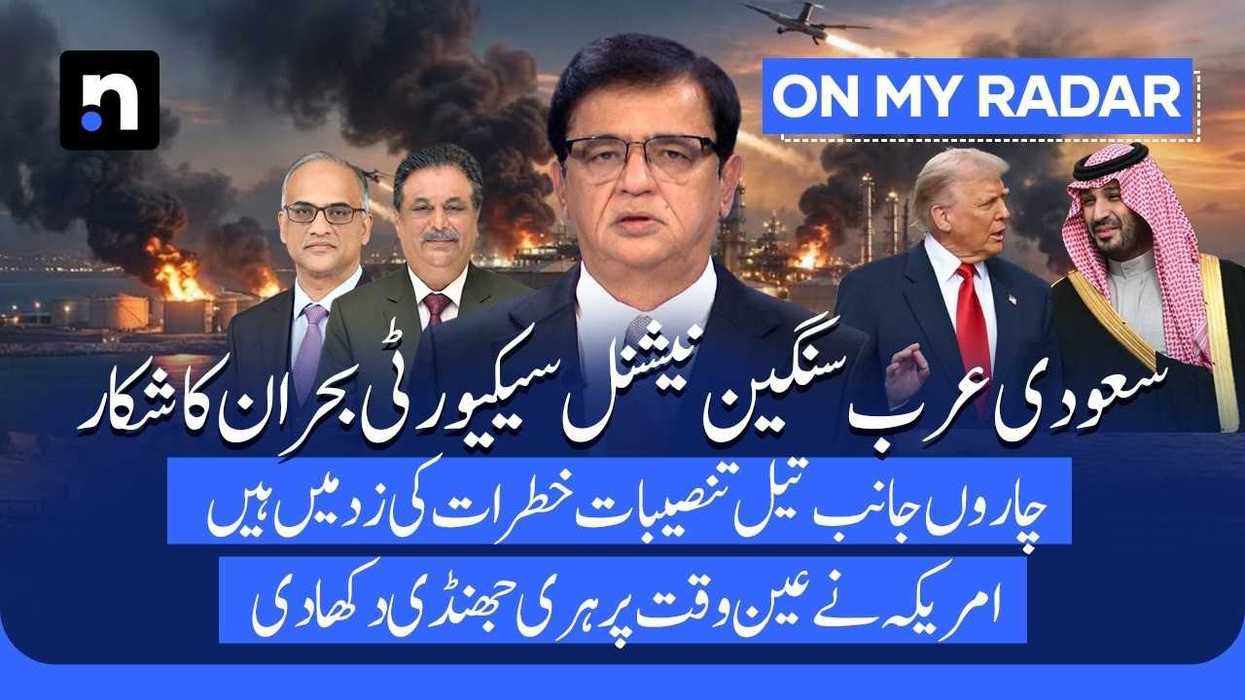
Saudi Arabia is facing what Kamran Khan describes as one of the most serious national security tests in its history, as the Iran war, Houthi attacks and growing questions over its long-standing security relationship with the United States put pressure on the kingdom’s economy, defense infrastructure and regional alliances.
In his latest episode of On My Radar, Khan said the Iran war has placed heavy pressure on the Gulf, oil supplies, the Strait of Hormuz and the Saudi economy, while Houthi missiles and drone attacks have become a continuing threat to Saudi territory, military installations, oil infrastructure and Red Sea shipping routes.
The crisis took on a particularly sensitive dimension Tuesday, when Saudi authorities said a Houthi drone was destroyed after it approached restricted airspace toward Makkah. The Houthis have denied targeting the holy city, but the reported threat near Makkah has raised concern in Saudi Arabia and across the Muslim world.
Khan said Saudi Arabia is now simultaneously trying to protect its economy, defense system and wider regional security structure.
Houthi attacks disrupt Saudi oil system
The Saudi oil industry has suffered a major impact from the attacks, Khan said. The East-West oil pipeline has been shut down, oil loading from Yanbu has been halted, and some shipments bound for Europe have been canceled or delayed.
Saudi Arabia has also been forced to use ship-to-ship transfers near Oman’s port city of Sohar to deliver oil to Asian buyers.
According to the International Energy Agency, Saudi Arabia’s oil market supply fell to about 6 million barrels per day in August, its lowest level in more than 36 years.
Jazan, Yanbu, Abqaiq and shipping routes in the Red Sea have remained exposed to repeated attacks. An attack on King Khalid Air Base damaged infrastructure, while Saudi air defenses continue to face missile and drone threats.
The Houthis also claimed Wednesday that they had shot down a Saudi F-15 fighter jet over Yemen’s Marib province. The claim was not independently confirmed.
US-Saudi security relationship faces questions
Khan said perhaps the biggest shock for Saudi Arabia has come from Washington.
Saudi Arabia has sought direct U.S. military assistance against the Houthis, but the Trump administration has so far avoided directly entering the war.
At the same time, Khan said, the United States has reached an arrangement with the Houthis over its own shipping in the Red Sea.
According to U.S. media reports cited by Khan, U.S. officials and Houthi representatives held a secret meeting in Oman last Sunday. The Houthis reportedly agreed to allow U.S. ships unrestricted access through the Red Sea in exchange for a guarantee that the United States would not directly intervene militarily in Saudi Arabia’s war.
Trump has said: “Houthis don’t want to fight US, are letting most ships through.”
For Saudi Arabia, Khan said, the situation is particularly difficult because the United States, from which Riyadh expected help against the Houthis, is now seeking safe passage for its own ships from the group.
Over the past 50 years, Saudi Arabia has bought hundreds of billions of dollars in advanced weapons from the United States and relied heavily on the American security umbrella, Khan said. He argued that the current crisis has raised questions about Riyadh’s earlier strategic assumptions about Washington’s role in a critical security situation.
Gulf unity tested by regional conflict
Khan said the conflict has also exposed weaknesses within the Gulf Cooperation Council.
Each Gulf state is trying to protect its airspace, ports, oil infrastructure and relations with Iran according to its own interests, he said. Although the security threat affects the region as a whole, there has been no joint military response.
Saudi Arabia is now looking toward the Makkah defense agreement with Pakistan and Turkey, which remains in its early stages, Khan said.
He described the crisis as an early test of the agreement because the threat is no longer merely at Saudi Arabia’s borders. It has reached the kingdom’s oil infrastructure, borders, alliances and the area near its holiest city.
“This is not only Saudi Arabia’s problem, but also an issue for Pakistan and Turkey,” Khan said.
According to reports cited in the program, the three countries are consulting on the situation.
Pakistan says defense pact remains active
In an interview Wednesday, when Director General Inter-Services Public Relations Lt. Gen. Ahmed Sharif Chaudhry was asked how Pakistan would respond if one of its allied countries came under attack, he said the operational strategy of defense agreements is never disclosed in public discussions.
“Operational details of Pakistan-Saudi-Turkey defense pact not public,” Khan said in summarizing the response.
Pakistan’s Foreign Office spokesman also said during a press briefing Thursday that the defense agreement between Pakistan and Saudi Arabia remains fully active.
The spokesman, Sajjad Haider, declined to provide details of military cooperation but said Pakistan would implement the agreement reached with Saudi Arabia and Turkey in accordance with its “true spirit and purpose.”
Pakistan pushes for end to Iran-US conflict
Pakistan is also making efforts to end the wider instability in the Middle East and the Iran-US war, Khan said.
According to Al Arabiya, Field Marshal Asim Munir spoke by telephone Wednesday with Iranian Foreign Minister Abbas Araghchi while Munir was visiting China.
The call came within 24 hours of Araghchi’s meeting with Chinese Foreign Minister Wang Yi.
During that meeting, Wang urged both Iran and the United States to avoid war and return to the framework agreed under the Islamabad memorandum of understanding.
The episode also featured defense affairs expert and former ambassador to Syria Air Marshal (retd) Saeed Mohammad Khan and defense affairs analyst Syed Mohammad Ali.




Comments
See what people are discussing