

SECP proposes national agricultural spot market to cut crop losses, expand farm credit
Plan would use modern warehouses and electronic receipts to expand farm financing; regulator also targets 2.5 million capital-market investors

Business Desk
The Business Desk tracks economic trends, market movements, and business developments, offering analysis of both local and global financial news.
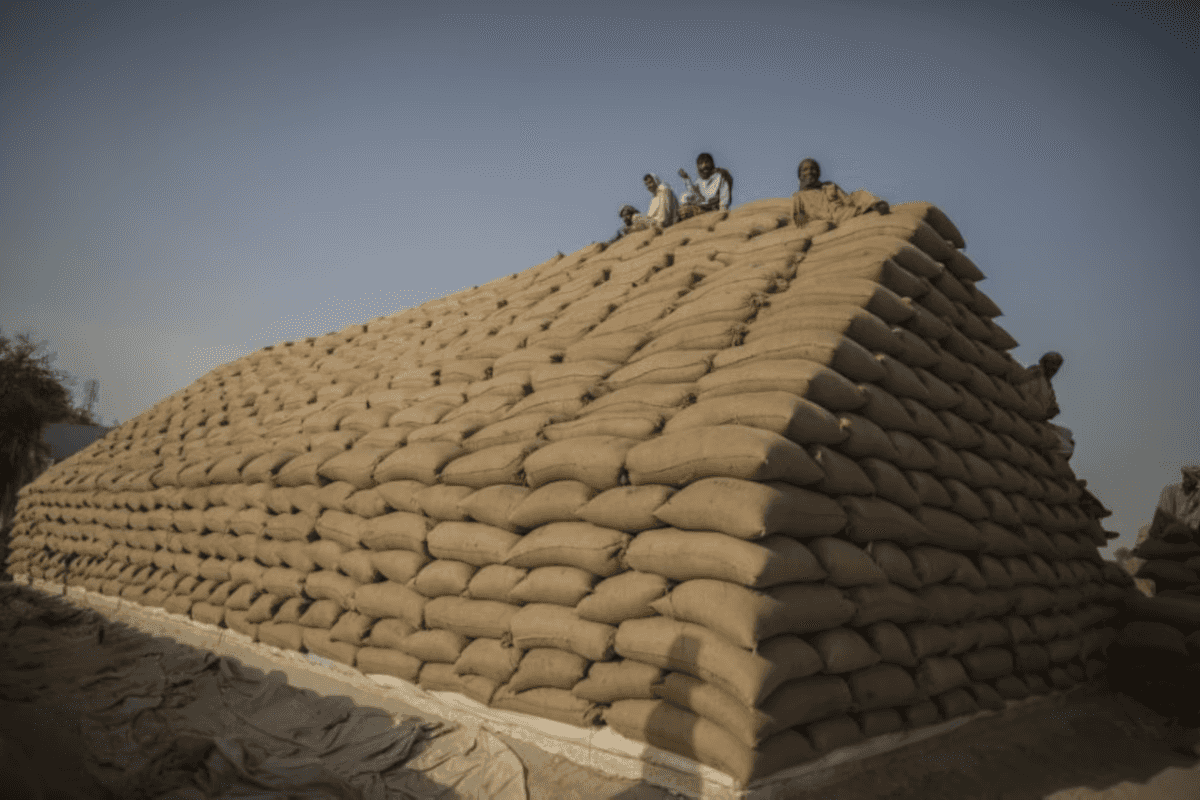
Laborers sit on a pyramid of wheat sacks used to store wheat supplies near Multan in Punjab.
Reuters
The Securities and Exchange Commission of Pakistan is proposing a national agricultural spot market backed by modern warehousing and electronic warehouse receipts to reduce post-harvest losses, improve farmers’ access to financing and make agricultural trade more transparent.
SECP Chairman Dr. Kabir Ahmed Sidhu outlined the proposal at the 39th International Conference and AGM of the Pakistan Society of Development Economists, held under the theme “Mission USD 100 Billion.”
Sidhu said agricultural market reforms were essential for broader economic growth.
Agriculture contributes 23.44% to Pakistan’s GDP, while the country’s crops are valued at about PKR 8.8 trillion, he said.
Post-harvest losses are estimated at 20% to 40%, with every 1% loss representing approximately PKR 88 billion in lost value, according to Sidhu.
How would Pakistan's proposed agricultural spot market work?
The proposed system would connect agricultural markets to an online trading platform while provincial governments retained regulatory oversight. Modern warehouses would allow farmers to store produce, receive electronic warehouse receipts and use those receipts as collateral for bank financing instead of selling crops immediately after harvest.
The SECP would provide technical support to develop the system, Sidhu said.
The proposed spot market would initially incorporate wheat, rice, corn, cotton and sugar in phases.
Standardized rules for quality, weight and grading would help farmers secure better prices, while the registration of commission agents and traders and the use of digital transaction records could strengthen protections for farmers and buyers.
Sidhu also called for a reliable mechanism to ensure timely payments to farmers and for modernization of agricultural market regulations, licensing requirements, fees and rules governing the movement of commodities.
Pakistan faces a large agricultural storage gap
Pakistan has only 326,000 metric tons of approved warehousing capacity compared with an estimated 55.7 million metric tons of storable dry agricultural commodities produced in the country, Sidhu said.
The proposed system would seek to attract investment in modern warehouses, cold storage and logistics infrastructure to reduce crop losses and improve access to export markets.
Under the electronic warehouse receipt system, farmers would be able to store their produce and obtain bank financing against the stored commodities rather than having to sell immediately after harvest, often when prices are lower.
Sidhu said improved storage and trading infrastructure could reduce losses, strengthen market transparency and expand Pakistan’s access to international agricultural markets.
SECP targets 2.5 million capital-market investors
Sidhu also said the SECP planned to launch a comprehensive financial awareness campaign aimed at encouraging young people to participate in Pakistan’s capital market.
The regulator has set a target of expanding the country’s capital-market investor base to 2.5 million, with reforms underway to simplify the process of opening investment accounts.
Sidhu said financial literacy and awareness were essential to increasing participation in financial markets, while the Pakistan Stock Exchange continued to offer investment opportunities despite regional uncertainty.
The investor target forms part of the SECP’s broader push to expand market participation through financial literacy and simpler investor onboarding.
Sidhu also called for stronger audit oversight, saying a separate and independent legal framework was needed to ensure effective supervision of audit firms.
Consumer and investor protection remained a priority in developing Pakistan’s financial markets, he said.
Sidhu said the SECP was also undertaking broader reforms to develop the commodities market.





Comments
See what people are discussing