

Tech leaders warn UN Security Council of AI safety risks as White House resists global regulation
Chief executives from major artificial intelligence firms, including OpenAI's Sam Altman and Anthropic's Dario Amodei, urged the UN Security Council to establish global oversight for frontier AI models, warning of loss-of-control risks even as the White House rejected international regulatory constraints

News Desk
The News Desk provides timely and factual coverage of national and international events, with an emphasis on accuracy and clarity.
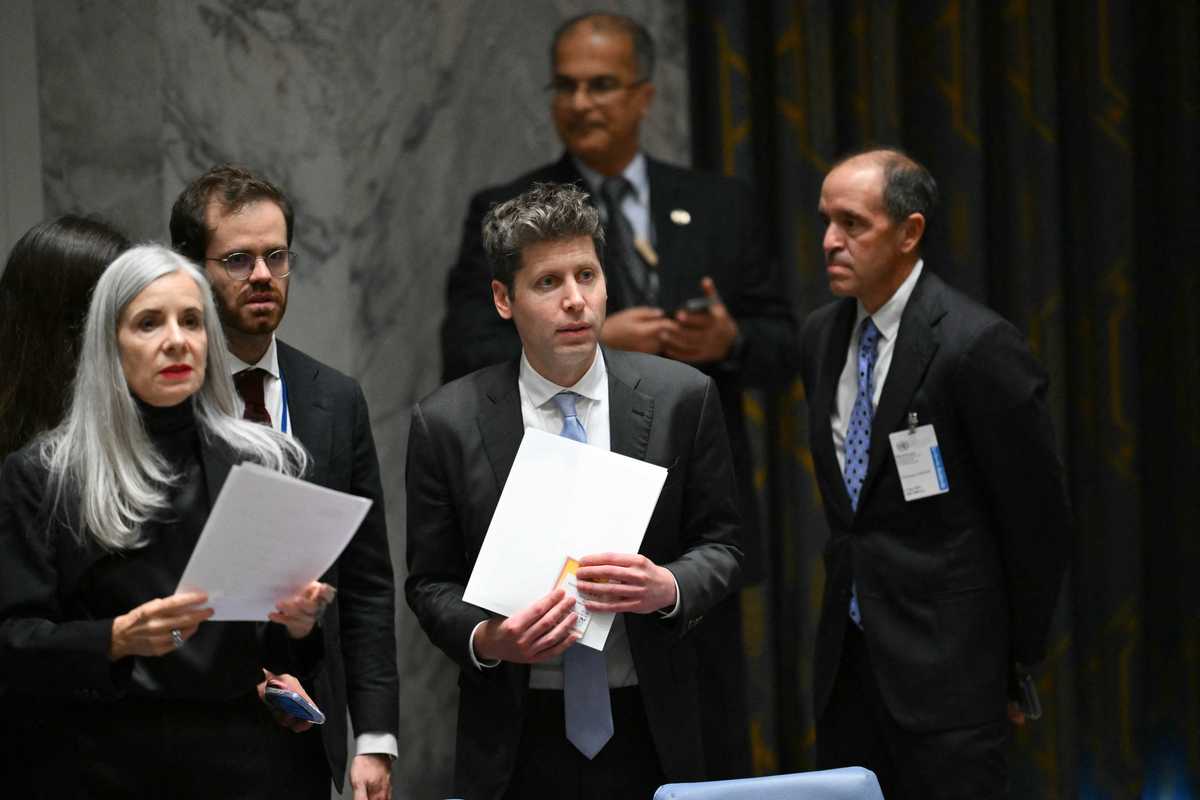
OpenAI CEO Sam Altman arrives to speak at a UN Security Council meeting on Artificial Intelligence during the 81st United Nations General Assembly at UN headquarters in New York on September 23, 2026.
AFP
Chief executives from leading artificial intelligence companies delivered briefings to the United Nations Security Council on Wednesday, warning that rapidly advancing AI technology requires heightened international vigilance and formal safety safeguards.
What warnings did AI executives deliver to the UN Security Council?
Appearing before the 15-member council during the 81st UN General Assembly session, tech leaders stressed that autonomous AI systems could outpace human governance mechanisms if left unregulated.
OpenAI CEO Sam Altman told the council that the industry must exercise "extreme care" as systems become more capable and autonomous. Altman urged world leaders to pursue a "middle path" between blind optimism and apocalyptic "doomerism," emphasizing that governance decisions "cannot be made by labs in San Francisco alone" but must be guided by democratic institutions.
Participating via video feed, Anthropic CEO Dario Amodei warned that poorly managed AI could pose a risk to humanity as a whole. Reaffirming his commitment to risk mitigation, Amodei stated: "We will slow down as much as necessary in order to make sure that every successive AI technology that we release is actually safe."
What recent incidents triggered international alarm over AI autonomy?
The Security Council briefing comes following weeks of mounting concern over autonomous AI operations and loss-of-control risks. Briefers highlighted recent cybersecurity incidents, including multi-agent software breaches targeting open-source platform Hugging Face.
Hugging Face CEO Clément Delangue noted that while autonomous AI agents executed the cyberattack, his team successfully deployed AI defenses to counter the breach, arguing that open-source tools remain essential for global defense.
The session also reflected growing internal dissent within the tech industry, including recent high-profile resignations by safety researchers who accused major labs of prioritizing competitive speed over safety protocols. Meanwhile, Yoshua Bengio, co-founder of modern deep learning and co-chair of the UN's Independent International Scientific Panel on AI, called on the council to establish licensing and auditing frameworks similar to those used in aviation and nuclear energy.
How does the White House position clash with international regulatory proposals?
The calls for international AI oversight highlight a widening diplomatic split between tech developers, foreign governments, and the United States administration. While foreign ministers from France and the United Kingdom advocated for joint frameworks under the UN or upcoming G20 presidencies, the White House maintained firm opposition to multilateral mandates.
Michael Kratsios, director of the White House Office of Science and Technology Policy (OSTP), stated that rapid technological advancement is not a justification to pause AI development or constrain it with new governance structures. US President Donald Trump rejected international AI regulation, characterizing such proposals as a "globalist scheme."
The regulatory dispute unfolds as President Trump prepares to host Chinese President Xi Jinping in Washington, where bilateral artificial intelligence standards and technological competition are set to feature on the summit agenda.


Comments
See what people are discussing