

Reports: Tony Blair to lead Gaza government under US plan
Strong Iraq War proponent would control Palestinian territory for up to five years despite widespread distrust

News Desk
The News Desk provides timely and factual coverage of national and international events, with an emphasis on accuracy and clarity.
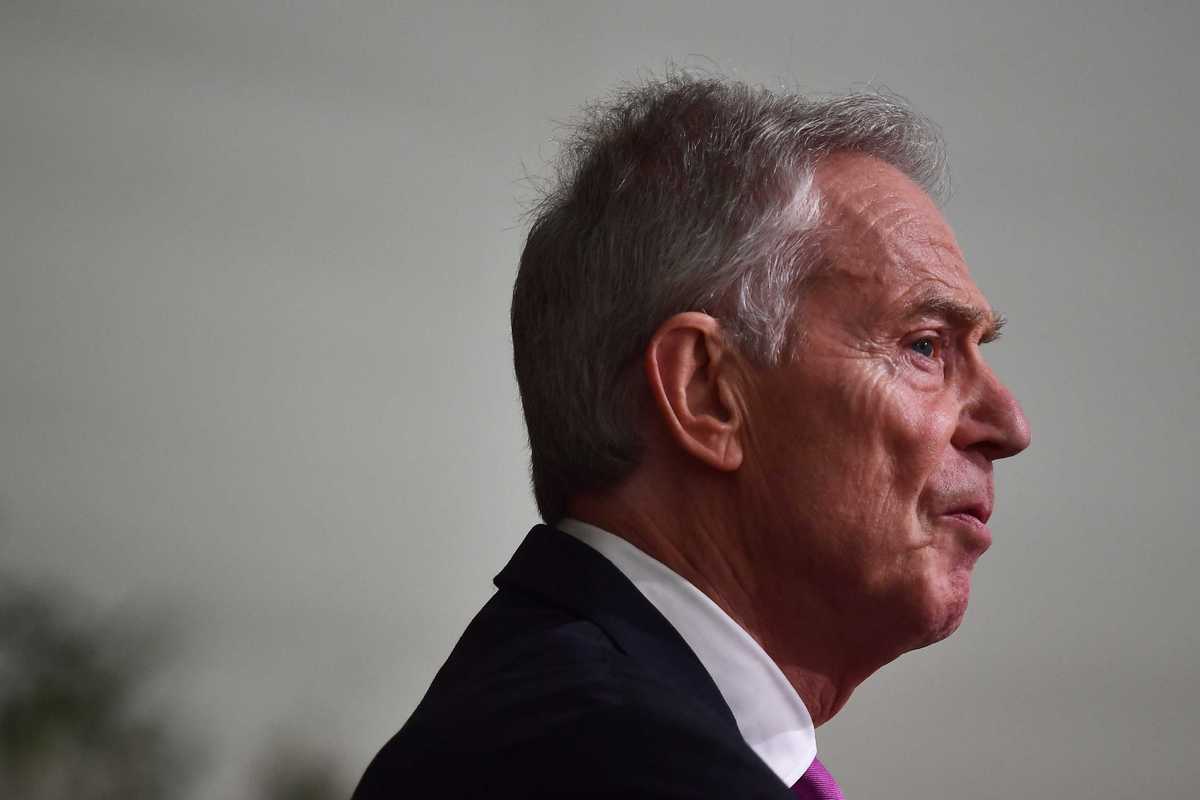
Former Britain's Prime Minister Tony Blair reacts as he delivers a speech in Belfast on April 19, 2023.
AFP
Seven to 10-member board initially based in Egypt, deploying with Arab forces
Abbas and Arab states show conditional support tied to Palestinian statehood path
Former British Prime Minister Tony Blair is being proposed to lead a transitional government in Gaza under a U.S.-backed plan that President Donald Trump told Arab leaders this week could "end the war right now."
The proposal would place Blair at the head of an international authority governing the war-torn Palestinian territory for up to five years, with backing from the White House and support from Gulf nations, before eventually transferring control to Palestinian leadership.
The BBC, the Financial Times and The Economist reported that the proposal has garnered backing from key figures connected to Trump, including Jared Kushner and Steve Witkoff, who presented the plan during a White House meeting in late August.
Blair, who led Britain from 1997 to 2007 and took the country into the Iraq War, has been involved in high-level planning discussions with the U.S. and other parties about Gaza's future governance after the current conflict ends.
The Economist reported that, "... on September 23rd Mr Trump was said to have presented the idea to the leaders of Turkey, Pakistan, Indonesia and five Arab countries. "Maybe we can end it [the Gaza war] right now," Mr Trump told them."
What's the plan?
Drafts of the plan, cited by the BBC, the Economist and the Jerusalem Post, describe the Gaza International Transitional Authority (GITA) as a trusteeship modeled on past international administrations in Kosovo and East Timor.
The authority would act as the "supreme political and legal authority for Gaza" for up to five years, initially based in Egypt before deploying into the Strip alongside a multinational Arab force once Gaza is stable.
According to draft documents circulated among diplomats, the proposal envisions a seven-to-10-member board chaired by Blair, comprising international figures, a senior UN official, Muslim representatives, and at least one Palestinian, likely from the business or security sector.
Blair's office said he would not support any proposal that displaced the people of Gaza, the BBC reported.
It also outlines an independent body overseeing humanitarian aid, reconstruction, security, legal affairs, and coordination with the Palestinian Authority, while excluding Hamas from the process.
The same documents say a technocratic Palestinian Executive Authority would manage ministries such as health and education, while a vetted, nonpartisan civil police and an Arab-led judiciary would enforce order.
A property rights unit would guarantee the return of displaced Gazans.
The initiative contrasts with the UN's New York Declaration, endorsed by more than 140 states, which calls for a one-year interim body before transferring authority to a reformed Palestinian Authority after elections.
Abbas, Arab states back plan
Palestinian President Mahmoud Abbas told the UN General Assembly that the PA is ready to govern Gaza and that Hamas will have no role.
Arab states have signaled conditional openness, stressing that any peacekeeping deployment must be tied to a clear path toward Palestinian statehood.
At a joint press conference on Thursday, Saudi Foreign Minister Prince Faisal bin Farhan said the U.S. plan and the New York Declaration could be complementary, with a Gaza ceasefire as the immediate priority and statehood as the ultimate goal.
But the proposal could face resistance among Palestinians, many of whom distrust Blair for his role in backing the U.S. invasion of Iraq and past obstruction of their statehood bid.
Israel's stance remains mixed: the Jerusalem Post reported that Prime Minister Benjamin Netanyahu has not endorsed the PA's return but has engaged constructively with U.S. discussions.
With competing blueprints on the table, the longer trusteeship under Blair's GITA and the shorter UN-backed transition to the Palestinian Authority, the future of Gaza remains unsettled.
Media reports suggest the outcome may hinge on whether Washington can align Israeli demands, Arab conditions, and Palestinian divisions into a workable postwar settlement.





Comments
See what people are discussing