

Trump adviser predicts more Muslim states will join Abraham Accords
Kamran Khan says momentum behind the Abraham Accords grows as more Muslim states weigh formal ties with Israel

News Desk
The News Desk provides timely and factual coverage of national and international events, with an emphasis on accuracy and clarity.
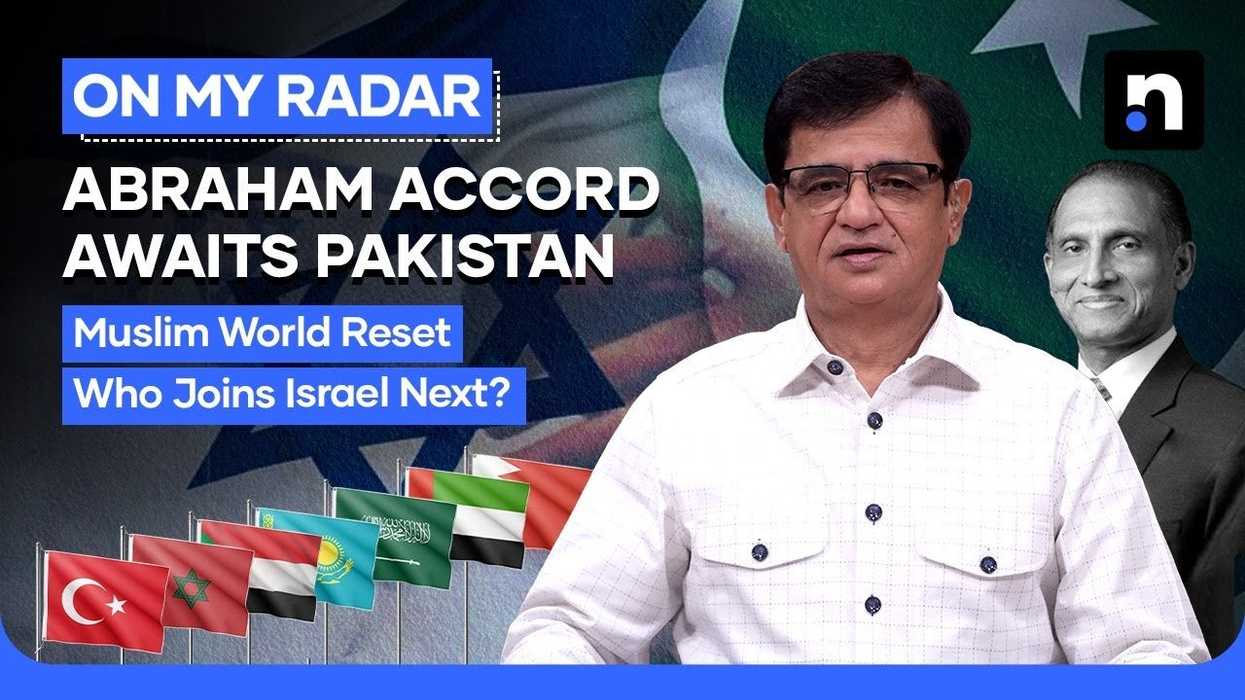
A senior adviser to U.S. President Donald Trump has claimed that additional Muslim-majority nations — including some long considered unlikely — may soon recognize Israel, adding new momentum to the Abraham Accords.
Kamran Khan discussed the remarks during an episode of his program “On My Radar,” calling them an early signal of potential diplomatic realignments across the Middle East.
Steve Witkoff, Trump’s adviser for Middle East affairs, said in a recent interview that countries previously “unimaginable” as partners for Israel may join the accords. Khan noted that while the claim is bold, it is not without basis. Still, he cautioned that predicting a timeline for a broader reconciliation between Israel and the Muslim world remains difficult.
Khan said the Middle East is standing at a crossroads, with diplomatic distance between Israel and several Muslim states gradually narrowing. After the United Arab Emirates, Bahrain, Morocco and Sudan recognized Israel under the Abraham Accords in 2020, speculation grew that other Muslim states might eventually follow.
Last month, from Nov. 24 to 26, the Anwar Gargash Diplomatic Academy in Abu Dhabi hosted a three-day conference on the future of the accords. Around the same time, Saudi Crown Prince Mohammed bin Salman met President Trump in Washington, signaling a major development when he said Riyadh was considering joining the process.
At the White House, Mohammed bin Salman said Saudi Arabia wanted sustainable peace and stability in the region and was evaluating participation in the accords. But he also emphasized that any Saudi move required clear guarantees for a two-state solution for Palestinians — a long-standing Saudi position that he reaffirmed forcefully. Khan said the crown prince’s remarks amounted to a diplomatic message that Riyadh’s involvement depends on progress toward Palestinian statehood.
Khan also highlighted movement in Central Asia. Kazakhstan, the region’s most economically stable Muslim-majority country, has expressed readiness to join the accords soon. Kazakhstan and Israel already have diplomatic missions and decades of cooperation in trade, agriculture, investment, and science and technology. But following a Nov. 6 meeting in Washington between Kazakh President Kassym-Jomart Tokayev and Israeli Prime Minister Benjamin Netanyahu, Trump announced that Kazakhstan would join the accords — a statement Tokayev supported.
If finalized, Kazakhstan’s entry would mark the most significant Muslim-majority addition to the accords since 2020.
Khan contrasted this trend with growing support for Palestinian statehood in Europe. The European Union and roughly 150 countries now recognize Palestine as a state. Several European nations — including the United Kingdom, Australia, France, Portugal, Belgium, Luxembourg and Malta — have recently moved toward recognition. Khan suggested these developments may form a parallel backdrop to the expansion of the accords.
He said the geopolitical landscape has shifted dramatically over the past decade. Once, nearly all Muslim states from the Gulf to the Levant opposed any diplomatic recognition of Israel. But as Saudi Arabia’s Mohammed bin Salman and the UAE’s Mohammed bin Zayed have taken more prominent roles in regional policymaking, the Middle East has gradually adopted a more pragmatic approach.
The accords are named after the shared spiritual lineage of Judaism, Christianity and Islam, echoing themes raised by former U.S. President Jimmy Carter in his 1985 book “The Blood of Abraham.” Carter argued that peace in the Middle East required recognition of common values across the Abrahamic faiths.
Khan also noted that the United States has supported interfaith and diplomatic initiatives connected to this concept for two decades. Harvard University launched the Abraham Path Initiative in 2004 with backing from the George W. Bush administration. In 2009, then-President Barack Obama referred to Muslims, Christians and Jews as “children of Abraham” during a speech in Cairo. In 2015, the University of Florida hosted an international seminar called “United States of Abraham” that included participants from Turkey and Israel.
The State Department describes the Abraham Accords as an effort not only to promote peace but also to expand cooperation in security, technology, tourism, intelligence and economic development.
Khan recalled the 2020 signing ceremony at the White House, where leaders from Israel, the UAE, Bahrain and Morocco marked what they described as a new era of regional cooperation. He noted that Turkey, Jordan and Egypt recognized Israel decades earlier, while Tunisia, Oman and Qatar have maintained informal channels. Central Asian states — including Kyrgyzstan, Uzbekistan, Turkmenistan and Azerbaijan — have long-standing trade links with Israel.
Several nations have been discussed in recent years as possible additions to the accords, including Saudi Arabia, Qatar, Syria, Kazakhstan, Lebanon, Indonesia and even Pakistan. But most predictions remained speculative, especially after Trump left office in 2021 and the Biden administration slowed the process.
Khan said Trump’s return to the presidency has revived expectations. Saudi Arabia and Qatar are again seen as serious possibilities, and recent U.S. engagement with Syria has fueled speculation that Damascus could join. Trump met Syrian President Ahmed al-Shar’a in Saudi Arabia and later announced a move to lift U.S. sanctions on Syria — a step that could clear the path for Syrian participation.
Khan said Trump is eager to cement a diplomatic legacy and has openly suggested he could win the Nobel Peace Prize if he secures major breakthroughs. He claims he can end “eight wars in eight months.” But Khan added that the real achievement would not belong to any one leader. It would reflect a broader regional shift toward coexistence, which ultimately depends on establishing a free Palestinian state.
For Pakistan, he said, the lingering question is whether its longstanding refusal to recognize Israel will endure as regional politics evolve. The answer, he added, may depend on how much the Middle East continues to change in the coming years.



Comments
See what people are discussing