

Trump steps up diplomacy as Iran-Israel clashes escalate again
Kamran Khan said escalation and diplomacy are now tightly linked, with Washington leading ceasefire efforts

News Desk
The News Desk provides timely and factual coverage of national and international events, with an emphasis on accuracy and clarity.
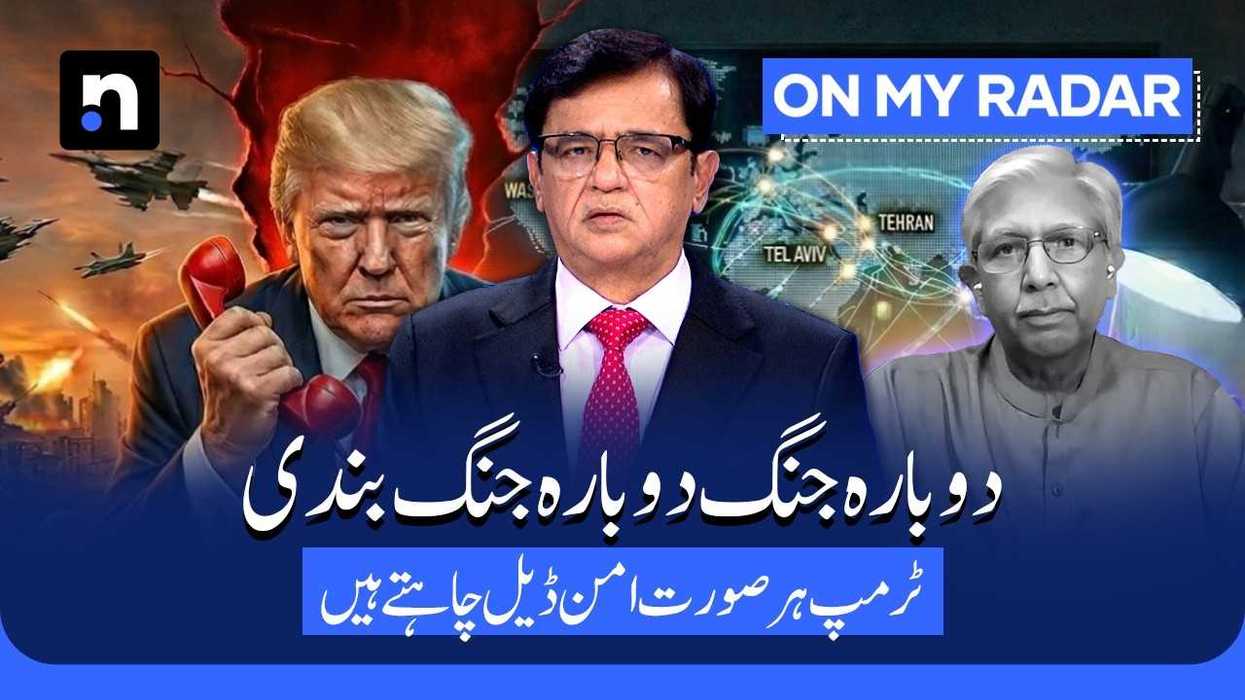
A fragile period of calm between Iran and Israel has collapsed into renewed military exchanges over the past 24 hours, with air and missile strikes reported on both sides. As tensions surge, U.S. President Donald Trump has intensified diplomatic efforts to contain the escalation and revive prospects of a broader deal between Washington and Tehran.
In the latest episode of On My Radar, Kamran Khan noted that the rapid cycle of escalation and attempted de-escalation underscores how closely the battlefield and diplomacy are now linked, with Washington positioning itself as the key driver of any possible ceasefire arrangement.
Over the past day, Trump held two separate phone calls with Israeli Prime Minister Benjamin Netanyahu, after which both Iran and Israel signaled a temporary pause in further attacks, even as underlying tensions remained unresolved.
The latest round of violence began on Sunday when Iran launched a barrage of missile strikes against Israel, warning that its response would intensify if Israeli operations in southern Lebanon continued.
Trump subsequently stepped up diplomatic engagement, telling Fox News, Axios and the Financial Times that the United States and Iran were close to finalising an agreement. He said he would urge Netanyahu to avoid retaliation, arguing that a major diplomatic breakthrough was within reach in the coming days. However, his appeals did not prevent further escalation.
On Monday, Israel launched airstrikes across several Iranian cities, including Tehran, Tabriz and Isfahan. Iranian media also reported that a petrochemical facility in Mahshahr was hit.
Iran responded with its own missile barrage targeting Israel. The Islamic Revolutionary Guard Corps (IRGC) said it struck a chemical plant in Haifa, describing it as retaliation for Israeli attacks on Iran’s energy infrastructure.
Despite the continued exchange of fire, Trump persisted with efforts to de-escalate the crisis. In a post on social media, he called on both sides to halt hostilities, after which Iran and Israel each announced a temporary cessation of attacks.
Israeli media, citing a military official, reported that Israel had suspended further strikes on Iran following Trump’s request, while maintaining that operations against Hezbollah in southern Lebanon would continue.
Iran also announced a temporary halt to its military operations against Israel, but warned it would respond with greater force if Israeli actions in Lebanon continued.
Even as fighting paused in parts of the conflict, diplomatic messaging continued across multiple channels. Iranian President Masoud Pezeshkian said in a post that diplomacy and defense were “two wings of national power,” stressing that Iran had neither abandoned resistance nor negotiations.
Separately, Iranian Foreign Minister Abbas Araghchi held a telephone conversation with Pakistan’s Chief of Army Staff Field Marshal Asim Munir. According to Iran’s IRNA news agency, Tehran expressed concern over the potential regional fallout from Israel’s military actions.
Trump, meanwhile, said in a Fox News interview that a deal with Iran could have been reached within days, but that recent strikes had complicated the process. He urged Tehran to return to negotiations, saying missile fire had already taken place and talks should resume immediately.
In a separate interview with the Financial Times, Trump said that any agreement with Iran would require acceptance by Israeli Prime Minister Benjamin Netanyahu, adding that Washington was leading the diplomatic process and that Israel would ultimately have to align with U.S. decisions.
He has repeatedly insisted that Washington and Tehran are close to an understanding. In an interview on NBC’s “Meet the Press” marking 100 days of the conflict, he said: “We are very close to a deal.”
Asked why a deal had not yet been reached despite Iran’s willingness, Trump described Iran as a “proud and strong nation” and acknowledged that its missile and drone capabilities remain intact.
Iranian Foreign Ministry spokesperson Esmaeil Baghaei said communication channels with Washington remained open, though indirect. In an interview with CNN, he said several complex issues persisted, with Iran’s nuclear rights forming the core of the dispute.
He added that Iran would not give up its rights under the Nuclear Non-Proliferation Treaty (NPT), and said Washington would need to reconsider its stance on sanctions and frozen Iranian assets.
Overall, the situation reflects a rapidly shifting balance between military escalation and diplomatic pressure, with Israel and Iran continuing to project force while the United States accelerates efforts to secure a deal. The coming days are expected to be critical in determining whether the crisis de-escalates or expands further.




Comments
See what people are discussing