


News Desk
The News Desk provides timely and factual coverage of national and international events, with an emphasis on accuracy and clarity.
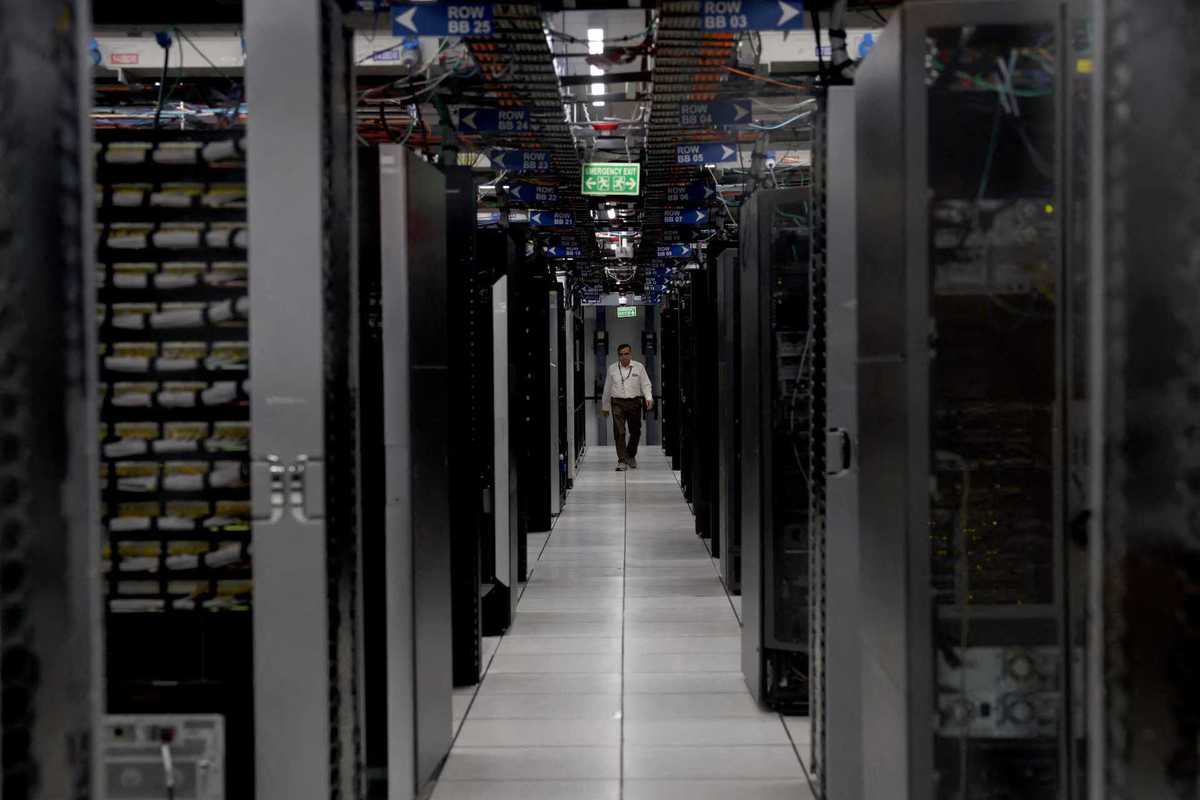
Data centers must keep running when temperatures top 45°C or heavy rain hits, with electricity and cooling systems working around the clock.
Reuters
As the UAE expands its artificial intelligence infrastructure, data centre operators are designing facilities to withstand temperatures above 45°C, heavy rainfall and growing pressure on water supplies.
Khazna Data Centers has assessed climate risks across its existing facilities and planned developments, according to its first environmental, social and governance (ESG) report, published this month, Khaleej Times reported.
The assessments cover extreme heat, flooding and water stress, with findings informing the design of a planned 200-megawatt development at the UAE-US AI Campus in Abu Dhabi.
How are UAE data centres preparing for extreme heat and floods?
Operators assess climate risks well before a facility becomes operational. At Khazna's planned development in Abu Dhabi, the findings have informed site layout, drainage, cooling systems and equipment choices.
The aim is to maintain uninterrupted power and cooling even during extreme weather.
Elisabetta Baronio, Khazna's ESG director, said a data centre's environmental impact is shaped long before it starts operating, including by its location, construction materials, cooling and power systems, suppliers and operating practices.
Why do AI data centres generate so much heat?
AI workloads require powerful computing equipment concentrated in relatively small spaces, increasing heat output and the demands on cooling infrastructure.
Power distribution systems must accommodate higher loads, while cooling equipment must remove more heat without compromising the reliability and redundancy required of facilities supporting critical digital services, Baronio said.
How much water do UAE data centres consume?
Khazna's owned facilities consumed about 393,000 cubic metres of water in 2025, including approximately 305,116 cubic metres for cooling.
Of the water used for cooling, 244,374 cubic metres was potable water, while 60,576 cubic metres came from recycled sources. Potable water therefore accounted for roughly 80% of cooling water consumption.
The figures highlight the challenge of expanding computing capacity while limiting pressure on water resources in a country with a hot, arid climate.
Where do UAE data centres get their cooling water?
At its DXB1 facility in Dubai, Khazna uses treated sewage effluent supplied by Dubai Municipality for cooling, reducing its reliance on desalinated water.
Recycled water accounted for 19.8% of cooling water requirements across Khazna's portfolio in 2025.
The challenge extends beyond the UAE. The International Energy Agency has found that nearly 40% of identified AI-dedicated data centre capacity worldwide is located in areas experiencing high or extremely high water stress. Cooling technologies can also involve trade-offs, with some conserving water but consuming more electricity.
What cooling technologies are used in AI data centres?
Khazna primarily uses air-based cooling. In 2025, 19 of its data centres were equipped with adiabatic free-cooling systems, which use outside air conditions to assist heat removal. Their effectiveness depends on the surrounding climate.
For facilities handling more intensive AI workloads, the company is also adopting liquid cooling, which brings coolant closer to the chips generating heat.
Its planned 100MW AI-optimised facility in Ajman will use air-assisted, direct-to-chip liquid cooling.
Baronio cautioned that closed-loop liquid cooling does not eliminate a facility's overall water needs. Operators must also account for how heat is ultimately discharged and the resulting implications for energy and water consumption.
Can AI help data centres reduce their own energy use?
Khazna is testing AI-based technology to improve cooling efficiency through a pilot announced with the UAE Ministry of Energy and Infrastructure and Agility. The project will evaluate Phaidra's AI-driven control technology, including its performance in high-temperature conditions.
Such systems analyse computing demand, equipment performance and outside temperatures to adjust cooling operations.
Khazna has not yet established a verified energy savings figure. Baronio said the technology's value should be measured through demonstrable improvements in operations rather than its technical sophistication alone.
What are Khazna's clean electricity targets?
Carbon-free electricity covered 27.9% of the electricity used for Khazna's mechanical load in 2025, through on-site solar generation and certified clean-energy instruments.
The company aims to increase that share to 50% by 2030 and 100% by 2035.
Baronio acknowledged that efficiency gains do not necessarily translate into lower overall consumption. A facility may use energy more efficiently while consuming more electricity as its computing capacity expands. The same principle applies to water use, she said, adding that the industry needs to be transparent about these trade-offs.
As AI infrastructure expands, the challenge for operators will be to increase computing capacity while managing the energy, water and climate risks associated with it.
Baronio said facilities being built today are expected to remain operational a decade from now. She hopes the industry will be able to demonstrate not only how much computing capacity it has delivered, but also how effectively it has managed the resources required to sustain that growth.





Comments
See what people are discussing