

UAE develops first homegrown rocket after two years of trials
The project is led by TII, uniting experienced researchers and young engineers across multiple engineering and science fields

Dubai Desk
The Dubai Desk reports on major developments across the UAE, covering news, culture, business, and social trends shaping the region.
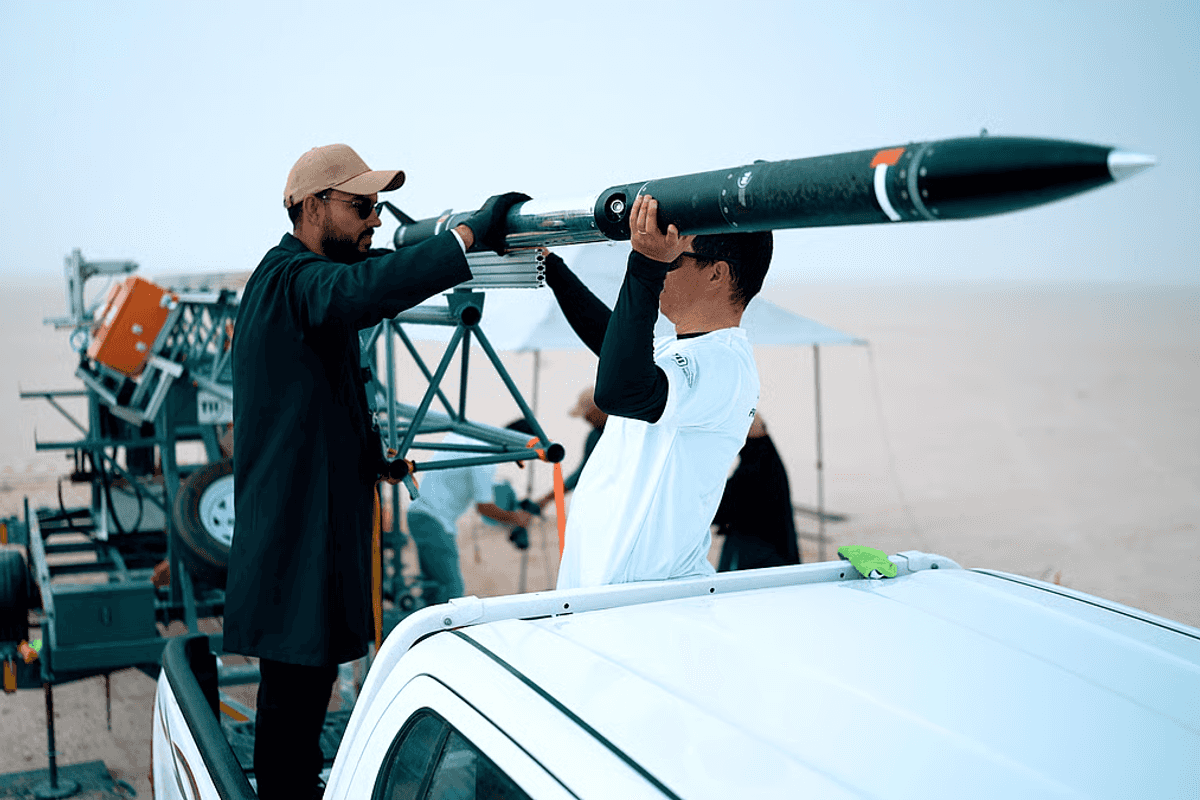
The goal is to advance experiments and develop tech for future rockets and small satellites.
Courtesy: Khaleej Times
The UAE has successfully launched its first locally developed hybrid rocket, marking a major milestone in the country’s growing space and advanced technology ambitions.
The achievement follows more than two years of continuous testing, system redesign, and close coordination between engineers and local manufacturers, according to Khaleej Times.
The project was led by the Technology Innovation Institute (TII), which deliberately formed a team combining experienced researchers with young engineers and specialists across propulsion, aerospace, mechanical, electrical, software, and computer sciences. Several UAE nationals were assigned responsibility for key systems, including telemetry, control pathways, launch-pad operations, and sensor software.
From the outset, the team chose to rely on local manufacturing, despite the added risks of working with prototype-scale components. This required repeated collaboration with suppliers to refine parts to the required precision, while materials scientists helped develop carbon-fiber structures critical to the rocket’s strength and performance.
Testing was extensive and iterative. Engineers carried out simulations, repeated ground tests of the rocket motor, and multiple firing trials, including tests conducted after the rocket had already been mounted on the launch pad. System integration — often underestimated in complexity — proved to be one of the most demanding phases, as all control, hydraulic, and telemetry systems had to function seamlessly under real launch conditions.
As launch day approached, pressure intensified. With a fixed timeline, engineers continued identifying and addressing issues late into the process. Even minutes before liftoff, final telemetry coding and verification were still underway, reflecting the narrow margins and high precision required for rocket launches.
The launch itself was met with tense silence from the team as the countdown began. Confirmation that the rocket had reached its intended altitude brought relief, but the defining moment came at peak flight when the rocket separated into two sections and descended safely under a parachute. Full recovery of the rocket was critical, allowing engineers to retrieve data, verify performance, and confirm that systems behaved as planned.
Using the data gathered from this flight, the team plans to scale the rocket to higher altitudes and larger payloads. The long-term objective is to enable more complex experiments and gradually progress toward technologies that could support future launch vehicles and small satellite missions.





Comments
See what people are discussing