

US, Iran and Israel caught in cycle of escalation and fragile diplomacy as tensions rise
Kamran Khan said the standoff shows conflict and diplomacy running in parallel with no decisive momentum

News Desk
The News Desk provides timely and factual coverage of national and international events, with an emphasis on accuracy and clarity.
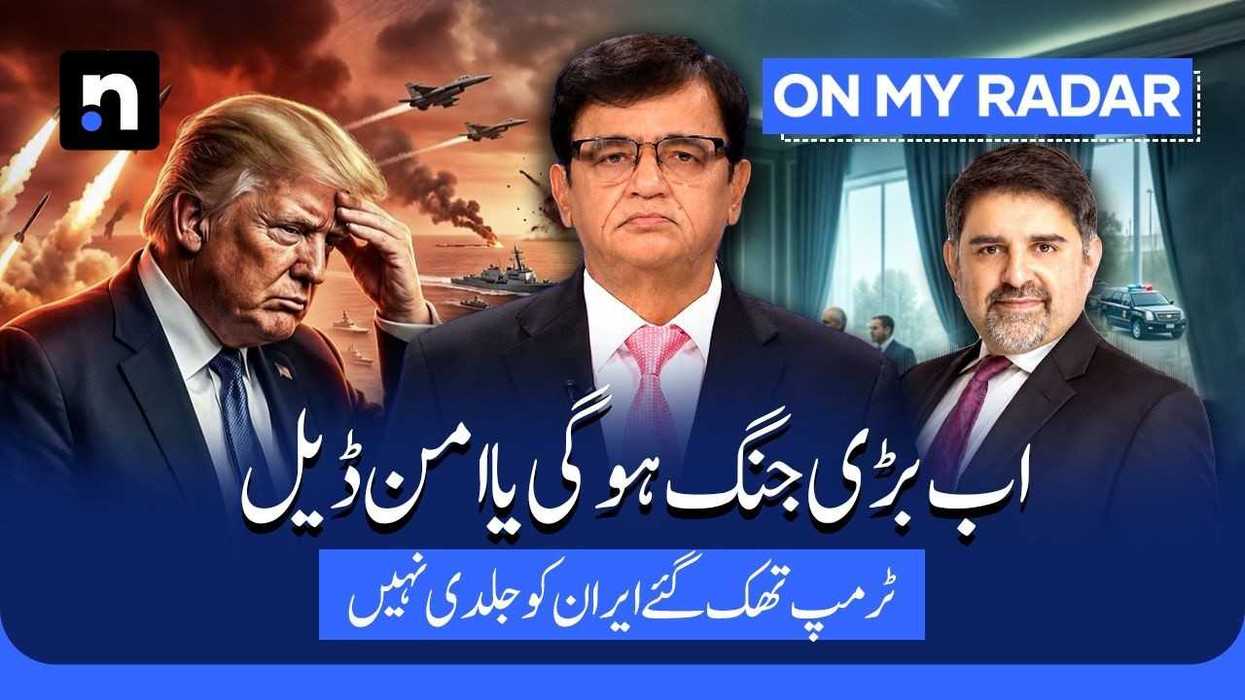
The United States, Iran, and Israel are currently locked in an unstable cycle of escalation and diplomacy, with periods of conflict, fragile ceasefires, and continuing negotiations unfolding simultaneously. Neither a full-scale war nor a durable peace has taken hold, while talks over a potential nuclear agreement remain unresolved.
In the latest episode of On My Radar, Kamran Khan said the evolving situation reflects a highly unusual strategic standoff in which conflict management and diplomacy are proceeding in parallel, without either side achieving decisive momentum. On one hand, missile and drone exchanges continue and military installations have come under attack; on the other, backchannel diplomacy over a possible nuclear deal remains active, keeping the door to negotiations open despite rising tensions.
Against this backdrop, US President Donald Trump has appeared increasingly frustrated with the pace of diplomacy. In a recent social media post, he claimed Iran had been “decisively defeated” and described the “Middle East bully” as effectively finished, while warning that Tehran had delayed too long in securing a deal that could have worked in its favor and would now face consequences.
In an interview with Fox News, Trump further accused Iran of unnecessarily prolonging negotiations and warned that the United States could authorize strikes on additional critical infrastructure, including power plants and bridges, if the impasse continues.
Iran, meanwhile, appears to be signaling a preference for continued engagement. President Masoud Pezeshkian said the country could not remain in a prolonged state of conflict and uncertainty, asking what alternative exists if talks fail. He also said Supreme Leader Ayatollah Ali Khamenei had approved negotiations with the United States and directed efforts toward a swift resolution.
In a parallel diplomatic development, a high-level Qatari delegation arrived in Tehran after consultations with US officials, according to CNN, in an effort to narrow remaining differences between Washington and Tehran and help advance a potential agreement.
Despite continued tensions, a de facto ceasefire between the United States and Iran has largely held over the past two months, underscoring the fluid and contradictory nature of the current situation. Trump has repeatedly claimed that both sides are close to a major agreement, which he described as a “very strong and powerful deal,” while US Vice President JD Vance said any such outcome would serve American interests regardless of Israeli preferences.
However, the fragile balance was disrupted over the weekend after an Israeli strike in Lebanon was followed by Iranian missile attacks on Israel, prompting further Israeli airstrikes on Iranian targets and reigniting regional tensions.
At the same time, a separate incident involving a US Apache helicopter near the Strait of Hormuz added further uncertainty. Trump said the aircraft crashed but confirmed both pilots survived, adding that Washington would respond. CNN reported it as the first known loss of a US Apache helicopter under such circumstances.
Iranian Foreign Minister Abbas Araghchi did not directly acknowledge responsibility, instead suggesting that foreign military presence near Iran’s borders carries inherent risks of accidents, human error, or crossfire, and arguing that regional stability would improve if foreign forces withdrew.
Shortly afterwards, US Central Command reportedly conducted strikes on Iranian naval and military radar installations, while Iranian forces were said to have targeted US-linked sites in Bahrain, Kuwait, and Jordan, further escalating tensions across the region.
Araghchi warned that Iran’s resolve should not be tested and said Tehran would respond to any act of aggression without hesitation.
The coming days are likely to determine whether the situation escalates into open conflict or whether ongoing negotiations can still produce a last-minute diplomatic breakthrough.




Comments
See what people are discussing