

US, Iran agree on 60-day roadmap toward final deal at Switzerland talks
Pakistan and Qatar say the US and Iran agreed on a 60-day roadmap toward a final deal after high-level talks in Switzerland

News Desk
The News Desk provides timely and factual coverage of national and international events, with an emphasis on accuracy and clarity.
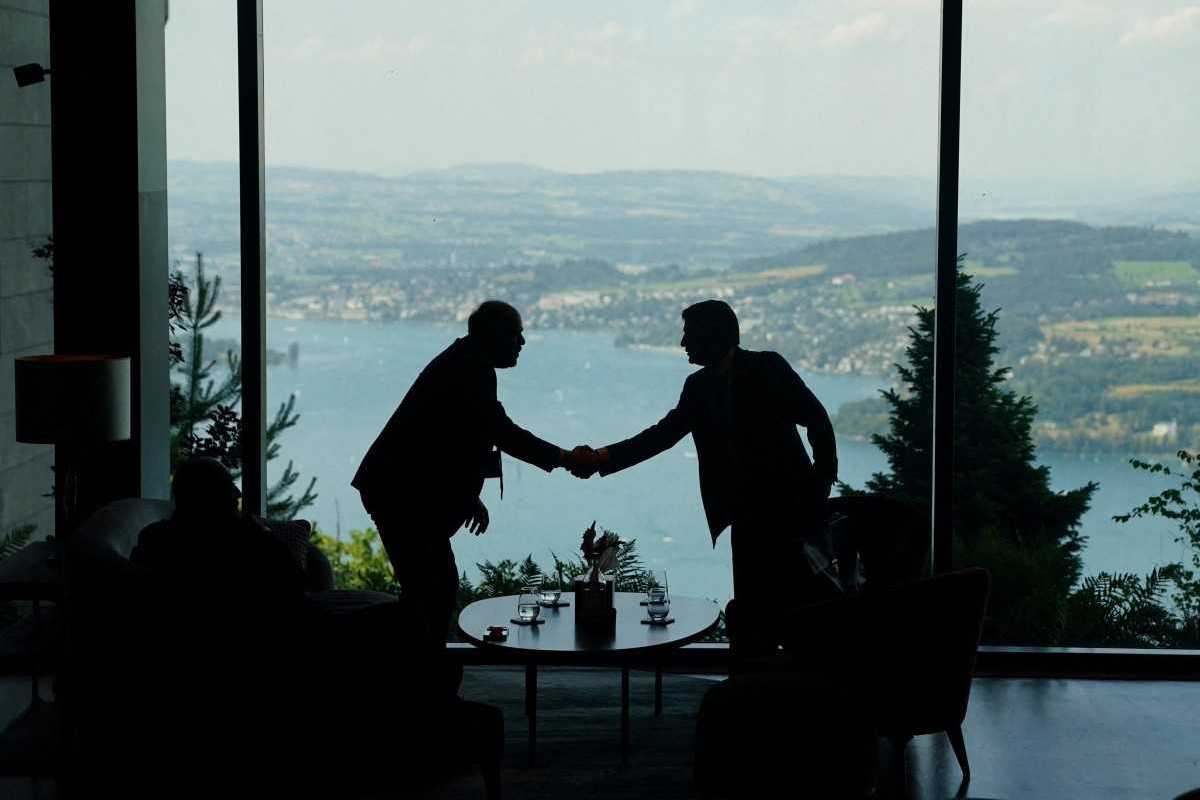
Delegation staff members meet in the lobby on the day of a quadrilateral meeting between the United States, Iran, Pakistan and Qatar at the Burgenstock luxury hotel complex overlooking Lake Lucerne, Switzerland, on June 21, 2026, as part of high-level talks aimed at advancing a deal to end the Middle East conflict.
AFP
The United States and Iran agreed on a 60-day roadmap toward a final deal Monday, following the first session of high-level talks under the Islamabad Memorandum of Understanding at the Lake Lucerne Summit in Burgenstock, Switzerland.
Pakistan and Qatar, mediating the talks, said negotiations proceeded in a "positive and constructive atmosphere."
🔊PR No: 1️⃣5️⃣1️⃣/2️⃣0️⃣2️⃣6️⃣
Joint Statement by the State of Qatar and the Islamic Republic of Pakistan Regarding the Conclusion of Lake Lucerne Summit, First High-Level Committee Meeting with Participation of the United States of America and the Islamic Republic of Iran pic.twitter.com/2G3PAf7LVY
— Ministry of Foreign Affairs - Pakistan (@ForeignOfficePk) June 22, 2026
What does the US-Iran 60-day roadmap include?
The roadmap sets a 60-day window to reach a final agreement and establishes a high-level political oversight committee. Chief negotiators will lead working groups on nuclear issues, sanctions, and monitoring.
The parties also created a communication line to prevent incidents and ensure safe passage through the Strait of Hormuz, a critical global energy shipping route.
What new structures came out of the Switzerland talks?
The joint statement from Pakistan and Qatar outlined several new mechanisms. A high-level committee will provide political oversight, with chief negotiators reporting to it regularly and leading working groups on nuclear issues, sanctions, and dispute resolution.
Technical talks are scheduled to continue through the rest of the week at the Burgenstock resort.
A de-confliction cell involving the United States, Iran and Lebanon was also created, facilitated by Pakistan and Qatar. It is designed to help maintain the end of military operations in Lebanon under the memorandum. Iranian Foreign Minister Seyed Abbas Araghchi called the Lebanon mechanism the "first real test" of the agreement.
Tireless Pakistani and Qatari mediation has delivered major progress to end Lebanon War. Oil and petrochem exports are waived, blockade lifted, some frozen assets released, and major reconstruction & development plan launched for Iran.
1st real test: Lebanon deconfliction cell https://t.co/q0okD2qwSO
— Seyed Abbas Araghchi (@araghchi) June 22, 2026
Araghchi said on X that Pakistani and Qatari mediation had produced "major progress," citing waivers on oil and petrochemical exports, a lifted blockade, the release of some frozen assets, and the launch of a reconstruction plan for Iran.
How did tensions nearly derail the Switzerland talks?
The latest round of negotiations had a rocky start. Iran's delegation briefly walked out after U.S. President Donald Trump warned Tehran against supporting Hezbollah in Lebanon, and threatened military action if Iran did not immediately halt what he described as its "proxies." Iran's chief negotiator Mohammad Bagher Ghalibaf responded that Iranian forces were prepared to respond to any attack.
Israeli Prime Minister Benjamin Netanyahu said Israeli troops would remain in southern Lebanon for as long as necessary, and repeated that Israel would not allow Iran to acquire nuclear weapons. Despite the turbulence, U.S. Vice President JD Vance described the Switzerland talks as a historic meeting and said the parties had an opportunity to permanently reshape relations in the Middle East.
Iranian President Masoud Pezeshkian reiterated that Tehran would not surrender its right to enrich uranium but said Iran had no intention of building a nuclear weapon.
— With additional input from AFP


Comments
See what people are discussing