


Razi Wani
Producer - News Desk
Razi Ud Din Ahmed Wani is a multimedia journalist and digital storyteller with a strong background in fact-checking, South Asian politics, documentary filmmaking, scriptwriting, and digital content production. With an MA in Mass Communication from the University of Karachi, he has experience directing and scripting web series and socio-political satires. And has worked across various media and digital platforms, focusing on emerging trends and storytelling formats.
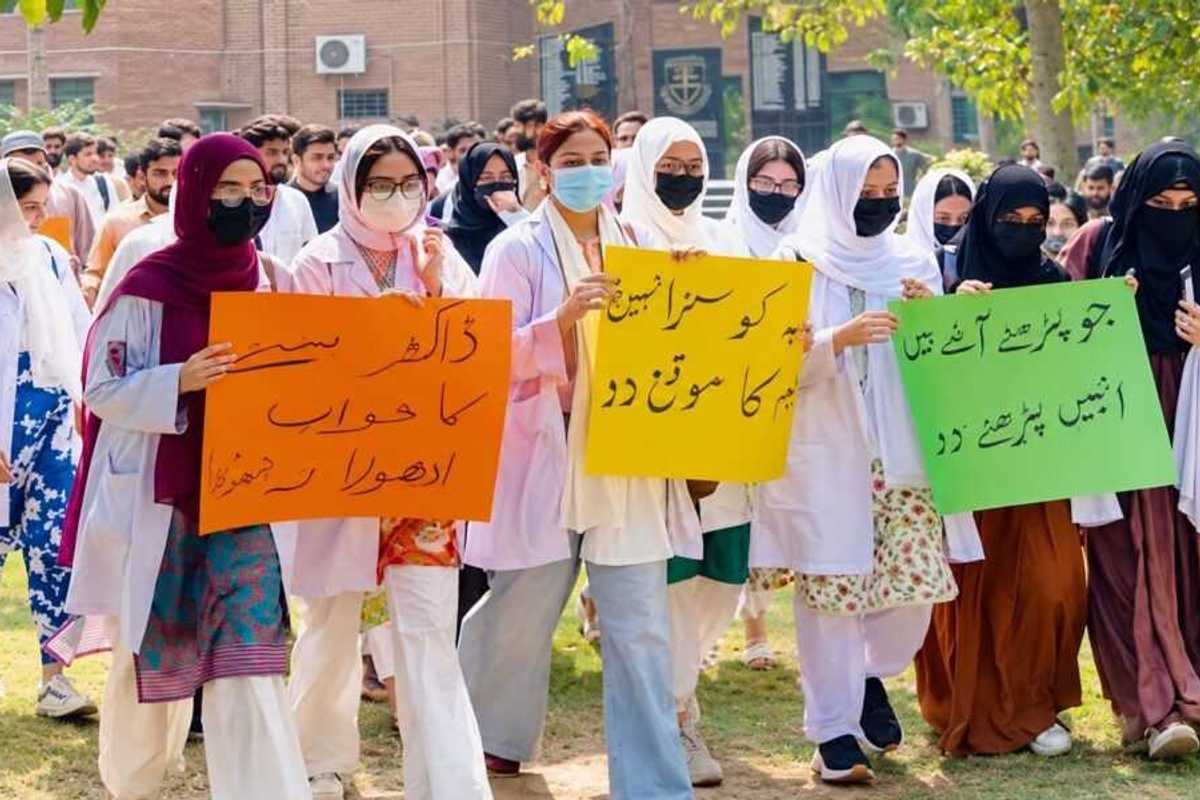
Students protest at Khyber Medical College in Peshawar in solidarity with Afghan medical students facing expulsion orders, according to Islami Jamiat-e-Talaba.
Picture Courtesy @Jamiatpk/x
The education of dozens of Afghan medical students in Pakistan has been thrown into uncertainty after the Pakistan Medical and Dental Council (PMDC) ordered enrolled Afghan students to leave the country mid-degree.
The students include those enrolled in MBBS and BDS programs, some of whom have spent four or five years studying in Pakistan and are now nearing graduation or house job training.
One Afghan medical student, who spoke to Nukta on condition of anonymity, said the directive has disrupted their education and lives. “The PMDC directive has completely disrupted our education and our lives,” the student said. “We just want to complete our education.”
Most arrived in Pakistan legally through the Allama Iqbal Scholarship Programme, with admissions, scholarships, and documentation in order. "We did not come here illegally or without an academic pathway," the student said. "We attended classes, completed clinical rotations, worked in hospitals, and passed our examinations. We built our lives around our education. Then suddenly, we were told to leave."
Students said they were given little time to vacate their hostels, told to collect No Objection Certificates and go. "For a student who has spent years studying medicine or dentistry, this is not simply being asked to leave a hostel," the student said. "It means being asked to walk away from years of education, clinical training, hard work and the future we have been building."
A closed door back home
For female students especially, the order carries a particular weight. Afghanistan remains the only country in the world that bars girls from secondary school and women from university altogether, restrictions the Taliban imposed in 2022.
UNESCO estimates roughly 2.4 million Afghan girls are now shut out of secondary education, a figure that has grown by 200,000 in the past year and could approach 4 million by 2030, as girls were shut out of secondary schools in March 2022, while women were barred from universities that December, months after the Taliban returned to power.
UN Women has projected the education ban could cost Afghanistan tens of thousands of future female doctors, nurses and teachers, with the country potentially losing more than 25,000 female teachers and health workers by 2030 if current restrictions persist.
"'Just go back to Afghanistan' is not a real educational solution for us," the student said. "It can mean the end of our education... Many of us chose medicine because we wanted to become healthcare professionals and serve Afghan communities, especially Afghan women who need female doctors."
The directive and the backdrop
The crisis traces back to letters the Pakistan Medical and Dental Council sent university vice chancellors on Aug. 31 and Sept. 1, 2026, directing them to issue NOCs to enrolled Afghan students and facilitate their return, citing national policy.
The order landed amid a much larger deportation campaign. Pakistan launched its Illegal Foreigners' Repatriation Plan in 2023, and by mid-2026, the government said more than 2.4 million Afghans had been sent back. Prime Minister Shehbaz Sharif said Pakistan deported more than 2.4 million Afghans since launching its repatriation drive in 2023.
In July, Islamabad ordered the immediate arrest of any Afghan national without a valid visa, directing chief secretaries and law enforcement authorities to strictly implement the deportation drive that has mostly targeted Afghans, and officials moved to expel more than a million refugees holding UN-issued Proof of Registration cards in a third wave of repatriation targeting Afghans holding Proof of Registration cards.
The UN's refugee agency has repeatedly urged Islamabad not to force returns, warning it risks refugees' safety, saying massive and hasty returns could jeopardize the lives and freedom of Afghan refugees while risking instability in the region.
Pakistani officials have defended the campaign by citing security concerns and the economic strain of hosting Afghans for more than four decades, arguing militants have used Afghan territory as a base and citing the economic burden of hosting millions of Afghan refugees. It is against that backdrop that the PMDC order swept up already-enrolled medical students — a group lawyers say was never meant to be treated as part of the undocumented-migrant crackdown.
'PMDC not an immigration authority'
Students from Dow University of Health Sciences and Jinnah Sindh Medical University, 29 petitioners represented by Barrister Iftikhar Ahmed Shah along with Advocate Ibtisam Sadiq, took the matter to the Sindh High Court.
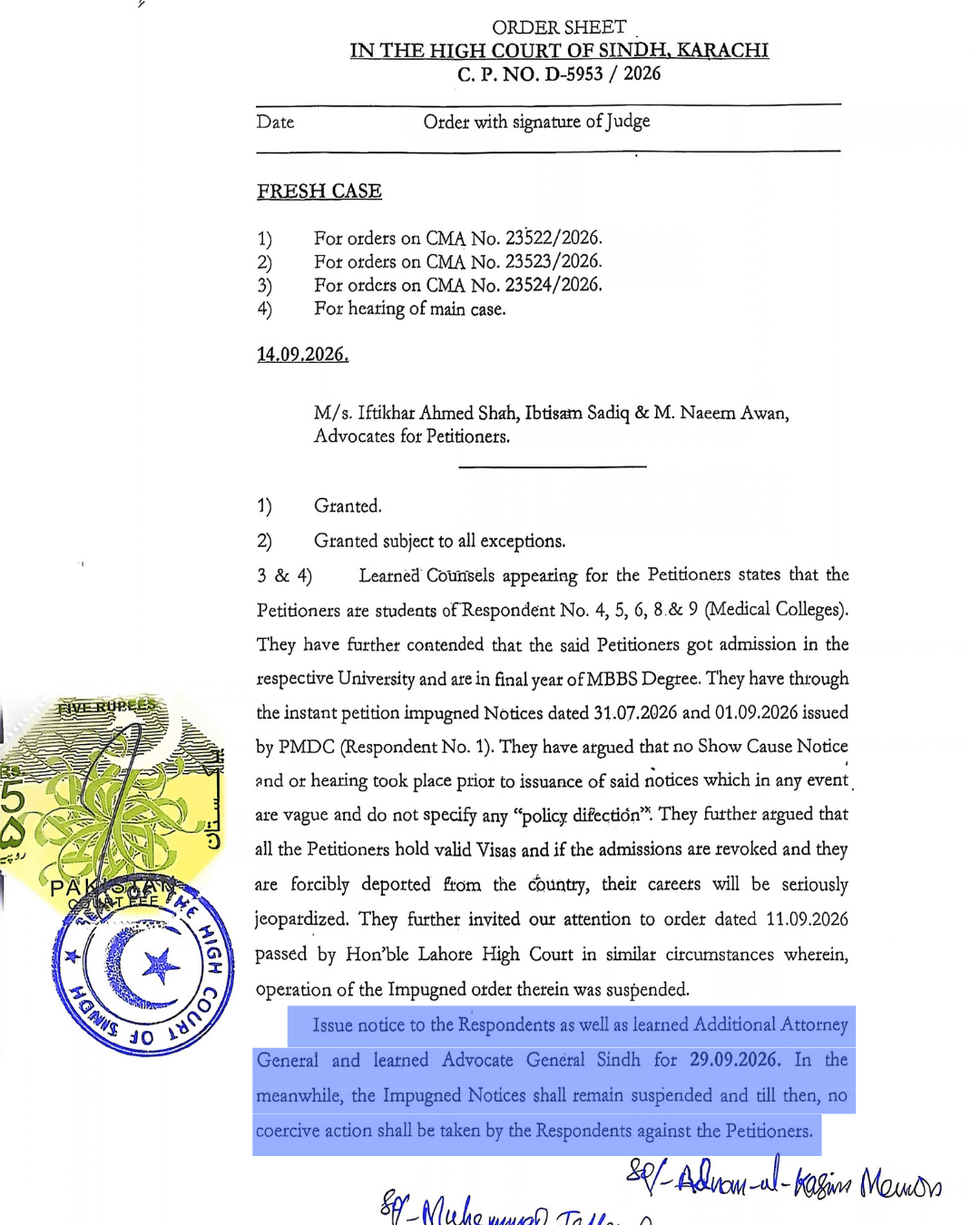 PMDC notices suspended; no coercive action against petitioners until the next hearing on September 29, 2026.Nukta
The court granted interim relief, suspending the PMDC notices and shielding petitioners from action until the next hearing on September 29. The order, in Constitutional Petition No. 5953 of 2026, states that notice was issued to respondents, the Additional Attorney General and the Advocate General Sindh, and that "the Impugned Notices shall remain suspended and till then, no coercive action shall be taken by the Respondents against the Petitioners."
Days earlier, the Lahore High Court had issued a parallel ruling. On September 11, Justice Khalid Ishaq suspended the PMDC directives while hearing more than 30 petitions from students at institutions including King Edward Medical University, barring Punjab colleges from expelling students or blocking their exams.
The petitions argued the Sept. 1 notification, which barred colleges from admitting or placing Afghan nationals this academic session, and echoed an earlier July 31 directive, violated students' rights to education, life and dignity, and exceeded PMDC's authority under the PMDC Act.
PMDC's counsel, Advocate Haris Azmat, defended the directive on national security grounds and argued the students lacked valid visas. Justice Ishaq rejected that reasoning, asking how the students had been granted education visas and admitted to the institutions in the first place if their status was now in doubt, and directed that if the government intends to send students back, they should first be allowed to complete their medical education. He also ordered that any students already removed from hostels be allowed to return. The court adjourned the case to Sept. 18, seeking replies from PMDC, the Ministry of Health and the named universities.
Barrister Shah, representing the Sindh petitioners, argues both directives are unlawful. "PM&DC is a medical regulator, not an immigration authority," he said, adding that neither it nor the medical institutions have the authority to facilitate the repatriation to Afghanistan.
He said the council acted without affording students a hearing, in violation of natural justice and Article 4 of Pakistan's Constitution, which requires every person in the country, citizen or not, to be treated in accordance with law.
"If the issue is illegal immigration, then target illegal immigration," he said. "You cannot treat a legally documented medical student the same way as an undocumented person."
'We only want our hard work to have a meaning'
For now, the interim orders let students stay in their hostels and continue attending classes. But both cases remain unresolved, and students describe an exhausting limbo. "We are mentally exhausted. We are emotionally overwhelmed," the student said. "Many of us are struggling to sleep, concentrate and study normally because we simply do not know what will happen to our future."
Years of sacrifice, the student said, now feel at risk of being erased overnight. "We are being made to feel as if none of it matters simply because of the nationality and passport we hold. That is what hurts the most... We only want our hard work to have a meaning."
For now, the interim orders let students stay in hostels and continue classes. But both cases remain unresolved, leaving students suspended between courtrooms and classrooms. "We only want our hard work to have a meaning," the student said.



Comments
See what people are discussing