

Zardari approves additional judges appointments to high courts
President Zardari approved additional judges' appointments to five high courts, ending a days-long delay that had disrupted Pakistan's judiciary

News Desk
The News Desk provides timely and factual coverage of national and international events, with an emphasis on accuracy and clarity.
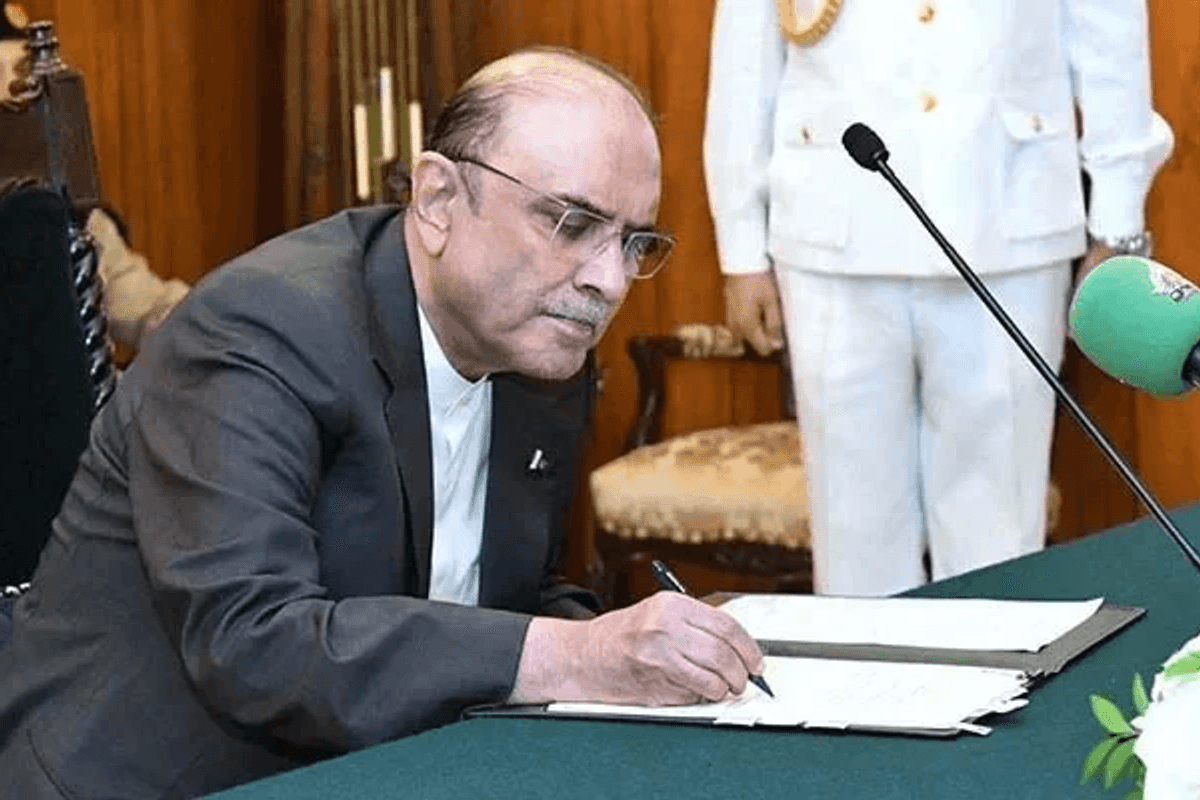
President of Pakistan Asif Ali Zardari signs a bill at the Aiwan-e-Sadr in Islamabad, on July 23, 2024.
APP/File
President Asif Ali Zardari on Tuesday approved the appointment of additional judges to five high courts across Pakistan, ending a days-long delay that had disrupted the superior judiciary. The Presidency also confirmed several additional judges of the Sindh High Court and Lahore High Court as permanent judges, according to a statement from Islamabad.
Why were the high court judges appointments delayed?
The appointments had been pending since July 20 and 21, when the Judicial Commission of Pakistan approved the nominations. The president's legal team objected, saying nearly all candidates proposed by the Pakistan Peoples Party were rejected during the commission proceedings. The team also raised concerns that some recommended nominees had criminal records.
Which judges did the Judicial Commission recommend?
The commission recommended confirming four additional judges of the Peshawar High Court and extending the term of an additional judge of the Sindh High Court by six months. It also recommended appointing 19 additional judges across the Lahore, Islamabad, Sindh and Balochistan high courts. Under Article 175-A, Clause 8, of the Constitution, the recommendations moved from the prime minister to the president for approval, where the summary remained pending.
How did the delay affect Pakistan's high courts?
The stalled approvals began disrupting the functioning of the high courts themselves. Four additional judges of the Peshawar High Court ceased holding office after their terms expired on Aug. 4, since formal notifications had not been issued. An additional judge of the Sindh High Court, whose term had earlier been extended by six months, also left office after his tenure expired on July 29.
What was the legal dispute over the delay?
The government examined whether Article 48(1) of the Constitution could let the law ministry issue the notifications directly, arguing the president was required to act within a fortnight of receiving the summary, a deadline that had passed. Government officials later said the notifications could not be issued because the matter had become sub judice, and the legal team planned to pursue an out-of-court settlement with the presidency.
The Presidency's legal team countered that Article 175-A sets no specific timeframe for presidential action and that Article 48(1) could not be used to bypass the president. It also cited Article 48(2), which gives the president discretion on matters the Constitution assigns to him and shields his actions from being challenged on any ground. Government sources maintained that judicial appointments are governed by constitutional provisions and that any deadlock must be resolved accordingly.
Separately, the Islamabad High Court reserved its verdict Monday on the maintainability of a petition seeking a court direction ordering the president to approve the appointments summary. Advocate Luqman Chaudhary filed the petition through counsel Zahid Chaudhry.
What other approvals did President Zardari make?
Zardari also approved equalizing the salaries, allowances and pensions of Supreme Court judges with those of Federal Constitutional Court judges, the Presidency said. He approved amendments to the 1997 order governing the leave, pensions and privileges of high court judges. Separately, he approved Haroon Akhtar's appointment as adviser to the prime minister on industries and production.





Comments
See what people are discussing