

Pakistan's central government debt rises by PKR 1 trillion in December
Domestic borrowing drives increase as total stock reaches PKR 78.5 trillion

Business Desk
The Business Desk tracks economic trends, market movements, and business developments, offering analysis of both local and global financial news.
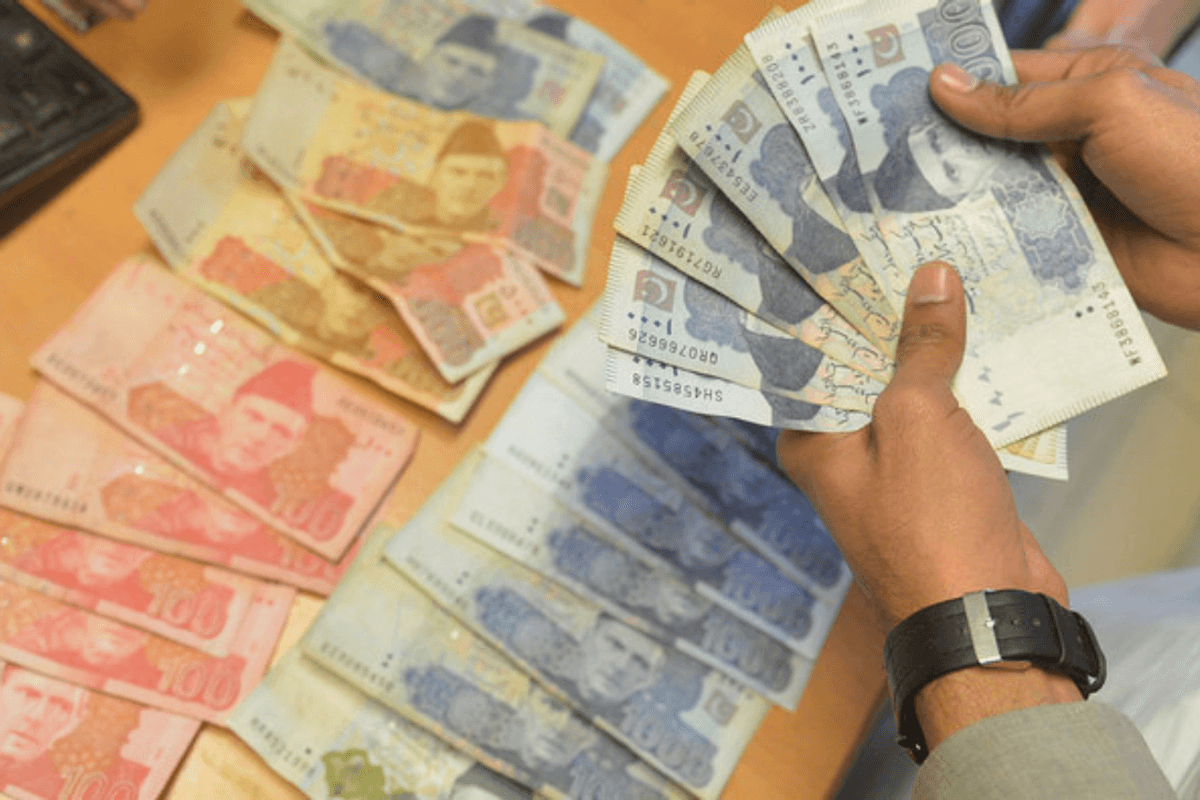
A money changer counts Pakistani rupees at a market in Karachi on January 6, 2023
AFP
Pakistan’s central government debt increased by about PKR 1 trillion in December from a month earlier, with domestic debt rising roughly PKR 760 billion and external debt climbing by nearly PKR 230 billion, according to data released by the State Bank of Pakistan (SBP).
On an average basis over the past year, domestic debt increased by approximately PKR 460 billion per month, while external debt rose by about PKR 110 billion per month, based on year-on-year growth figures published by the SBP. Combined, total central government debt expanded by an average of roughly PKR 570 billion per month over the period.
Total central government debt stood at PKR 78.5 trillion at the end of December, up 1.3% month-on-month and 9.6% compared with a year earlier, SBP data showed.
Domestic debt, which makes up more than two-thirds of the total, rose 1.4% from November and 11.0% year-on-year to PKR 55.4 trillion in December. External debt increased 1% month-on-month and 6% year-on-year to PKR 23.1 trillion.
In dollar terms, central government external debt rose to $82.7 billion in December from $81.7 billion in November. It was $82.5 billion in June 2025, the SBP data showed.
Domestic borrowing drives increase
The data indicates the government continues to rely more heavily on domestic sources to finance its fiscal gap. The 11% annual growth in domestic debt outpaced the 6% rise in external obligations.
“The government’s increasing reliance on domestic borrowing is crowding out private sector credit and putting upward pressure on interest rates,” analysts said, citing SBP figures.
Higher domestic borrowing typically involves instruments such as Pakistan Investment Bonds and Market Treasury Bills, which can increase the government’s interest servicing burden, particularly in a high-rate environment.
External debt sees moderate growth
External debt growth remained comparatively contained at 6% year-on-year, suggesting a more measured pace of foreign borrowing. However, the stock remains elevated at $82.7 billion, underscoring Pakistan’s continued dependence on multilateral and bilateral creditors.
A stronger dollar or exchange rate volatility can amplify repayment pressures, as external liabilities are largely denominated in foreign currencies.
Fiscal pressures persist
With total debt at PKR 78.5 trillion, debt servicing is expected to remain one of the largest components of federal expenditure.
“The sustained increase in public debt highlights the structural imbalance between revenue generation and expenditure needs,” analysts said, pointing to SBP data showing steady month-on-month growth.
While the pace of increase appears gradual on a monthly basis, the cumulative expansion — averaging more than half a trillion rupees per month over the past year — underscores the scale of Pakistan’s fiscal challenge.



Comments
See what people are discussing