

China battery makers set to benefit from energy security push after Iran conflict, Fitch says
Supply disruptions boost demand for storage systems, reinforcing cost and technology edge

Business Desk
The Business Desk tracks economic trends, market movements, and business developments, offering analysis of both local and global financial news.
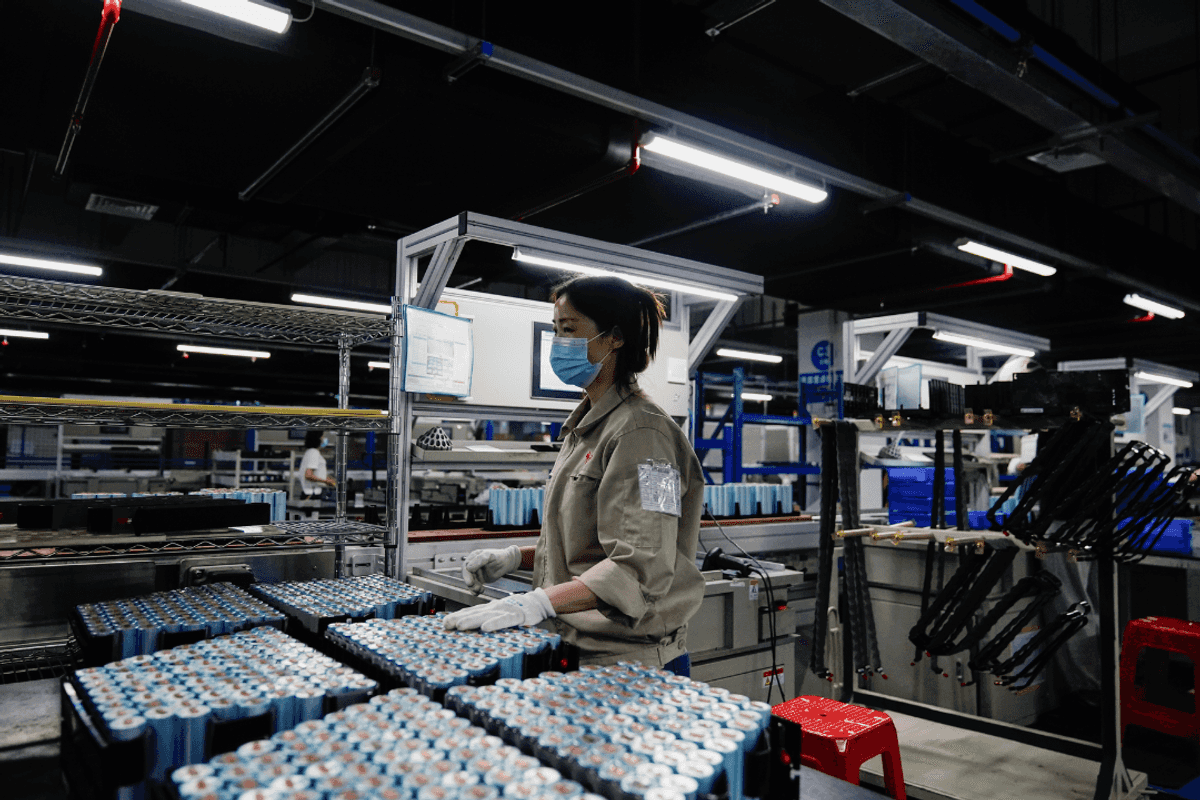
An employee works on the production line of electric vehicle (EV) battery manufacturer Octillion in Hefei, Anhui province, China
Reuters
China’s battery manufacturers are likely to strengthen their position as key beneficiaries of the global energy transition following the Iran conflict and related supply disruptions, Fitch Ratings said.
The ratings agency said prolonged disruptions to oil and liquefied natural gas supplies could accelerate investment in renewables and battery energy storage systems (BESS), particularly in energy-importing economies.
“Prolonged oil and liquefied natural gas supply disruptions add upside by strengthening energy security-driven investment,” Fitch said, noting this would support demand and utilisation for large-scale Chinese producers that dominate the global lithium iron phosphate battery market.
Energy security to drive demand
Fitch said demand for battery storage systems is expected to rise even if the conflict is resolved quickly, as gas supply disruptions have made electricity “more expensive and less stable” in markets dependent on gas-fired generation.
The agency identified “solar power plus battery storage” systems as a key growth channel, especially in emerging markets that rely on imported energy and lack stable electricity supply.
Declining system costs in recent years have strengthened the economic case for these solutions compared with fossil fuel-based power, although rising raw material costs could lead to some price increases.
China’s domestic market is already advanced in electrification, meaning future growth is likely to be driven by overseas demand linked to energy security concerns.
Expanding applications beyond EVs
While demand for electric vehicle batteries remains broadly in line with expectations, Fitch said battery use is expanding into commercial and industrial sectors, including trucks, vessels and construction machinery.
Global demand for BESS batteries has exceeded expectations in recent quarters, with some manufacturers reallocating production capacity originally intended for EV batteries.
Costs, trade risks and supply chains
Fitch cautioned that near-term profitability will remain sensitive to input-cost volatility, particularly for materials such as lithium. While higher costs can generally be passed on, margins may still narrow.
The agency also flagged structural challenges from trade fragmentation and regulatory pressures.
Chinese battery producers face tariffs and supply-chain restrictions in the United States, while European policies encouraging local production could fragment supply chains and increase capital expenditure.
This has prompted Chinese firms to expand overseas through foreign direct investment, particularly in Southeast Asia and Europe, while retaining more advanced production domestically.
Despite these constraints, Fitch said leading manufacturers’ “speed and cost advantages” in scaling capacity are likely to reinforce their global competitiveness as demand grows.
Energy security concerns could also offset risks tied to a potential slowdown in China’s battery exports following the planned phase-out of export tax rebates by the end of 2026, the agency added.


Comments
See what people are discussing