

Climate change driven 'compound crisis' caused deadly China-Nepal glacial collapse, scientists find
World Weather Attribution study concluded that climate change and permafrost thaw were core drivers of the August 26 Langtang Lirung mountain collapse, which left 1,446 dead and over 6,600 missing across Nepal and China

News Desk
The News Desk provides timely and factual coverage of national and international events, with an emphasis on accuracy and clarity.
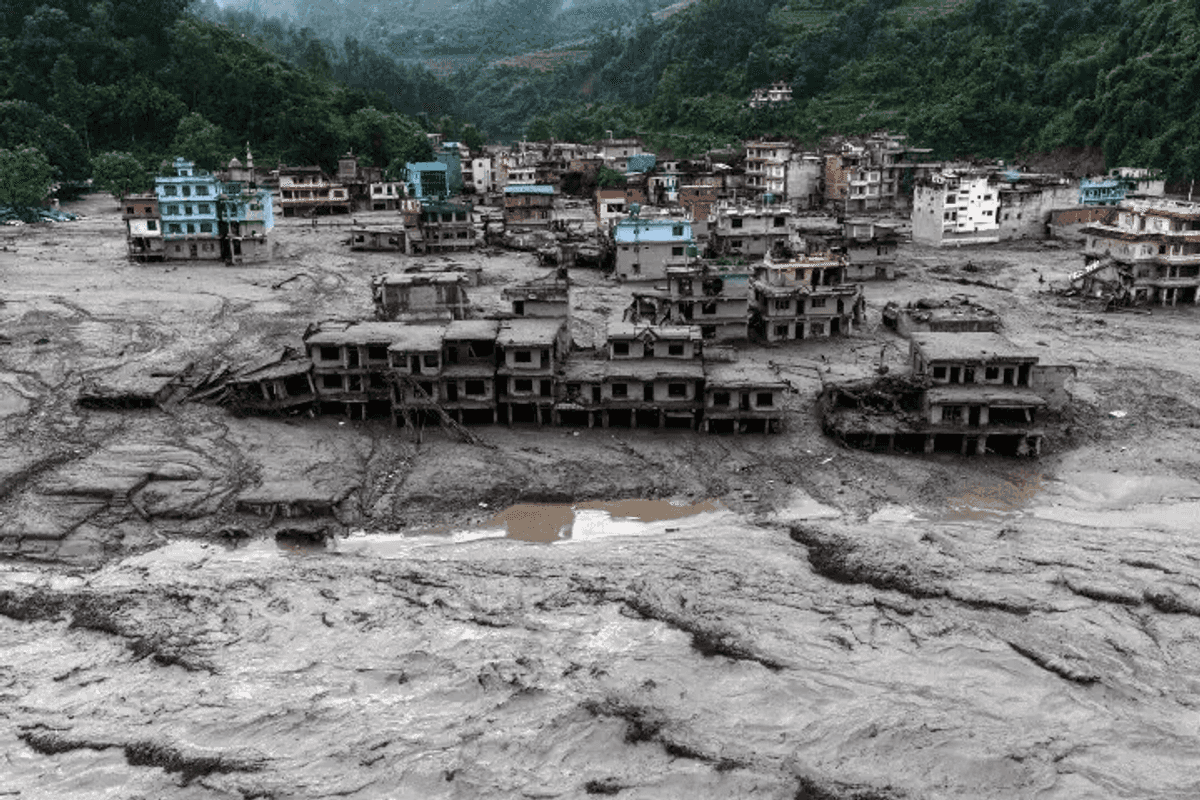
Scientific researchers from the World Weather Attribution (WWA) group confirmed on Thursday that climate change was a fundamental driver of the catastrophic August 26 glacial collapse along the China-Nepal border.
The disaster was triggered when a massive section of rock and ice broke away from Langtang Lirung mountain, swept down the Bhote Koshi and Trishuli river basins, leaving a combined toll of 1,446 dead and at least 6,669 missing across Nepal and Tibet.
What caused the Langtang Lirung mountain collapse according to scientists?
The WWA study characterized the disaster not as an isolated extreme weather event, but as a "compound crisis" produced by decades of high-altitude global warming, permafrost degradation, and pre-existing geological vulnerability.
Record-high local temperatures in July and August 2026 elevated the Himalayan freezing threshold, exposing deep bedrock ice and permafrost to extended thawing temperatures and severely weakening steep mountain faces.
Heavy snowfall in late 2025 generated increased meltwater runoff, while structural rock fractures left by Nepal's 7.8-magnitude earthquake in 2015 further compromised slope integrity prior to the breach.
Co-author Walter Immerzeel, a mountain hydrologist at Utrecht University, noted that the high-altitude Himalayas are undergoing "fundamental, irreversible shifts." Imperial College London climate scientist Friederike Otto added that there is "no doubt that climate change is one of the drivers," emphasizing that the disaster falls directly under the scope of international loss and damage frameworks.
What is the updated toll and economic cost of the disaster?
The announcement came as disaster management authorities in Kathmandu sharply revised casualty figures following comprehensive field data verification across northern districts:
- Nepal: Authorities confirmed 1,403 bodies retrieved (with 105 formally identified) and updated the missing list to 6,150 people.
- China (Tibet): State media reported 43 fatalities and 519 individuals missing along the border corridor.
- Reconstruction Cost: Nepal's government estimated total post-disaster reconstruction and infrastructure recovery costs at $4.78 billion.
Prime Minister Balendra Shah announced he will lead Nepal's delegation to the United Nations General Assembly in New York next week, where he plans to formally present the WWA findings and demand dedicated international climate adaptation funding and loss-and-damage compensation for vulnerable mountain nations.





Comments
See what people are discussing