

Cluster bombs kill, wound 1,063 people in 2025: monitor
Cluster bombs killed or wounded 1,063 people in 2025, with Ukraine accounting for 87 percent of casualties, a new monitor report finds

News Desk
The News Desk provides timely and factual coverage of national and international events, with an emphasis on accuracy and clarity.
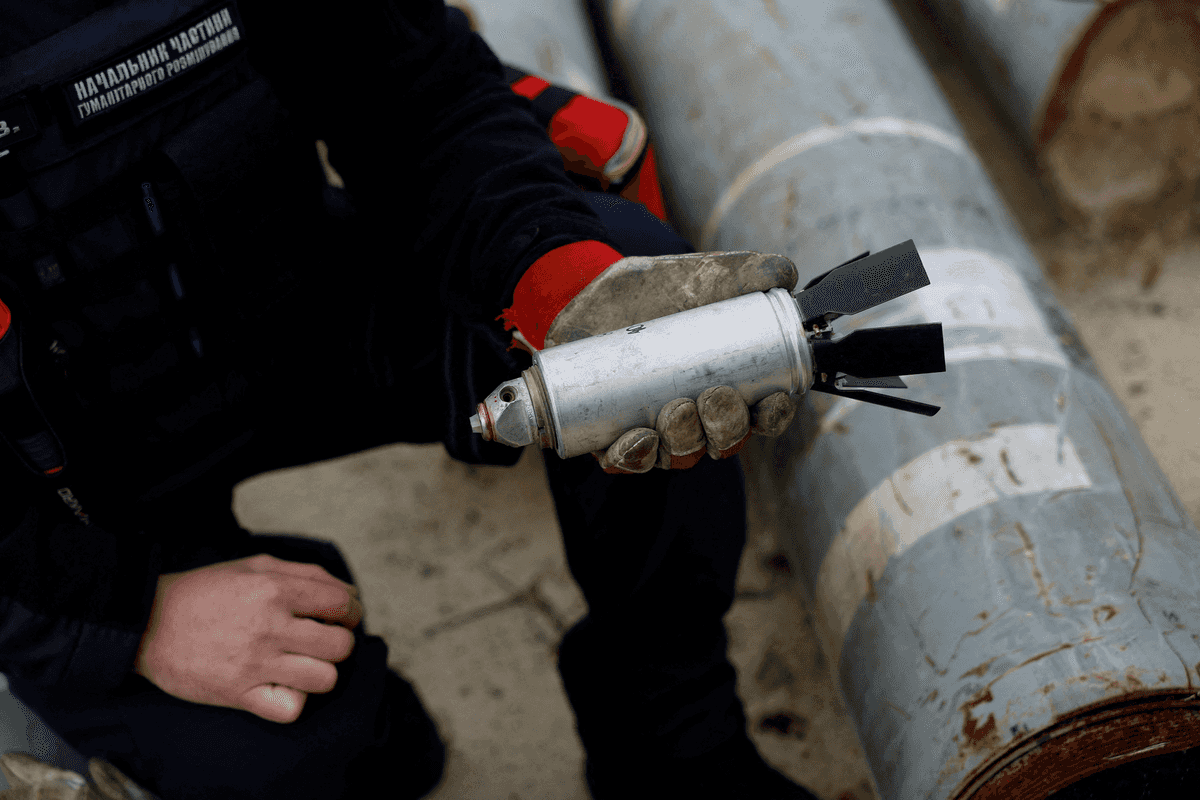
Ukrainian serviceman Igor Ovcharruck holds a defused cluster bomb from a Russian MSLR missile in Kharkiv, Ukraine, Oct. 21, 2022.
Reuters
Cluster munitions killed or injured more than 1,000 people worldwide in 2025, most of them in Ukraine, a monitor said Tuesday.
Civilians accounted for the vast majority of victims across nine countries, in one of the highest annual totals on record.
How many people were killed by cluster bombs in 2025?
Cluster munitions killed or wounded at least 1,063 people in 2025, according to the Cluster Munition Coalition (CMC). Civilians made up 87 percent of all casualties. Ukraine alone accounted for 927 of the total, or 87 percent, continuing a pattern seen since Russia expanded its invasion in February 2022.
Which countries recorded cluster munition casualties in 2025?
Casualties were also recorded in Afghanistan, Cambodia, Iraq, Laos, Lebanon, Myanmar, Russia and Syria, the CMC said in its annual report. Cluster munitions can be dropped from planes or fired from artillery, exploding in mid-air and scattering bomblets across a wide area. Many bomblets fail to explode on impact, effectively acting as landmines that can detonate years later. Erik Tollefsen, head of the weapon contamination unit at the International Committee of the Red Cross, said the often colourful bomblets tend to attract children in particular.
Which countries used cluster munitions in 2025?
Five countries used cluster munitions in 2025, the report found. Russia and Ukraine both continued using them on each other's territory, while Myanmar used them domestically. Iran used the weapons in Israel, and Thailand used them in its border conflict with Cambodia. The weapons were also used in Mali by actors that remain unconfirmed.
Are cluster bombs illegal under international law?
None of the countries known to have used cluster munitions in 2025 are among the 112 states party to the 2008 Convention on Cluster Munitions, which bans their use, transfer, production and storage. The past year also saw reports or allegations of use by non-signatory states including Israel, Pakistan and the United States, as well as Yemen's Iran-backed Houthi rebels. The findings emerged as countries prepared to meet in Laos for a third review conference on the convention, amid concerns that the stigma around the weapons may be weakening.
CMC chief Tamar Gabelnick said the report shows the convention keeps delivering results to affected communities. She warned that the rising human toll, along with continued and new use, production and transfers by non-signatory states, are stark warnings that these gains cannot be taken for granted. CMC said deep cuts to international development and aid funding have also hurt clearance and survivor support efforts.
Why did Lithuania's withdrawal from the treaty worry experts?
Experts said Lithuania's withdrawal from the convention last year, the first by any state party, sent a particularly concerning message. Lithuania, along with Poland, Latvia, Estonia and Finland, also quit a treaty banning anti-personnel landmines, citing concerns over Russia's aggression.
Fahad Amed, an ICRC legal advisor, acknowledged that states have the right and sovereignty to protect their borders. He warned against treating any prohibited weapons as acceptable, asking where that logic would end: chemical, biological or nuclear weapons. He called it a very dangerous path to go down.





Comments
See what people are discussing