

Cummins rejects Khawaja’s claims as Warner hits back
The Australian captain spent 69 minutes addressing questions, insisting that he had no knowledge of the sandpaper being taken onto the field during the third Test against South Africa in March 2018.

Zaid Hassan
Producer
Zaid Hassan, a seasoned sports journalist, led Cricket Pakistan as editor for four years, shaping its coverage with insightful analysis. Now a producer at Nukta, he expands into broader storytelling while remaining a key voice in Pakistan’s sports media.
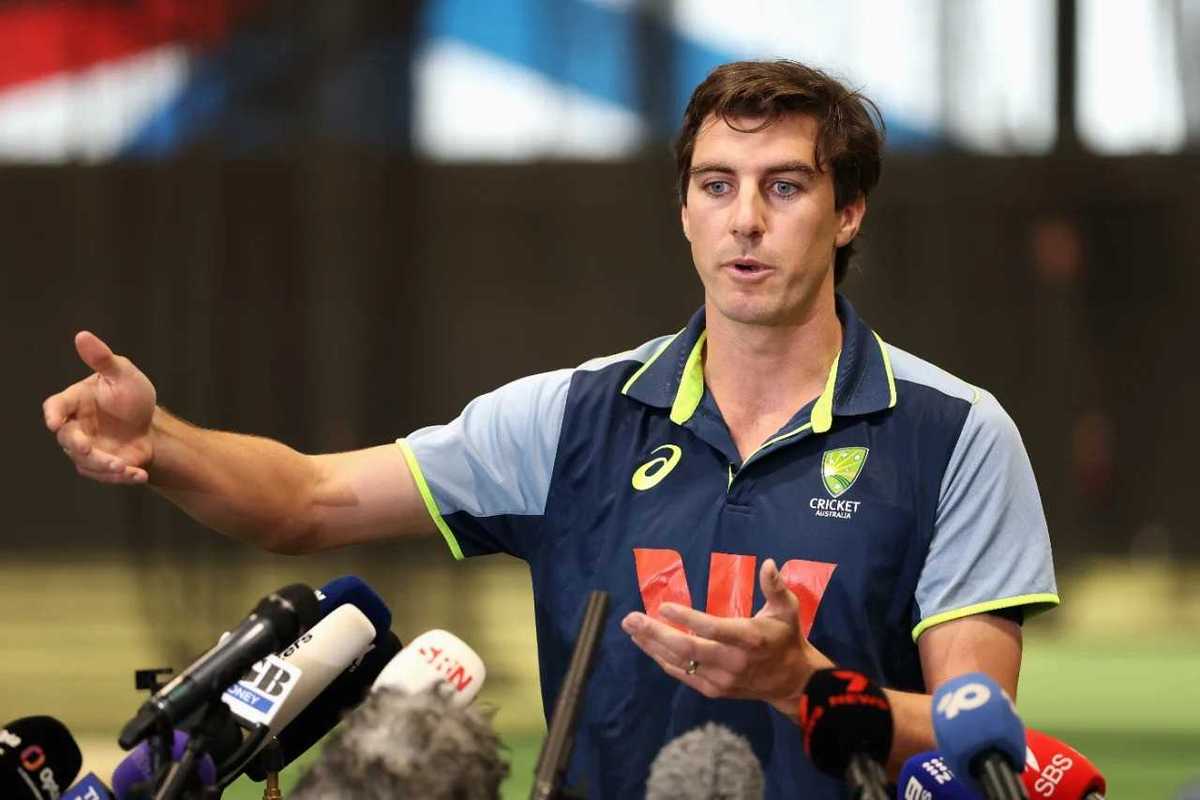
Australia Test captain Pat Cummins began his press conference by making it clear that he wanted to address every question surrounding the controversy before putting the matter behind him.
Cricket Australia
The controversy surrounding Australia's infamous 2018 ball-tampering scandal has resurfaced, with Pat Cummins strongly rejecting Usman Khawaja's claims about the team's knowledge of the incident, while David Warner has publicly accused the current Test captain of throwing his former teammate under the bus.
Eight years after the Cape Town Test brought Australian cricket into one of its darkest periods, disagreements over who knew about the use of sandpaper have once again exposed divisions among members of the team involved in the scandal.
The latest dispute began after Khawaja made a series of revelations in his autobiography, Sabr, claiming that everyone in the Australian dressing room knew about the plan to alter the condition of the ball during the third Test against South Africa in March 2018.
Speaking to the Sydney Morning Herald ahead of his book's release, Khawaja suggested that the responsibility for the incident extended beyond the three players who were ultimately punished: Warner, Steve Smith and Cameron Bancroft.
Cummins, who was part of that Australian side, responded with a lengthy press conference on Friday, firmly dismissing Khawaja's allegations and questioning the manner in which his former teammate had presented his account.
The Australian captain spent 69 minutes addressing questions, insisting that he had no knowledge of the sandpaper being taken onto the field.
However, Warner subsequently appeared on Fox Cricket during Australia's first ODI against England at Optus Stadium, backing Khawaja's account and expressing disappointment with Cummins' response.
The former opener also renewed calls for the truth about the scandal to be acknowledged, arguing that he, Smith and Bancroft had endured consequences that continued to affect their lives.
What did Cummins say about Khawaja's allegations?
Cummins began his press conference by making it clear that he wanted to address every question surrounding the controversy before putting the matter behind him.
"I’ll stay here until you have no more questions. I don’t want to talk about this again after today."
However, the Australian captain showed little hesitation in rejecting Khawaja's suggestion that the entire team knew about the use of sandpaper during the Cape Town Test.
While Warner had previously described Khawaja's revelations as '100 percent accurate', Cummins labelled the allegations '100 per cent wrong' and dismissed suggestions that he and other teammates had been involved in planning the ball-tampering operation.
"When he says ‘We all knew’, if by that he means that we knew sandpaper was going out in the field, he’s 100 per cent wrong," Cummins said. "I’ve said that consistently for the last eight years. I did not know that was happening.
"But I think Usman actually says things that are actually far more serious than that. He says that I and others were architects of a scheme to ball tamper with sandpaper. That’s complete and utter nonsense.”
Cummins also expressed surprise over Khawaja's admission that he had warned Bancroft to be careful while using sandpaper during the match.
The Australian captain suggested that such behaviour was inconsistent with the person he had known over the years, particularly considering Khawaja's involvement in efforts to improve the team's culture following the scandal.
"I was genuinely shocked this week when I found out that Usman admitted that he told Cam [Cameron Bancroft] to be careful when using sandpaper (in Cape Town). That’s not the Usman that I know. It’s not the Usman that has been part of a team that’s helped rebuild the Australian cricket culture over the last eight years. The Usman that would have stopped that from happening there and then."
Although Cummins acknowledged his friendship with Khawaja, he questioned whether the former opener had adequately considered the impact his allegations could have on the reputations of other players.
"Usman’s a friend, but friends aren’t casual with each other’s lives and reputations. In his book, Uzzy has been casual with my life, and the lives of many others, and I think Australian cricket...This really affects Australian cricket. The way that he’s presented his story. I think he’s done that in a very casual manner, and it affects a lot of people. That’s what I’m grappling with at the moment because I don’t think it’s okay.
"… Usman is a friend, but I think the way he’s kind of been quite casual and flippant with people’s lives in Australian cricket, I don’t think that’s okay, and I don’t think that’s what friends do."
What did Cummins reveal about ball-tampering practices before Cape Town?
During the press conference, Cummins also provided insight into his understanding of ball-tampering practices in Australian and international cricket before the 2018 South Africa tour.
He admitted that after returning to international cricket following an extended injury absence, he had encountered several methods allegedly used by players to alter the condition of the ball and generate reverse swing.
These included using substances such as superglue and nail polish, certain brands of mints, lifting the seam and employing sandpaper.
Cummins suggested that some of the practices he witnessed at the time had appeared relatively normal to him, although his perspective had changed over the years.
"There’ve been previous times which I thought was normal (deterioration), which I’m starting to think it’s less normal now because I haven’t seen it a long time, where maybe the quarter seems a little bit higher than it should be," he said.
"Maybe someone’s just tried to lift it up a tiny bit with a finger. I’ve not seen that since then. But at the time coming back into the team after not much cricket, I thought that was very normal."
He also recalled an incident during the Sheffield Shield in which he witnessed a senior batter attempting to alter the ball's condition using a bottle cap.
Cummins said the umpires intervened immediately, making it clear that such conduct would not be tolerated.
"It was a batter, it was a senior player – I won’t mention him – but he took a bottle cap out on the field. That was the one time I’ve seen it on the field,” Cummins said. “I was looking, going, ‘Wow, that’s not okay.’ It was dealt with, the umpires knew it as well. They called him out and said, ‘You got to stop that right now’. That’s the only time I’ve seen something illegal out there."
However, he maintained that these experiences occurred before Australia's 2018 tour of South Africa.
Interestingly, Cummins also questioned the severity of the punishments imposed on Smith, Warner and Bancroft following the Cape Town incident.
The trio received lengthy suspensions, with Warner and Smith banned for 12 months and Bancroft handed a nine-month suspension.
Cummins described the series as an unusually chaotic period in international cricket and suggested that the sanctions imposed on the three players were excessive.
"There was a lot of lawlessness about what was going on in that series...it was just a crazy series and I’m very glad we haven’t seen a series like that since. And it [ball tampering] was also quite prevalent. We have heard stories of other teams doing it. I think the whole scale got a little bit lost (in the punishments given to those three players). It’s my personal opinion but I think their bans were way over the top.”
Why did Warner accuse Cummins of throwing Khawaja under the bus?
Warner responded to Cummins' comments shortly after the press conference, making it clear that he continued to support Khawaja and believed his former teammate had been unfairly criticised.
Speaking during Fox Cricket's coverage of Australia's ODI against England, the former Australia opener described Khawaja's autobiography as an honest account and expressed disappointment with the way Cummins had addressed the allegations.
"I still stick by Uzzie," he said. "And what he's written in that in that book. It is the truth and I really, really support him.
"I actually feel for him at the moment. I actually feel that the captain today actually threw Uzzie under the bus. And I'm very, very disappointed about that."
When former England captain Michael Vaughan asked whether Warner possessed concrete evidence that other members of the team knew about the plan, the former opener did not provide any specific proof.
Instead, he pointed towards the limited opportunity he believed the three punished players had received to revisit the investigation and explain their positions.
He also revealed that he had approached Cricket Australia chief executive Todd Greenberg about reopening the matter.
"Well, the the thing for us, Vaughan, is that we don't have that opportunity to to go there and and speak again. I told Greenberg (Cricket Australia CEO), 'Quash that,' um, the other day. So I thought there'd probably going to be conversations, uh, behind the scenes, uh, probably after all this."
Why is Warner unhappy with the silence from former teammates?
Another major source of Warner's frustration appears to be the lack of communication from other members of the Australian dressing room since the scandal.
Responding to Gilchrist's question about his conversations with Khawaja and Bancroft, Warner revealed that both remained upset about how the situation had unfolded.
He claimed that none of the other players involved in the 2018 dressing room had approached the three punished cricketers to discuss the incident during the subsequent eight years.
"Yeah, I was speaking to both of them. They're quite upset about this all as well, and I think the main part about this is that, in those eight years, not one of those people who were in that dressing room, besides those three, spoke to us about that."
Warner argued that the absence of any meaningful conversation was particularly disappointing given the relationships that had continued between former teammates.
He pointed out that he had remained in contact with Cummins and had even played golf with the Australian captain on several occasions.
"I think that's the mateship that we talk about, the honesty that you have with each other; there has been no contact or questions about it. And we're all adults, and we're open to conversation. We're open to that, but I've played golf with Pat Cummins a couple of times," he said.
Warner further explained that he had shared dressing rooms and celebrated major international successes alongside Cummins after the scandal, yet the issue had never been raised between them.
He suggested that the absence of any discussion made the latest public disagreement particularly difficult to understand.
He added: "I've been in the dressing room, you know, since and played and won some World Cups, and it's just never been questioned or asked about it. So, yeah, look, at the end of the day, you know, Pat's not going to grieve me. I'm not going to grieve him. He's obviously spoken about what he thinks about Uzzie's book, but I stand by Uzzie and his comments."
Will Warner reveal his own version of the Sandpaper gate controversy?
Despite calls from former Australia batter Mark Waugh to move on from the controversy, Warner indicated that he was not prepared to leave the matter behind without what he considers an acceptance of the truth.
The former opener also hinted that he could eventually publish his own account of the incident, potentially through an autobiography.
"In time, you know, potentially, it's inevitable everyone writes a book at the end of their careers. But, you know, for me, it's about accepting the truth, and I don't sort of think this will rest," he said bluntly.
When Gilchrist asked whether he intended to share his account through a book, a press conference or another platform, Warner reiterated that he was unwilling to accept conflicting versions without the truth being established.
His response left little doubt about his position.
"Yeah, each person's going to have their differences, but I'm not going to accept it until the truth's out there."




Comments
See what people are discussing