

A Milestone Worth Noting: FAST Cables and Pakistan’s First BASEC Certification
For Pakistani manufacturing more broadly, this kind of achievement carries weight beyond the company itself.

Partner Content
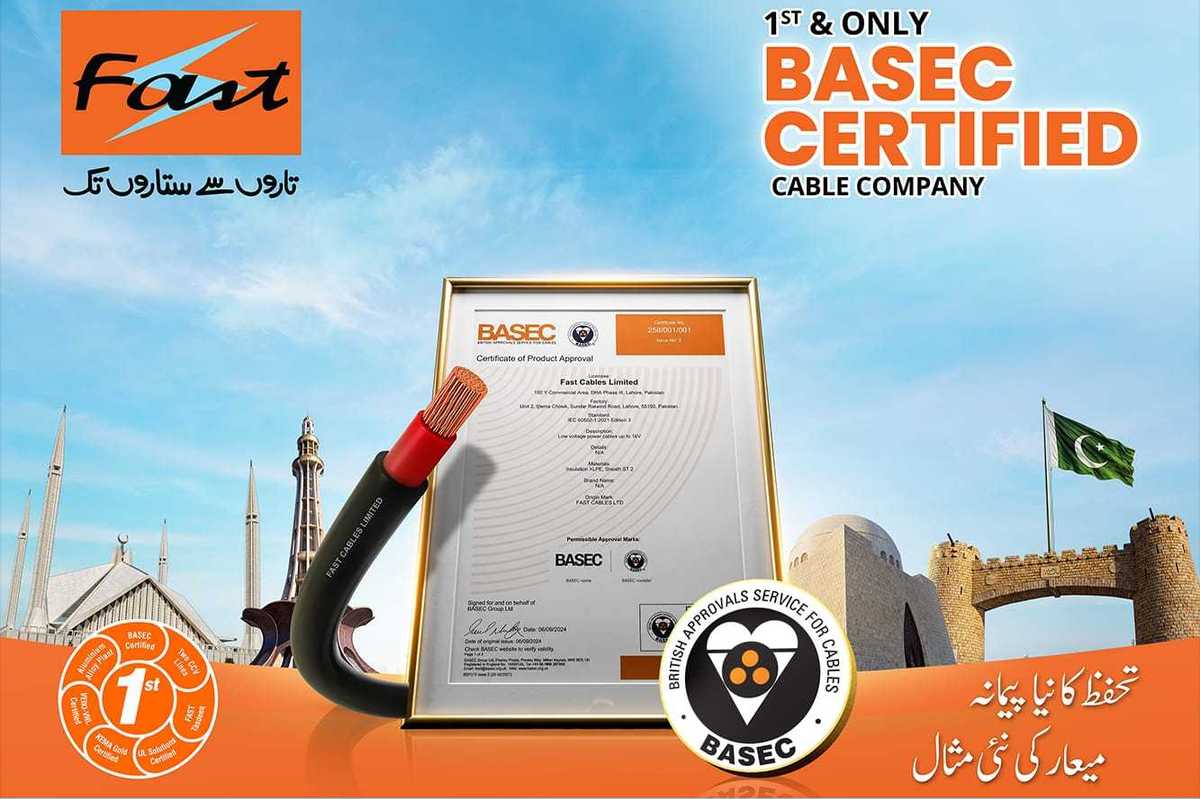
Supplied
It’s always encouraging to see Pakistani companies take steps that raise the bar for our local industry. I recently came across the news that FAST Cables has achieved BASEC certification, making it the first cable manufacturer in Pakistan to reach this milestone. It’s the kind of development that deserves more attention than it typically gets, not because it’s flashy, but because of what it actually represents for manufacturing standards in the country.
We often talk about improving the quality and competitiveness of Pakistani manufacturing, but real progress rarely comes from talk. It comes from companies actually investing in the systems, processes, and standards needed to get there. FAST Cables becoming the first cable manufacturer in Pakistan to achieve BASEC certification is a clear example of that kind of investment translating into something tangible.
Why BASEC Certification Matters
For those unfamiliar with it, BASEC (British Approvals Service for Cables) is an internationally recognized certification body based in the UK. It’s respected precisely because it doesn’t just slap a label on a finished product and call it a day. Achieving BASEC certification involves an independent, rigorous assessment of a manufacturer’s entire production process, quality management systems, testing protocols, and ongoing compliance monitoring. It’s not a one-time inspection; it’s a continuous verification process that manufacturers have to maintain over time.
That distinction matters a great deal, especially in an industry like cable manufacturing where reliability isn’t just a nice-to-have; it’s fundamental to safety. Cables sit behind walls, run through ceilings, and power everything from homes to hospitals to industrial facilities. A substandard cable isn’t just an inconvenience; it’s a fire hazard, an electrical risk, and a potential point of failure in critical infrastructure. When a certification body independently verifies that a manufacturer’s processes meet international benchmarks, that verification builds a level of trust that self-declared quality claims simply cannot match.
What This Means for the Industry
For Pakistani manufacturing more broadly, this kind of achievement carries weight beyond the company itself. It’s a positive development for the engineering and construction sectors that rely on locally produced materials, and it serves as a reminder that Pakistani manufacturers are fully capable of meeting internationally recognized standards when quality and continuous improvement are taken seriously as organizational priorities rather than afterthoughts.
There’s a broader narrative here too. Pakistani industry, cables included, has sometimes struggled with a perception problem in both domestic and international markets: the assumption that “made locally” somehow implies a compromise on quality compared to imported alternatives. That perception isn’t baseless; it has been shaped by real gaps in standards and enforcement over the years. But it also isn’t the whole story, and achievements like this one push back against it in a meaningful way. When a Pakistani manufacturer subjects itself to the same independent scrutiny that internationally recognized brands undergo, and passes, it chips away at that narrative one credible data point at a time.
Building Customer Confidence
From a customer’s perspective, certifications like BASEC aren’t just technical badges; they’re a proxy for peace of mind. Contractors, developers, and even individual homeowners making decisions about wiring and electrical infrastructure are rarely equipped to evaluate the technical minutiae of cable manufacturing themselves. What they can do is look for trusted third-party validation. That’s the entire point of certification systems: they translate complex technical assurances into something a non-specialist can rely on when making a purchasing decision.
For a company to earn that kind of trust, it has to be willing to open up its operations to external scrutiny, accept the findings, and make whatever changes are necessary to meet the standard. That’s not a trivial undertaking. It requires sustained commitment from leadership, investment in testing and quality infrastructure, and a willingness to hold internal processes to a bar set by an outside authority rather than an internal one. Companies that take shortcuts on quality don’t typically pursue certifications like this, because they know they wouldn’t pass.
A Reminder, Not a Conclusion
None of this is to suggest that one certification transforms an entire industry overnight. It doesn’t. But industry-wide change rarely happens in one sweeping motion; it happens through individual companies deciding to raise their own bar, and in doing so, creating pressure and precedent for others to follow. If FAST Cables’ achievement encourages other manufacturers, in cables or elsewhere, to pursue similar independent validation of their processes, the ripple effect could be far more significant than the initial certification itself.
For now, though, it’s worth simply acknowledging the achievement for what it is: proof that Pakistani manufacturers can meet the same rigorous, internationally recognized standards that global brands are held to, when they choose to prioritize quality and continuous improvement. That’s a meaningful milestone, and one that deserves recognition, not just from within the industry, but from anyone interested in seeing Pakistani manufacturing continue to move in the right direction.




Comments
See what people are discussing