

Pakistan imposes emergency in Khyber Pakhtunkhwa, removes CM Sohail Afridi
Emergency in Khyber Pakhtunkhwa: President Zardari removes CM Sohail Afridi citing terrorism, as PTI rejects the move and vows a legal challenge.
Aamir Abbasi
Editor, Islamabad
Aamir; a journalist with 15 years of experience, working in Newspaper, TV and Digital Media. Worked in Field, covered Big Legal Constitutional and Political Events in Pakistan since 2009 with Pakistan’s Top Media Organizations. Graduate of Quaid I Azam University Islamabad.

Kamran Ali
Correspondent Nukta
Kamran Ali, a seasoned journalist from Khyber Pakhtunkhwa, Pakistan, has a decade of experience covering terrorism, human rights, politics, economy, climate change, culture, and sports. With an MS in Media Studies, he has worked across print, radio, TV, and digital media, producing investigative reports and co-hosting shows that highlight critical issues.
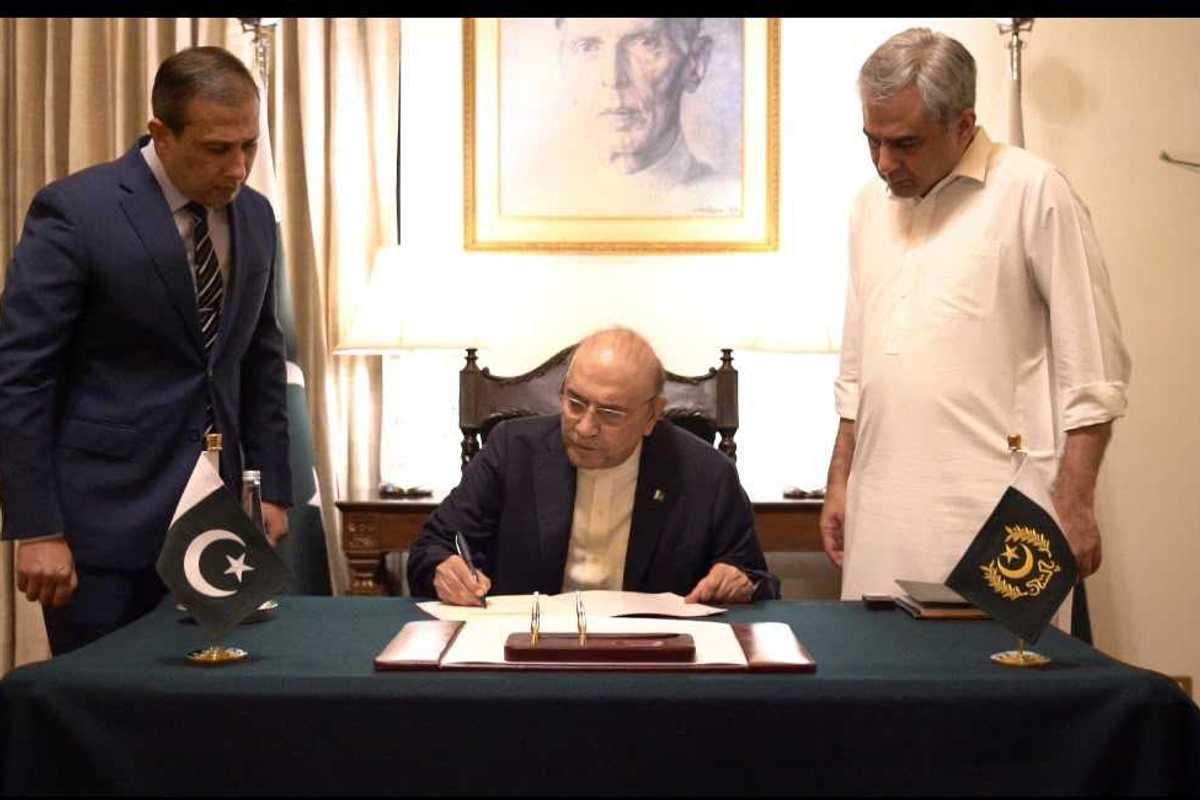
President Asif Ali Zardari signs the order imposing emergency rule in Khyber Pakhtunkhwa, removing Chief Minister Sohail Afridi’s administration with immediate effect.
Picture Courtesy: Pakistan Government
President Asif Ali Zardari declared a state of emergency in Khyber Pakhtunkhwa on Sunday, removing Chief Minister Sohail Afridi and his administration over terrorism and a breakdown of constitutional machinery. The move comes as the opposition Pakistan Tehreek-e-Insaf (PTI) marches toward Islamabad, and it is likely to deepen tensions with the federal government.
What does the emergency in Khyber Pakhtunkhwa mean?
The proclamation invokes Articles 232 and 234, transferring executive authority over provincial departments to the governor, who acts under federal directives. Ministers, advisers and the advocate general are removed. The provincial assembly stays intact, but its legislative powers are suspended and passed to Parliament.
The order took effect immediately after advice from the federal cabinet and a report by Governor Faisal Karim Kundi that the province's constitutional machinery had broken down. The government cited escalating terrorist attacks, threats to public safety and the provincial administration's alleged failure to counter violence effectively.
Afridi, provincial ministers, advisers, special assistants and the advocate general were all removed from office. The move came while Afridi and PTI were leading a protest march toward Islamabad, raising the prospect of a wider political confrontation.
Who is the new chief secretary of Khyber Pakhtunkhwa?
The federal government appointed Grade 22 Pakistan Administrative Service officer Dr. Muhammad Fakhr Alam Irfan as the province's new chief secretary, according to an official notification. Irfan previously served as secretary of the Power Division in the federal Ministry of Energy. His appointment took effect immediately and will remain in place until further orders.
Separately, Chief Secretary Shahab Ali Shah and 15 other senior officials were removed from their positions, according to reports.
Governor Kundi called the emergency a step welcomed by the province's people, saying they wanted peace, stability, development and prosperity. In a video message to residents, he said the public had decided not to support what he called "Fitna al-Khawarij," a term Pakistani authorities use for the banned Tehreek-e-Taliban Pakistan and associated terrorist elements.
Kundi said residents would stand alongside security forces and fight terrorism, adding that the province wanted a peaceful and prosperous future rather than unrest and disorder. He also called for stronger cooperation with other provinces and the promotion of democratic values and development. He urged residents not to break the law, incite violence or riot, warning that anyone who disrupted public order or took the law into their own hands would face action.
How has PTI responded to the emergency?
PTI Chairman Barrister Gohar Ali Khan condemned the declaration and rejected the federal government's decision, describing it as a serious political mistake and an undemocratic measure. "We strongly condemn the imposition of emergency in the province in the strongest terms and outrightly reject this action," he said in a statement. He added that the people of Khyber Pakhtunkhwa would not accept steps that undermined their rights and electoral mandate.
"The mandate of the people of Khyber Pakhtunkhwa is their constitutional and legal right," Gohar said. He argued that weakening provincial autonomy and creating a confrontation between the federal and provincial governments would neither establish peace nor bring stability.
Gohar said there was no disagreement over the need to eliminate terrorism, but warned that the fight must not be used to suppress public opinion, pursue political objectives or restrict provincial constitutional powers. "Combating terrorism is only possible through national unity and a joint strategy," he said. He also argued that a strong federation could not be built by weakening its provinces, and called for political dialogue and respect for the Constitution.
He pledged to challenge the decision through constitutional, legal and democratic forums. "There is still time; this decision can be reversed within a few days," he said, urging the federal government to set aside its ego, recognize ground realities and respect public sentiment to avoid further political and economic damage.
What is happening on the ground in Khyber Pakhtunkhwa?
PTI workers began protesting against the emergency in Bara, in the Khyber district, according to reports. "We will not let the emergency be implemented in KP," a PTI lawmaker from Khyber said. Reports also emerged that PTI leader Junaid Akbar Khan and Chief Minister Sohail Afridi had been arrested, though the circumstances were not immediately clear.
Following the declaration, the governor called the first meeting of his advisory council for 2 p.m., according to sources. The developments followed days of political consultations in Islamabad as the federal government weighed extraordinary constitutional measures against the PTI-led provincial administration.
Prime Minister Shehbaz Sharif held separate meetings with Zardari and Jamiat Ulema-e-Islam-Fazl chief Maulana Fazlur Rehman on Saturday to discuss options for avoiding a direct confrontation with the PTI. Fazlur Rehman, who has been facilitating contacts between the government and opposition, also met Gohar and PTI leader Asad Qaiser to discuss the government's possible response if the march continued.
A senior JUI-F leader said the party was acting only as a facilitator. "We are only facilitators of talks to defuse the prevailing tension but the decision will have to be made by the government and the PTI," the leader said.
Interior Minister Mohsin Naqvi had said earlier that there was no room left to avoid imposing an emergency, claiming the government had exhausted its options for reaching an understanding with the PTI. "I tried my best till the very end, but I have nothing left," Naqvi said.
Information Minister Attaullah Tarar confirmed that the prime minister had convened a federal cabinet meeting on Sunday to consider the emergency and governor's rule. Minister of State for Interior Affairs Tallal Chaudhry also said the government was examining multiple options.
Khyber Pakhtunkhwa police chief Zulfiqar Hameed had issued instructions to district police officers before the announcement, warning of possible violence and sabotage during protests. Station house officers were directed to identify vulnerable locations along protest routes and deploy sufficient personnel to protect them.
Why did the government impose the emergency?
Addressing the federal cabinet, Sharif said the PTI-led provincial government could not be allowed to undermine Pakistan's economic stabilization efforts amid escalating tensions. "I will not allow them (PTI) to destabilize the economy," he said.
The prime minister also condemned the continuing loss of life in terrorist attacks in Khyber Pakhtunkhwa and Balochistan, expressing grief over the deaths of civilians, police officers, security personnel, children and women. "The way common citizens are being martyred, the way police officials and security officials, children and mothers… there can be nothing more heart-wrenching," he said.
Sharif said Pakistan had repeatedly urged neighboring Afghanistan to rein in terrorist elements, but the appeals had not produced the desired results. He also reiterated Pakistan's condemnation of a recent deadly Houthi attack on Saudi Arabia, reaffirming solidarity with Riyadh and warning that aggression against the kingdom would not be tolerated. "Our only goal is that peace should be restored in the region," he said.
Turning to the economy, Sharif said Pakistan hoped to unlock a $1.2 billion tranche from the International Monetary Fund within the year following a staff-level agreement. He recalled meeting IMF Managing Director Kristalina Georgieva on the sidelines of the United Nations General Assembly last month. He praised the political and military leadership for strengthening fiscal discipline and highlighted Pakistan's diplomatic efforts, including its role in mediation in the Middle East conflict.
What does the Constitution say about emergency powers?
Article 232 allows the president to proclaim an emergency when the security of the country, or any part of it, is threatened by war, external aggression or internal disturbances beyond a provincial government's ability to control. The article provides for a resolution from the provincial assembly. If the president acts independently, the proclamation must be submitted to both houses of Parliament for approval within 10 days.
During an emergency, Parliament may legislate on matters outside the federal legislative list for the affected province. Article 233 provides for the suspension of certain fundamental rights during an emergency, subject to constitutional provisions.
Article 234 deals with the failure of constitutional machinery in a province. After receiving a report from the provincial governor, the president may assume provincial government functions or direct the governor to exercise them on the president's behalf. The article also allows the president to declare that the provincial assembly's powers will be exercised by or under the authority of Parliament.
The decision to invoke emergency powers and remove the provincial administration is likely to face political and legal challenges, with the PTI vowing to resist the move through constitutional and democratic channels.
Did the KP governor form an advisory council?
Yes, Governor Kundi has formed an advisory council to oversee key provincial departments, with each member assigned responsibility for a specific sector.
Tariq Mahmood Pasha will look after the province's finance affairs, while Amir Javed will oversee legal matters. Amir Abdullah has been assigned education, and Nigar Johar will handle the health sector.
Dr. Sarfaraz Ali Shah will oversee mines and minerals, while Dr. Irshad will handle industries and commerce. Asif Rafiq will be responsible for communications and works, and Maulana Tayyab Qureshi will oversee religious affairs.
Samar Haroon Bilour has been assigned information and broadcasting, while Usman Saifullah will look after energy-related matters.




Comments
See what people are discussing