


News Desk
The News Desk provides timely and factual coverage of national and international events, with an emphasis on accuracy and clarity.
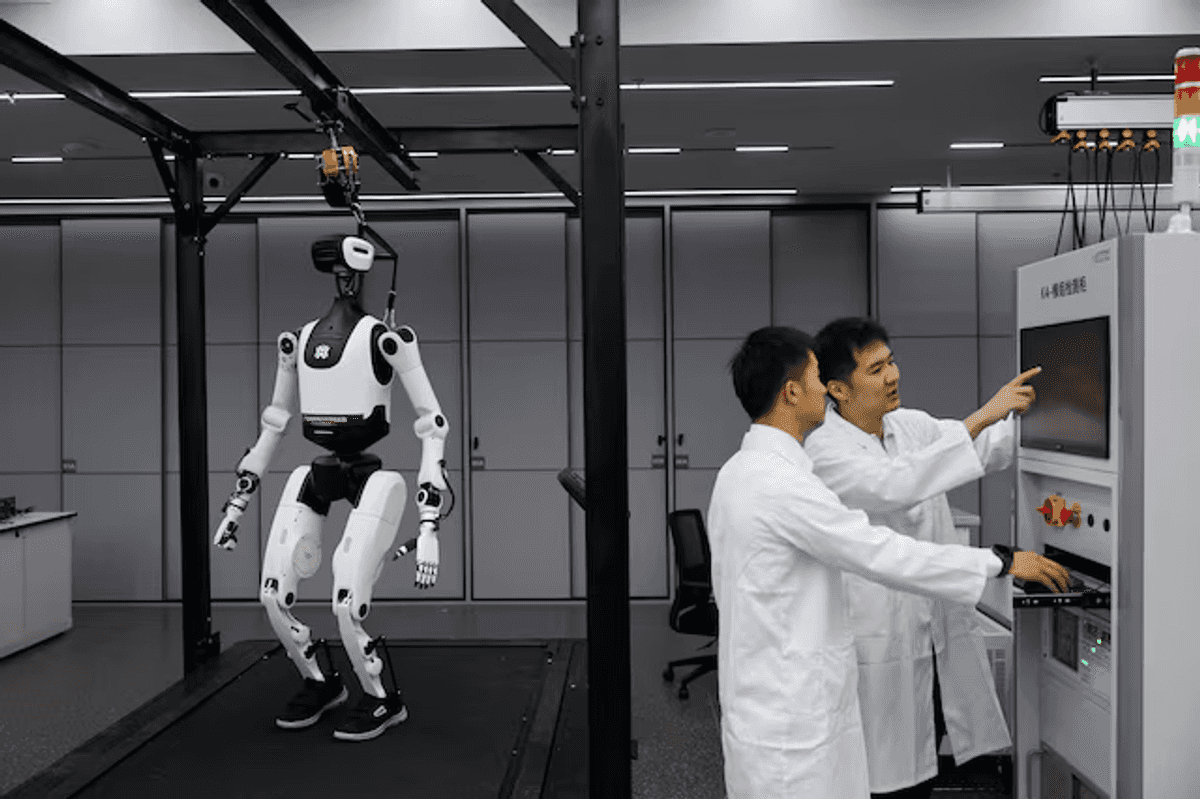
A humanoid robot at a robotics laboratory during a government-organized media trip in Guangzhou, Guangdong province, China, April 16, 2026.
Reuters
The Trump administration banned imports of new Chinese humanoid and quadruped robots and connected power inverters on Tuesday, citing national security and cybersecurity risks. The Federal Communications Commission issued the restrictions to protect America's artificial intelligence supply chain. The rules took effect immediately and apply only to models not yet released.
What does the FCC's Chinese humanoid robots ban cover?
The ban applies to new Chinese-made humanoid and quadruped robots, along with connected power inverters used to link renewable energy and batteries to electricity grids and data centers. It does not affect robots or inverters already approved for sale in the United States. The FCC can still revoke existing authorizations if it finds a security risk.
Why did the FCC ban Chinese humanoid robots and inverters?
The administration said the measures protect the U.S. AI supply chain from disruption, data theft and cyberattacks, according to Reuters. The FCC warned that robots can collect data that could be used to surveil Americans or let foreign intelligence services remotely commandeer the devices. Officials also cited the Volt Typhoon hacking campaign as evidence of cyber threats to critical infrastructure.
"These devices could create supply chain vulnerabilities that could disrupt U.S. economic and national security and could create a cybersecurity risk that threatened American critical infrastructure," the FCC said in a statement. FCC Chairman Brendan Carr said the agency "will continue to do our part to secure America's critical supply chains." Rep. John Moolenaar, who chairs the House Select Committee on China, said the move "protects our country and strengthens our nation's robotics industry."
How has China responded to the robot ban?
The Chinese Embassy in Washington criticized the decision, urging the United States to "heed the objective and rational voices of the business communities in both countries." The embassy said Beijing would "take all necessary measures in response to any action that causes material harm to its interests." It also accused Washington of "smearing Chinese companies and threatening them with sanctions."
Which companies will the ban affect?
Unitree, a Chinese robotics firm holding just under a fifth of the global humanoid robot market according to Counterpoint Research, is expected to be hit hardest. The company was recently added to a Pentagon list of firms alleged to have ties to China's military, a designation that can precede tougher U.S. action. Unitree had partnered with Nvidia to use its Blackwell chips, though Nvidia said robot data stays in the United States and that Unitree's largest customers are American academic and research institutions.
On the inverter side, Sungrow Power Supply and Huawei are among the Chinese manufacturers likely affected. China remains the world's largest producer of power inverters. Huawei has already faced extensive U.S. sanctions in other sectors. None of the three companies immediately responded to requests for comment.
Will non-Chinese suppliers be exempt from the ban?
Four sources told Reuters the FCC is expected to exempt many non-Chinese suppliers, mirroring recent U.S. actions on foreign drones and routers. The exemptions would let manufacturers based outside China continue supplying robots and inverters to the U.S. market. The approach reflects a broader strategy of targeting Chinese-origin technology rather than entire product categories.
What comes next for U.S.-China tech restrictions?
The robot and inverter ban is part of wider U.S. efforts to secure technology supply chains and critical infrastructure from Chinese-linked risks. Treasury Secretary Scott Bessent has separately warned that Chinese AI firms could face U.S. sanctions over alleged theft of American intellectual property. The FCC's action adds robotics to a growing list of sectors, including drones and networking equipment, facing similar import restrictions.





Comments
See what people are discussing