

France imposes nighttime curfews in Paris and major cities as cost-of-living unrest spirals
French PM Sébastien Lecornu announced nighttime curfews across Paris, Lyon, and Lille and refused to rule out a state of emergency after violent cost-of-living riots led to more than 2,500 arrests, museum closures, and spreading unrest across Europe

News Desk
The News Desk provides timely and factual coverage of national and international events, with an emphasis on accuracy and clarity.
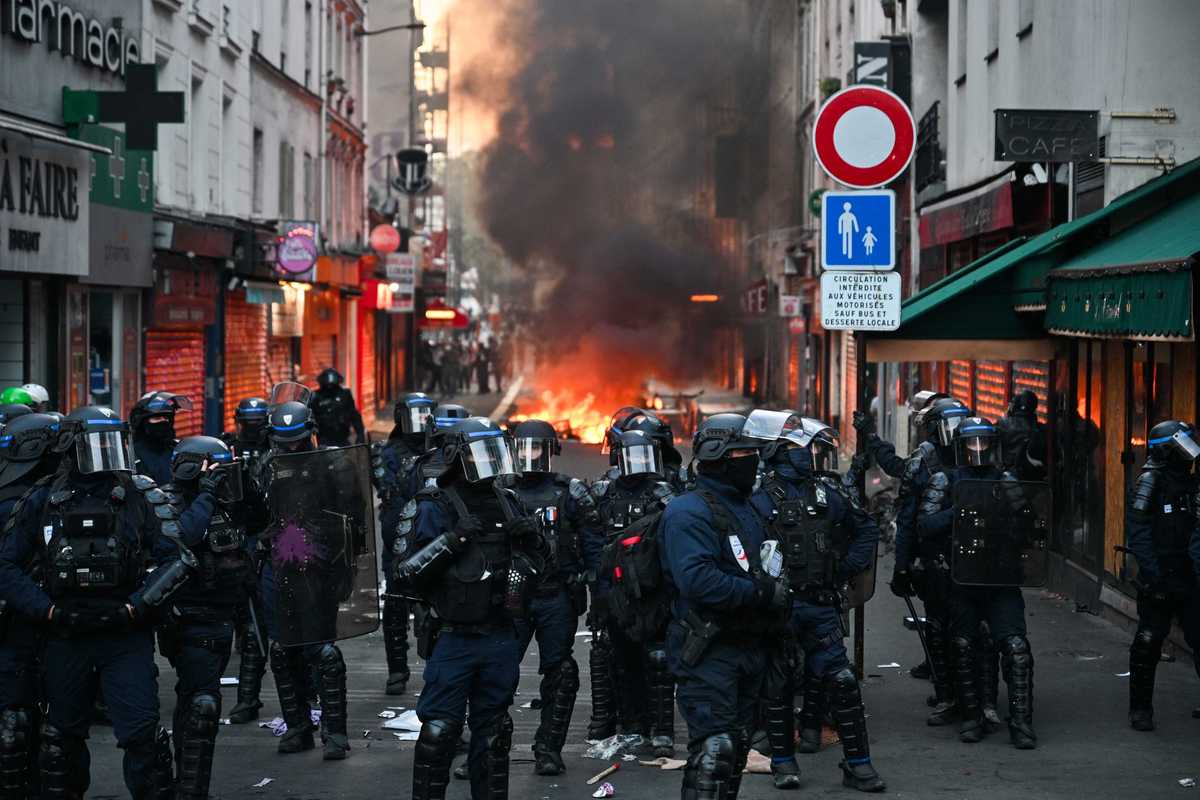
Police stand near a street fire during clashes at an unauthorised protest in central Paris on October 18, 2026, following nationwide cost-of-living demonstrations.
AFP
The French government imposed partial nighttime curfews across Paris, Lille, and Lyon on Monday, October 19, scrambling to restore public order as nationwide demonstrations over soaring living costs devolved into intense urban violence and prompted international travel advisories.
What security measures and curfews has the French government enforced?
Following scenes of widespread destruction over the weekend, authorities ordered nighttime curfews taking effect Monday evening through Tuesday morning in key metropolitan hubs. In the capital, outdoor demonstrations were banned starting at 8:00 PM, with a mandatory curfew enacted from 11:00 PM (2100 GMT).
Prime Minister Sébastien Lecornu affirmed that the government is "absolutely determined to restore public order" and did not rule out invoking a formal state of emergency after Interior Minister Laurent Nuñez conceded that police forces had temporarily "lost control" during the peak of the riots. Nuñez tendered his resignation to President Emmanuel Macron, who refused to accept it.
The enforcement measures come in the wake of Saturday's rallies, where roughly 500,000 citizens mobilized nationwide after four weeks of escalating student demonstrations. The protests subsequently saw masked factions attack administrative buildings, set municipal structures on fire, torch vehicles, and loot commercial corridors.
Justice Minister Gérald Darmanin confirmed that 2,513 people have been taken into custody nationwide since the weekend, with 67 already incarcerated and dozens of expedited criminal proceedings opened. Darmanin announced that prosecutors and police units will deploy facial recognition tools across social media footage to identify participants in the destruction.
Meanwhile, Digital Minister Anne Le Henanff summoned executives from online resale platforms, including eBay and Vinted, demanding that they systematically scrub listings for stolen merchandise looted from at least 3,000 vandalized shops, where economic damages are estimated in the hundreds of millions of euros.
How has the unrest disrupted daily life, tourism, and spilled across Europe?
The crisis spilled directly into Paris’s tourism sector on Monday when a bloc of student demonstrators blockaded the entrance to the Louvre, forcing the world’s most visited museum to close its doors and leaving international travelers stranded outside the iconic glass pyramid.
The instability prompted foreign governments to act: the US Embassy in Paris advised American citizens to avoid protest zones, Germany updated its travel advisory warning of potential new outbreaks of violence, and Chinese state broadcaster CCTV reported that Beijing issued cautionary advisories for travelers in France.
The urban unrest has heightened political tension ahead of the April–May 2027 presidential election, which will decide Macron's successor. Far-right candidate Marine Le Pen, who continues to lead national polls, pointed to the riots as proof of state breakdown, while government officials accused far-left factions of orchestrating violence to elevate the electoral profile of left-wing candidate Jean-Luc Mélenchon. Organizers have already called for a fresh wave of nationwide rallies next Saturday.
The economic grievances driving the French unrest have begun reverberating across Europe. Over the weekend, demonstrators clashed with police in Milan, Italy, prompting Mayor Giuseppe Sala to warn that economic discontent is drawing momentum from a wider, self-reinforcing international crisis. In Belgium, law enforcement deployed tear gas and water cannons against demonstrators in Brussels and Liège, while housing cost activists set up tent encampments in central Madrid, Lisbon, and Porto.
According to reporting by Le Monde and France 24, French intelligence services and senior interior ministry officials convened emergency security assessments late Monday to prepare crowd-control operations ahead of the planned weekend demonstrations.





Comments
See what people are discussing