

Global poverty reduction stalls as 811 million remain extremely poor: World Bank
New report warns that weak job creation, conflict and climate risks threaten poverty reduction, with millions still struggling to achieve economic security

Business Desk
The Business Desk tracks economic trends, market movements, and business developments, offering analysis of both local and global financial news.
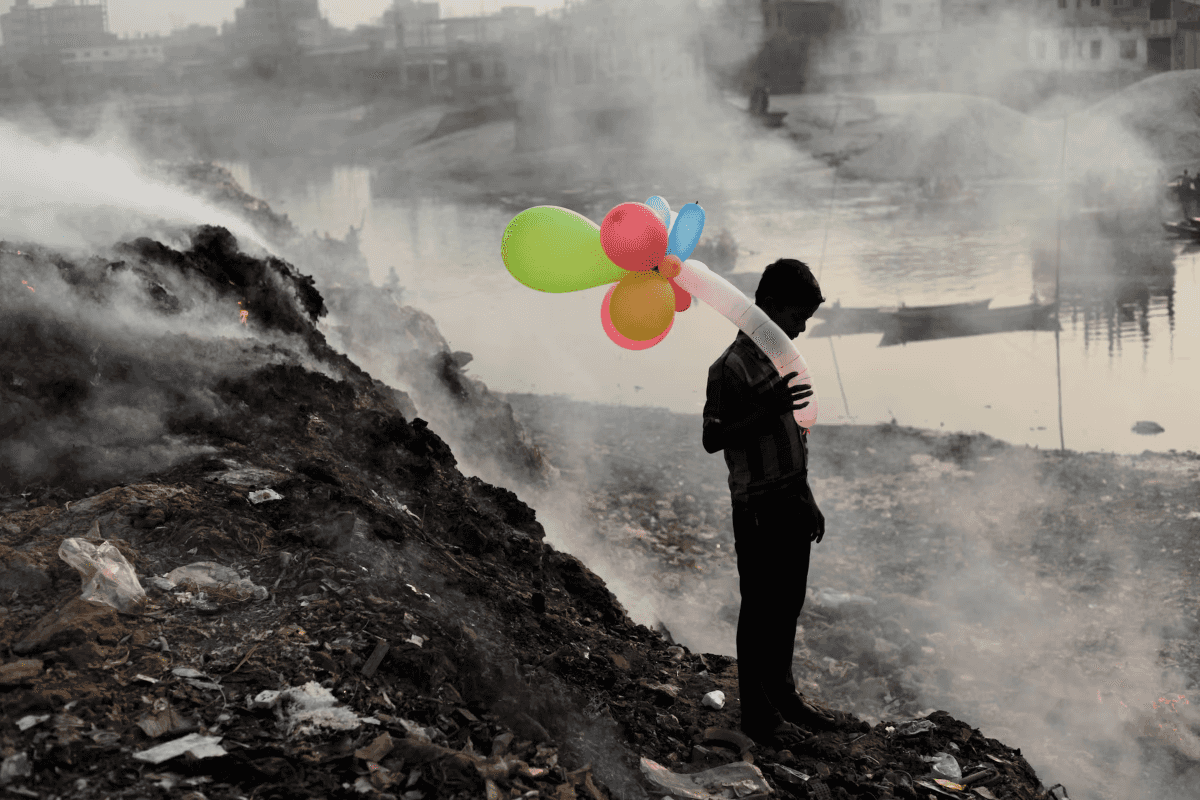
A boy plays with balloons by Buriganga river as smoke emits from a dump yard during sunset in Dhaka
Reuters
The World Bank has warned that progress in reducing global extreme poverty has stalled, with an estimated 811 million people, or one in 10 worldwide, living on less than USD 3 a day in 2026, while climate risks and inadequate employment opportunities continue to threaten vulnerable populations.
In its Poverty, Prosperity, and Planet Report 2026, the World Bank said the extreme poverty rate remained virtually unchanged from 2019, adding that 243 million more people could have escaped poverty if the pace of reduction recorded between 2000 and 2013 had continued.
Why is extreme poverty proving harder to reduce?
Poverty is increasingly concentrated in regions affected by conflict, instability and climate-related risks. More than half of the world's extremely poor people live in just nine economies. By 2030, the World Bank estimates that 87% will live in Sub-Saharan Africa, in fragile and conflict-affected situations, or both.
The bank warned that population growth was fastest in countries with the highest poverty rates, meaning that if economic growth continued at the pace recorded during 2015–2024, both the global poverty rate and the number of people in extreme poverty could be higher in 2030 than in 2026.
Why are billions still economically vulnerable?
The report highlighted the growing gap between escaping extreme poverty and achieving economic security. Nearly half of humanity, or 3.7 billion people, still live on less than USD 8.30 a day, the poverty threshold for upper-middle-income economies.
The World Bank's international poverty thresholds are adjusted for purchasing power, allowing comparisons of living standards across countries.
Most people who have escaped extreme poverty since 2000 have moved into the USD 3–8.30 daily income bracket, leaving them vulnerable to economic shocks that could push them back below the extreme poverty line.
The share of the global population living on between USD 8.30 and USD 28 a day has roughly doubled since 2000, according to the report. However, the expansion has largely been concentrated in upper-middle-income economies.
In lower-middle-income countries, people living on USD 3–8.30 a day remain the largest income group, while those earning more continue to represent a small minority in low-income economies.
How are climate risks threatening poverty reduction?
The World Bank said climate-related risks extended well beyond people living in extreme poverty, with 1.5 billion of the 4.5 billion people exposed to major climate hazards also facing high vulnerability because of limited social protection and inadequate access to basic infrastructure.
Most of those highly vulnerable people live above the extreme poverty line, highlighting the wider economic consequences of climate change.
The risks are particularly concentrated in the Middle East, North Africa, Afghanistan and Pakistan, as well as Sub-Saharan Africa. The World Bank's research shows that around 90% of people in Sub-Saharan Africa face high vulnerability on at least one measure, meaning almost everyone exposed to climate hazards is also considered at risk.
In South Asia, however, the proportion of people facing high climate risks has fallen below 20%, largely because of improvements in reducing vulnerability.
Globally, the share of people facing high climate risks declined from roughly one-third in 2010 to one-fifth in 2021, although the number of people exposed to climate hazards increased by 461 million over the period.
The bank also highlighted the unequal distribution of greenhouse gas emissions, noting that global emissions, excluding land use and forestry-related sources, reached 52.8 billion metric tons of carbon dioxide equivalent in 2024, up 48% from 2000.
Nearly all the increase came from upper-middle-income economies, where emissions more than doubled, while emissions in high-income economies edged down despite economic growth.
Low-income economies, which are home to an increasing share of the world's extremely poor, account for only a small fraction of global emissions. The World Bank estimated that the economic growth required to eliminate extreme poverty would add less than 5% to global emissions.
How could better jobs help reduce extreme poverty?
The World Bank said employment and higher earnings remained central to poverty reduction, as work was the main and often the only source of income available to poor households.
Working-age adults in poor households were employed at rates only six percentage points below those in nonpoor households. However, poor workers put in three to four fewer hours a week and supported three times as many dependents as workers in the richest households.
The employment gap has widened, with employment among poor people declining in 88 of 138 economies between 2003 and 2024.
The bank said earnings growth, rather than increased employment, accounted for all growth in per capita consumption among people at the bottom of the income distribution.
It estimated that increasing employment in poor households to 75% of working-age adults, the rate already achieved by poor men, could reduce extreme poverty by one-fifth.
Bringing education levels among poor workers up to the average for nonpoor workers could cut extreme poverty by nearly half, while moving workers out of agriculture or into wage employment could reduce it by about one-fifth.
The report said the benefits of higher earnings largely accrued to the poorest households, while gains from increased employment were concentrated among families just above the extreme poverty line, where nonworking adults were predominantly women.
The bank also stressed the importance of improving productivity in agriculture and household enterprises, particularly in the poorest economies, where most workers remain outside formal wage employment.
It said moving workers into higher-paying activities was essential to creating sustainable pathways out of poverty, while businesses' ability to generate better-paying jobs would determine how many workers could progress beyond small-scale enterprises and self-employment.
Employment also played a critical role in preventing households from slipping back into poverty, helping turn temporary escapes from extreme poverty into lasting economic security.





Comments
See what people are discussing