

IMF team to visit Pakistan next week to discuss $1 billion climate financing, finance minister confirms
The IMF has recommended that Pakistan invest 1% of its GDP annually in climate resilience and adaptation reforms

Business Desk
The Business Desk tracks economic trends, market movements, and business developments, offering analysis of both local and global financial news.
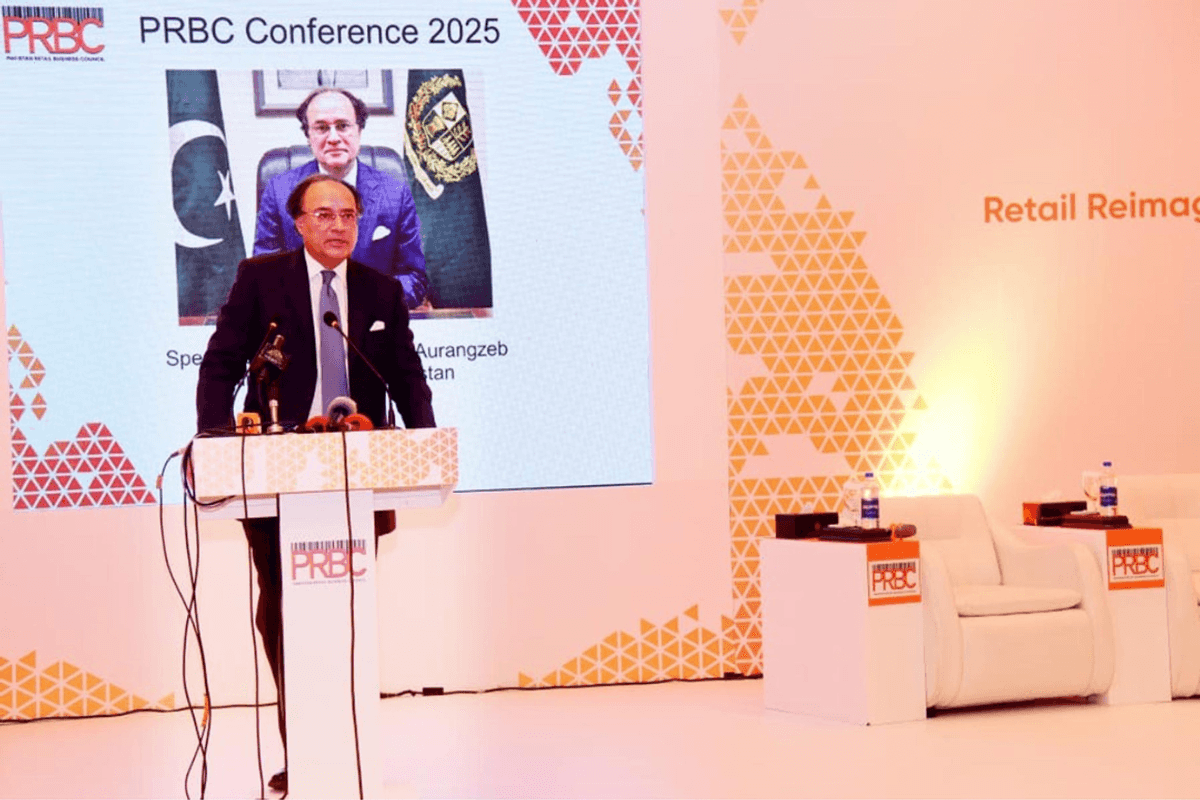
Pakistan Finance Minister Muhammad Aurangzeb addresses a conference organized by the Pakistan Retail Business Council in Islamabad on Feb 20
PID
Pakistan Finance Minister Muhammad Aurangzeb confirmed on Thursday that a team of the International Monetary Fund (IMF) would visit Islamabad from February 24-28 to discuss climate financing amounting to at least $1 billion.
In an informal talk with reporters, he said that discussions with the IMF team would be held on the amount with the goal being to reach an agreement.
"In my view, the amount should be at least a billion dollars," Aurangzeb said.
Funding under the IMF's Resilience and Sustainability Fund (RSF) is made available to nations who commit to high-quality reforms to build resilience against climate catastrophes through adaptation.
In October, IMF recommended that Pakistan invest 1% of its GDP annually — equivalent to over PKR 1.24 trillion based on current estimates — in climate resilience and adaptation reforms to be ready to fight increasing cycles of extreme weather conditions.
The IMF mission would be followed by another staff mission, tentatively in the first week of March, for the first biannual performance review of the $7bn EFF program.
Engaging with rating agencies
Speaking at the "Retail Reimagined: Innovate, Collaborate & Thrive" conference in Islamabad organized by the Pakistan Retail Business Council (PRBC) earlier in the day, the finance minister said Pakistan was actively engaged with international rating agencies with a clear goal to upgrade its credit rating to a "single B" category.
The country had already made significant strides in this direction, with a notable rating upgrade last year, he noted.
Building on this momentum, he added that Pakistan was hopeful of securing a further upgrade, which would have far-reaching implications for its economic prospects.
"A 'single B' rating would not only enhance Pakistan's credibility in the eyes of international investors but also pave the way for the country to diversify its funding base and regain access to national capital markets," Aurangzeb added.
'Burdening salaried class'
During his address, Aurangzeb also reiterated his call for the tax net to be widened, highlighting that the disproportionate burden of taxes on the manufacturing, services industry, and salaried class was unsustainable.
The minister noted the country's retail sector — which contributes a significant 19% to the country’s GDP — was paying a mere 1% in taxes, sparking concerns over the sector's lack of contribution to the national exchequer.
"We need to bring other segments, including agriculture, real estate, retail, and wholesale, into the tax net," Aurangzeb said. For national interest, "we cannot afford to have people taking a free ride anymore," he added.


Comments
See what people are discussing