


News Desk
The News Desk provides timely and factual coverage of national and international events, with an emphasis on accuracy and clarity.
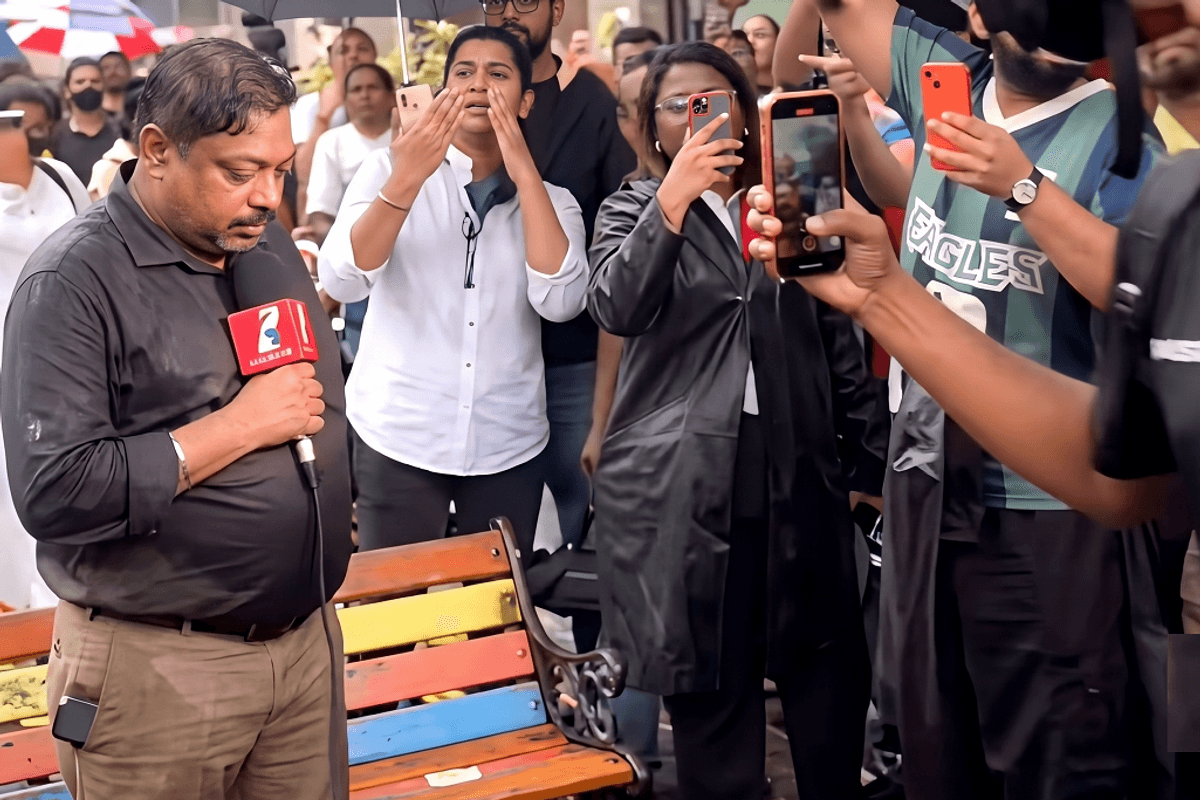
Reporters are being targeted as protesters view mainstream TV as pro-government
Screengrab enhanced with AI
When Indian television reporter Dev Kotak went to cover a massive youth protest against Prime Minister Narendra Modi's government this week, he planned to deliver a live broadcast, mill around and leave.
Instead, he was beaten by dozens of protesters chanting "godi (lapdog) media" because his channel is seen as pro-government.
Why are Indian reporters being attacked at youth protests?
Reporters are being targeted because many protesters view mainstream television channels as pro-government and biased against their cause. Mobile phone footage of the assault on Kotak went viral on social media. Crews from almost all of India's major channels have faced heckling and abuse during the protests, which gained momentum last week.
"The mob might have actually killed me. There was a seething anger among them because they felt the media hadn't reported their side of the story," said Kotak, 36, who covers general news for the Times Now channel. "There were slaps, kicks, punches and water bottles being thrown. I was very scared and feared for my life. I just wanted to get out alive."
Anger has boiled over especially since a police crackdown on tens of thousands of protesters marching on parliament on Monday injured many students. "People kept shouting that we hadn't shown their side of the story," Kotak said. "That's simply not true. I've reported injuries on both sides." Times Now's editor-in-chief, Navika Kumar, did not respond to multiple requests for comment.
How has India's press freedom changed under Modi?
The hostility toward reporters reflects a broader debate over declining media freedom in the world's most populous democracy since Modi took office in 2014. India's ranking in the Reporters Without Borders World Press Freedom Index has deteriorated sharply over the past decade, falling from 122nd in 2010 to 157th out of 180 countries in 2026.
The Paris-based watchdog attributes the decline to violence against journalists, media ownership concentrated among businesses aligned with the government, and growing political polarization. The Editors Guild of India condemned anger directed at outlets seen as close to the government and ruling party, but added that flawed and biased reporting worsens the situation and weakens media's role as a democratic pillar. The Information and Broadcasting Ministry and Modi's office did not immediately respond to requests for comment, and a spokesperson for Modi's Bharatiya Janata Party declined to comment.
Who coined the term 'godi media'?
Prominent journalist Ravish Kumar, a winner of the Ramon Magsaysay Award, is credited with coining the term "godi media," which spread widely partly because it rhymes with Modi. The term now covers almost all TV channels and some national newspapers, criticised for what detractors call fawning coverage of Modi and little scrutiny of dissent. "The godi-media is anti democracy, anti-people, anti-opposition," Kumar said. "They vilify any opposition, label critics as agents of foreign governments, and barely ever feature voices of political parties from opposition."
A spokesperson for the protest movement, led by the Cockroach Janta Party, said organizers had repeatedly urged demonstrators not to mistreat reporters. "We have urged and we keep urging protesters to not misbehave with godi-media," said Deepak Baliyan. "Let them do their job. We want to make sure that no one gets mistreated here."
Why do protesters distrust mainstream Indian media?
Manisha Pande, editorial director of news website Newslaundry, said the distrust stems from years of growing disillusionment with mainstream television news. "We have always had propaganda, partisanship, opinion-driven prime-time news," Pande said. "But what has really happened after 2014 is that you have seen a clear shift in how news has become anti-people."
Digital commentator Akash Banerjee said declining trust in traditional outlets has driven audiences toward independent online platforms. "The fact that the media has stopped questioning the government has resulted in a rise of alternative digital media, which would not have happened otherwise," said Banerjee, a former Times Now journalist whose YouTube channel now attracts millions of followers. He said the crowds chanting against television crews were expressing years of accumulated frustration.
Pande warned that the rising hostility carries its own dangers. "The worrying part is that the anger has now taken on a life of its own," she said. "For many protesters, a reporter is no longer seen as an individual but as the face of a thick-skinned media establishment that is responsible for their pain."


Comments
See what people are discussing