

Iran’s envoy to Pakistan explains how external forces escalated protests into violence
Amiri Moghadam says unrest killed 2,497 civilians, 3,117 security personnel and was fueled by foreign statements
Aamir Abbasi
Editor, Islamabad
Aamir; a journalist with 15 years of experience, working in Newspaper, TV and Digital Media. Worked in Field, covered Big Legal Constitutional and Political Events in Pakistan since 2009 with Pakistan’s Top Media Organizations. Graduate of Quaid I Azam University Islamabad.
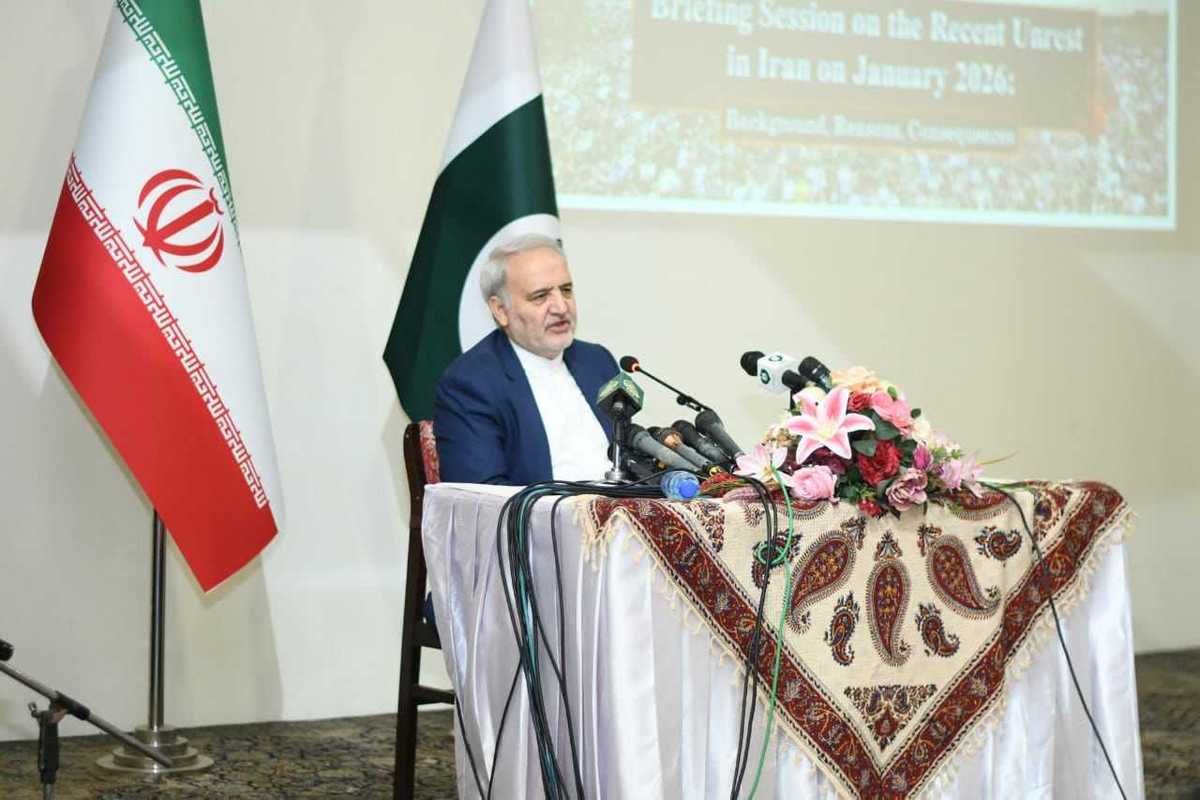
Iran’s Ambassador to Pakistan, Reza Amiri Moghadam, speaks to journalists in Islamabad on Thursday.
PID
Iran’s Ambassador to Pakistan, Reza Amiri Moghadam, on Thursday explained to journalists how peaceful domestic protests in Iran were manipulated by external forces, accusing the United States and Israel of inciting violence.
Speaking in Islamabad, he said Tehran seeks no war but will defend itself against any foreign aggression.
Briefing reporters on Iran’s internal situation, Amiri Moghadam said the protests began on December 28, triggered by fluctuations in foreign exchange rates and broader economic concerns. Demonstrators reportedly demanded market stability and relief measures, while carrying portraits of Supreme Leader Ayatollah Ali Khamenei and the Iranian national flag.
The ambassador said Iranian media covered the protests transparently, and central and provincial authorities engaged with demonstrators.
“For the first time, representatives of the protesters were invited to a cabinet meeting, where discussions were held on resolving their issues,” he said. Senior Iranian officials, including Khamenei, acknowledged the public’s right to protest and instructed authorities to address legitimate grievances.
According to Amiri Moghadam, the situation escalated after statements by Israeli and U.S. leaders. He cited a December 31 statement by the Israeli prime minister and remarks by the U.S. president on January 2 signaling possible intervention, which he said emboldened hostile elements.
He also referenced a tweet by former U.S. Secretary of State Mike Pompeo claiming links between protesters and Israel’s intelligence agency, Mossad.
“After these statements, peaceful protests were hijacked and turned violent,” he said, adding that public and government property, police stations, mosques, and security personnel were attacked using modern weapons. The ambassador stressed that these violent actions were carried out by organized hostile groups and bore no connection to the peaceful demonstrators. He said Western-backed media operating from abroad incited violence and encouraged the use of weapons.
Amiri Moghadam provided figures detailing the toll of unrest, saying 2,497 civilians were killed and more than 3,117 security personnel and police officers were “martyred.”
He added that 690 “terrorists” had been neutralized. He described widespread destruction, including 414 government buildings, 749 police stations, 120 Basij centers, 200 schools, 350 mosques, 24 gas stations, 305 ambulances and buses, 750 banks, 700 convenience stores, 300 private homes, 253 bus stations, 15 libraries, two Armenian churches, 600 ATMs, and 800 vehicles.
The ambassador reaffirmed Iran’s stance against U.S. “coercion and intimidation,” saying, “We do not want war, but we will defend ourselves.” He emphasized that Iran’s armed forces and intelligence agencies have defensive plans in place. He thanked Pakistan for its support and said consultations with Islamabad had taken place even before the recent unrest. He added there was no evidence of Indian or Afghan citizens being involved in anti-Iran activities with state backing.
Addressing threats against Iran’s Supreme Leader, Amiri Moghadam called alleged statements by U.S. President Donald Trump “shameful” and said attempting to threaten or assassinate any head of state violated international law. He said detainees, including those linked to foreign elements, would be dealt with under Iranian law.
He also expressed support for Pakistan–Saudi Arabia defense cooperation and broader collective Muslim security frameworks, noting that despite U.S. military presence in the region, Iran remains hopeful that war can be avoided. “We are trying to prevent war. Fifty percent of success lies with us and fifty percent with the other side,” he said.
PM Shehbaz holds talk with Iranian president
Meanwhile, Prime Minister Muhammad Shehbaz Sharif held a telephone conversation with Iran’s President, Dr. Masoud Pezeshkian, on Thursday.
The two leaders exchanged views on the evolving regional situation, with Sharif emphasizing the importance of sustained dialogue and diplomatic engagement to promote peace, security, and development.
Highlighting the historically close ties between Pakistan and Iran, the leaders reaffirmed their commitment to strengthen bilateral cooperation. They agreed to maintain high-level contacts and consultations through institutional mechanisms to deepen collaboration across areas of mutual interest.



Comments
See what people are discussing