

Iran FM Araghchi arrives in Islamabad as Pakistan pushes US talks
Visit seen as potential opening for renewed US-Iran dialogue amid regional tensions

News Desk
The News Desk provides timely and factual coverage of national and international events, with an emphasis on accuracy and clarity.
Aamir Abbasi
Editor, Islamabad
Aamir; a journalist with 15 years of experience, working in Newspaper, TV and Digital Media. Worked in Field, covered Big Legal Constitutional and Political Events in Pakistan since 2009 with Pakistan’s Top Media Organizations. Graduate of Quaid I Azam University Islamabad.
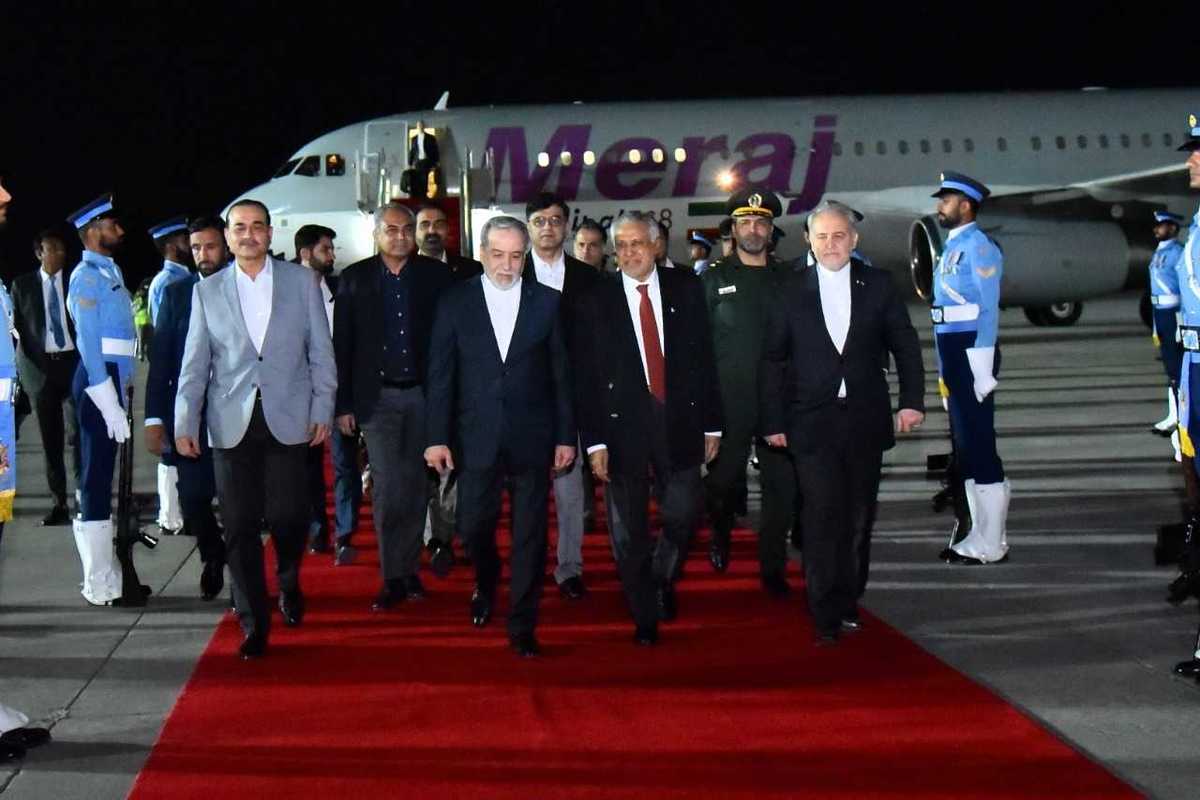
Iranian Foreign Minister Abbas Araghchi arrived in Islamabad late Friday.
Information Ministry
Iranian Foreign Minister Abbas Araghchi arrived in Islamabad late Friday amid intensified diplomatic activity, as Pakistan steps up efforts to facilitate dialogue between Tehran and Washington.
H.E. Seyed Abbas Araghchi, Honorable Foreign Minister of the Islamic Republic of Iran arrived in Islamabad in order to review bilateral matters and consulate on regional developments. pic.twitter.com/Pzkh9ZsPfA
— Embassy of IR Iran Pakistan (@IraninIslamabad) April 24, 2026
Foreign Office spokesperson Tahir Andrabi said in a statement: “The Iranian delegation headed by the Foreign Minister of Islamic Republic of Iran H.E. Abbas Araghchi has arrived in Islamabad today. The Iranian Foreign Minister was received by Deputy Prime Minister/Foreign Minister Senator Ishaq Dar, Chief of Army Staff and Chief of Defense Forces Field Marshal Asim Munir along with other senior officials upon arrival.”
“During the visit, the Iranian Foreign Minister will hold meetings with Pakistan’s senior leadership to discuss the latest regional developments as well as ongoing efforts for regional peace and stability,” Andrabi added.
The Iranian delegation headed by the Foreign Minister of Islamic Republic of Iran H.E. Abbas Araghchi has arrived in Islamabad today. ⁰ ⁰The Iranian Foreign Minister was received by Deputy Prime Minister/Foreign Minister Senator Mohammad Ishaq Dar, Chief of Army Staff and Chief…
— Tahir Andrabi (@TahirAndrabi) April 24, 2026
Official sources said the aircraft carrying Araghchi was given a special security escort by the Pakistan Air Force upon entering Pakistani airspace, ensuring a secure arrival in the federal capital.
The visit comes at a critical time, with Islamabad actively facilitating dialogue between Iran and the United States. Government officials say Pakistan is playing a key mediatory role aimed at reducing tensions and exploring pathways toward renewed negotiations between the two longtime adversaries.
Sources said Araghchi is accompanied by a small but high-level delegation and is expected to hold key meetings with Pakistani officials and members of the country’s mediation team. Talks are likely to focus on regional stability, security cooperation and prospects for a second round of indirect negotiations between Tehran and Washington.
U.S. President Donald Trump’s special envoy Steve Witkoff and adviser Jared Kushner are expected to travel to Pakistan on Saturday for talks with Araghchi, a U.S. official told Reuters.
Vice President JD Vance is not currently planning to attend but will remain on standby to travel if talks progress, according to CNN.
The White House confirmed the development, with spokesperson Karoline Leavitt saying Tehran requested the meeting after Trump urged direct engagement, signaling a possible diplomatic opening in U.S.-Iran relations.
Two Pakistani government sources told Reuters the visit could signal a resumption of talks, though this has not been confirmed and Washington’s response is still awaited.
Araghchi “will tell us what instructions he has when he arrives. All this is speculative,” one source said. The sources added that Araghchi would hold bilateral talks and present Iran’s position on a possible framework for negotiations, which would then be conveyed to Washington.
Iran’s state news agency IRNA said the purpose of the trip was to hold bilateral consultations and discuss regional developments, including what it described as the “imposed war by the United States and the Israeli regime against Iran.”
The last round of talks expected earlier this week did not take place. Iran said it was not ready to commit, and a U.S. delegation led by Vance did not depart Washington.
Earlier, Dar spoke by phone with Araghchi to discuss regional developments, the ceasefire and ongoing diplomatic efforts. According to Pakistan’s Foreign Office, Dar “underscored the importance of sustained dialogue and engagement to address outstanding issues to advance regional peace and stability at the earliest,” while Araghchi appreciated Pakistan’s “consistent and constructive facilitation role.”
A day earlier, Trump said he would not use nuclear weapons in the conflict. “Why would I use a nuclear weapon? We've totally, in a very conventional way, decimated them without it,” he told reporters at the White House.
“No, I wouldn't use it. A nuclear weapon should never be allowed to be used by anybody,” he said. “There's nothing worse than a nuclear weapon that takes out cities, destroys the Middle East, or creates a nuclear holocaust in Europe.”
Asked how long he was willing to wait for a deal, Trump said, “Don't rush me.”
“I want to make the best deal. I could make a deal right now ... but I don't want to do that. I want to have it everlasting,” he added.
Security has been tightened in Islamabad in recent days, particularly in the Red Zone, where key government buildings and diplomatic missions are located. Authorities have imposed restrictions and work-from-home directives for public offices, underscoring the sensitivity of the ongoing diplomatic efforts.
Pakistan has historically maintained balanced relations with both Iran and the United States and has repeatedly called for resolving conflicts through dialogue.
While no official outcome has been announced, diplomats see Araghchi’s visit as a potentially important step toward de-escalation in a region marked by longstanding tensions.



Comments
See what people are discussing