


News Desk
The News Desk provides timely and factual coverage of national and international events, with an emphasis on accuracy and clarity.
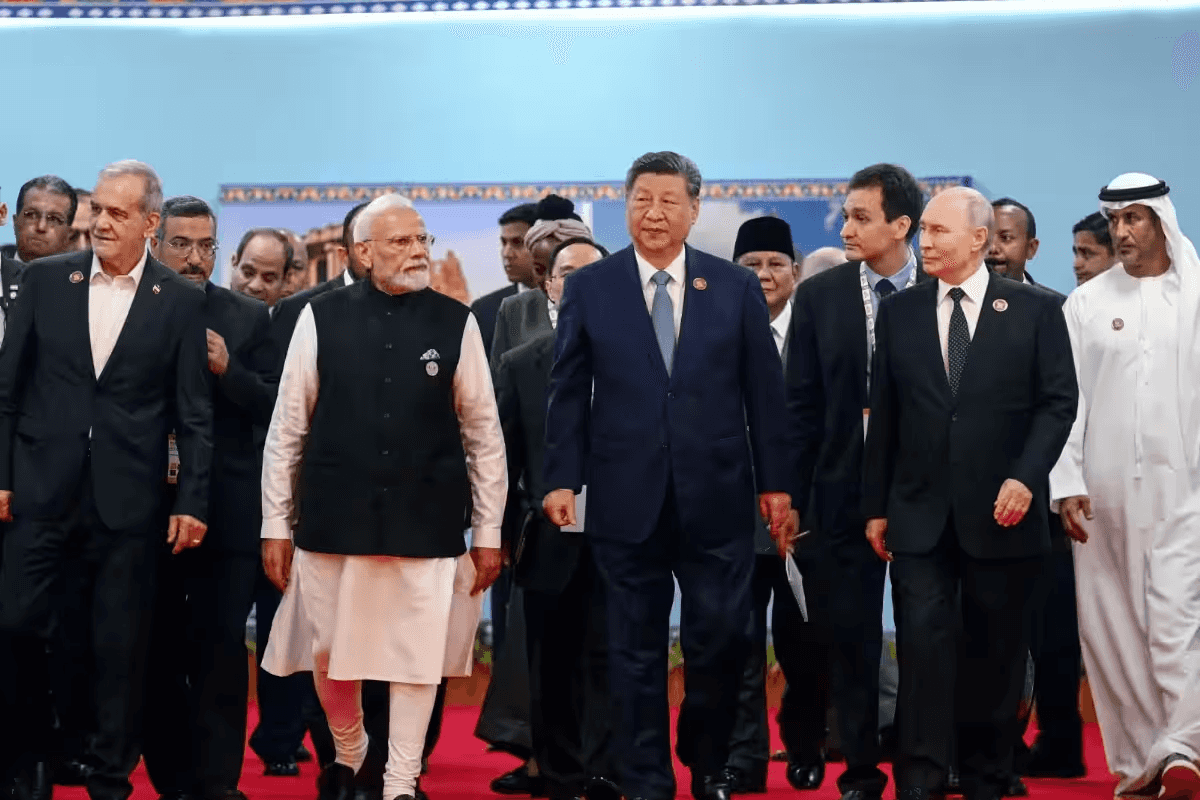
The declaration expressed deep concern over the continued escalation of tensions in the Middle East and West Asia.
Reuters
Iran and the United Arab Emirates signed up to a joint statement from the BRICS group of nations calling for restraint in the Middle East war on Saturday.
The move was seen as a sign of diplomatic progress between the two countries, which have been divided by the conflict. It came as leaders gathered in New Delhi for the bloc's annual summit.
What did the BRICS declaration say about the Middle East war?
The declaration expressed deep concern over the continued escalation of tensions in the Middle East and West Asia. It called for maximum restraint and urged all parties to avoid actions that could further aggravate the situation.
The statement also called for the protection of civilians, respect for the sovereignty and territorial integrity of states, and safeguards for global trade, supply chains, energy flows and maritime security.
Why did Iran and UAE leaders meet at the BRICS summit?
Iranian President Masoud Pezeshkian met the Crown Prince of Abu Dhabi, Sheikh Khaled bin Mohamed bin Zayed Al Nahyan, on the sidelines of the summit's first day. It was the countries' highest-level meeting since the war began. The two leaders discussed regional and international issues, de-escalation, stability and efforts to advance regional peace and development, the Abu Dhabi media office said on X, without detailing any resolution.
The Iranian embassy in India posted a photo of the meeting but did not disclose what was discussed. Iran has launched repeated attacks on the UAE during the six-month-old conflict, most recently in late August when it targeted the Al Minhad Air Base, which housed US forces and helicopters. Summit organizers and diplomats have been focused on bridging the Iran-UAE divide, even as the United States and Iran resume tit-for-tat strikes.
Foreign policy experts said the key test for the bloc was finding language on the Middle East crisis acceptable to both Abu Dhabi and Tehran. Such a statement was unlikely to shift the geopolitical landscape on its own, they said, but it would demonstrate unity among a grouping of emerging nations.
What is the BRICS bloc and who are its members?
The BRICS summit is a test of the diplomatic clout of a bloc set up in 2009 to challenge a world order dominated by the United States and its Western allies. It originally comprised Brazil, Russia, India, China and South Africa. The group later expanded to include Egypt, Ethiopia and Indonesia, as well as Iran and the UAE.
The bloc is seeking to raise its profile by influencing international rules and demanding reform of institutions such as the World Bank, International Monetary Fund and World Trade Organization. Some members view these institutions as being dominated by Western powers. Leaders attending the summit included Russia's Vladimir Putin, China's Xi Jinping and South Africa's Cyril Ramaphosa.
What have leaders said about ending the Middle East war?
"The key to ending the war lies with the US and Israel," Sunjay Sudhir, a former Indian ambassador to the UAE, told Reuters. "What India has done is keep the difficult conversations going, by showing that countries of the region can sit at the same table, engage diplomatically, and build on where their interests converge."
Host India's Prime Minister Narendra Modi said the bloc had come of age and that it was time to translate its unity and consensus into concrete results on the global stage. Chinese President Xi Jinping said BRICS countries should firmly stand on the right side of history by steering the international order toward greater equity and justice. He added that China was ready to play its "due role" in achieving peace and stability in the Middle East.
"Relevant parties must remain committed to a political settlement and work towards achieving a permanent and comprehensive ceasefire," Xi said, according to state broadcaster CCTV. New Delhi has strong ties with the United States, Russia, Israel, Iran and the Gulf Arab states, placing it in a delicate diplomatic position. Modi used the summit to press BRICS members to boost trade cooperation, reduce barriers and expand business opportunities.




Comments
See what people are discussing