

Iran war exposes growing US-Israel tensions as regional risks mount
Kamran Khan examines how the seven-month conflict has weakened Iran, strained US ties and divided Arab states

News Desk
The News Desk provides timely and factual coverage of national and international events, with an emphasis on accuracy and clarity.
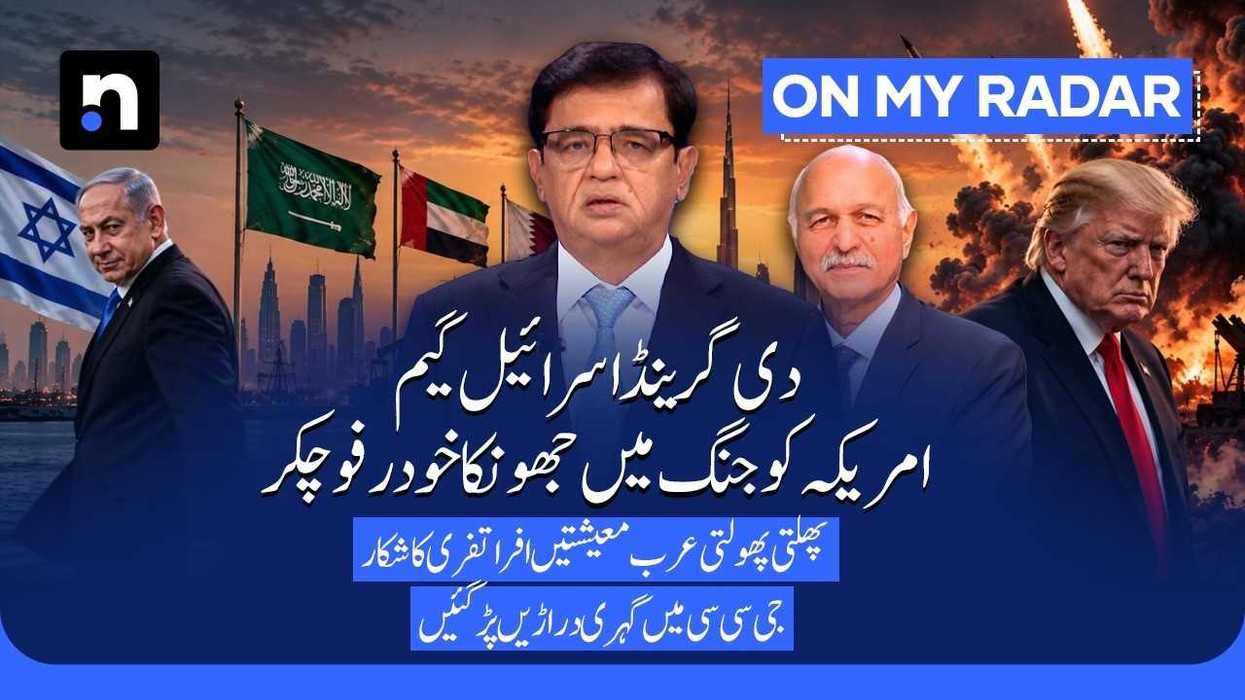
The seven-month U.S.-Israeli war with Iran has produced consequences far different from the quick victory initially anticipated, with Iran's government still in power, the United States facing the costs of a prolonged conflict and Arab states confronting heightened security and economic risks, according to Kamran Khan's latest episode of "On My Radar."
Khan said that if the predictions and claims made by the United States and Israel at the start of the conflict had proved correct, the war that began Feb. 28 would have ended within a week, Iran's government would have been overthrown and a U.S.- and Israel-friendly government would have taken power in Tehran.
"But that did not happen," Khan said.
He argued that President Donald Trump's pursuit of a military victory had instead become a prolonged challenge, while Iran's Islamic government remained in place. Iran has suffered severe economic damage, he said, while the economies of Gulf Cooperation Council states have also faced the effects of months of war.
The central question, Khan said, is who ultimately benefited from the conflict.
Iran has been severely weakened, the United States has been drawn into a costly war and Gulf Arab states have faced security and economic pressures. Khan cited military and strategic analysts from the United States, Europe and Asia who argue that Israel has emerged as the conflict's "ultimate beneficiary."
The New York Times reported in April that Netanyahu's alignment with Trump and discussions inside the White House played a major role in the decision to launch the U.S. military campaign against Iran. The report described a series of Situation Room meetings in the weeks before the operation and said Netanyahu's presentation to Trump influenced the president's decision to join Israel's campaign.
Khan said Netanyahu had spent years seeking U.S. support for military action against Iran. He cited former U.S. secretaries of state Hillary Clinton, Antony Blinken and John Kerry as having discussed Netanyahu's efforts to persuade successive administrations to take military action.
According to Khan, former presidents George W. Bush, Barack Obama and Joe Biden had resisted or delayed such action, while Trump became the president who ultimately joined Israel in attacking Iran.
The conflict has also produced dissent inside the United States. Khan highlighted the resignation of Joe Kent, a senior counterterrorism official, who argued that U.S. policy had been influenced by pressure from Israel and its supporters and that Washington had been drawn into another Middle Eastern war.
At the beginning of the conflict, Israel, with U.S. assistance, inflicted major damage on Iran's military capabilities, according to Khan. He said senior figures in Iran's military intelligence and Islamic Revolutionary Guard Corps leadership were killed.
But he argued that as the war continued, much of the military, financial and political burden shifted toward Washington.
Khan cited figures of $44 billion in U.S. war spending and a further $67 billion requested from Congress. He also said the conflict had imposed costs on ordinary Americans through higher prices and fuel costs.
Public opinion data does show significant opposition to the U.S. military campaign. A Pew Research Center survey conducted March 16-22 found that 61% of U.S. adults disapproved of Trump's handling of the military action against Iran, while 59% said the decision to use military force was wrong.
By May, Pew found that 62% disapproved of Trump's handling of the conflict and 59% said the decision to use military force was wrong.
The conflict also coincided with increasingly negative views of Israel among Americans. A Pew survey conducted March 23-29 found that 60% of U.S. adults had an unfavorable view of Israel, compared with 53% in 2025. Only 37% viewed Israel favorably, while 59% expressed little or no confidence in Netanyahu's handling of world affairs.
Khan said a second major objective attributed to Israel's strategy was to place Iran and the Arab states in direct confrontation.
Israel, he argued, knew that Iran could respond to attacks by targeting U.S. military bases in the Gulf and other regional countries. Those bases are located in countries including Qatar, Bahrain, Kuwait, the United Arab Emirates, Jordan and Oman.
As a result, the conflict spread beyond Iran and Israel to threaten Arab airspace, cities and military installations.
The United Arab Emirates became a prominent example. Khan said Emirati officials reported that Iran had launched more missiles and drones against the UAE than against Israel. At one point, he said, the possibility of a direct Iran-UAE war became serious.
The UAE leadership nevertheless exercised restraint and avoided entering a full-scale war with Iran, Khan said.
Had the UAE entered the conflict, he argued, Saudi Arabia, Bahrain and Kuwait could have faced greater pressure to intervene. The confrontation could then have expanded from a U.S.-Iran war into an Arab-Iranian conflict, or potentially a broader Sunni-Shia regional war.
Such an escalation, Khan said, could have weakened both Arab and Iranian power, further divided the Muslim world and pushed the Palestinian issue into the background while strengthening Israel's position as the region's major organized military power.
That part of what Khan described as Israel's strategic objective, however, did not fully materialize because Arab governments did not enter a direct, full-scale war with Iran.
Instead, the Gulf states pursued different approaches. Qatar and Oman moved toward diplomacy and mediation, while the UAE focused on protecting trade and economic security. Bahrain and Kuwait faced risks because of their hosting of U.S. military facilities, while Saudi Arabia faced renewed pressure from Yemen and the Houthis.
Khan said the war had exposed differences within the GCC, which increasingly appeared to be pursuing separate national interests rather than operating as a unified military bloc.
The Houthi issue added another layer of pressure. Khan said Saudi Arabia faced missile and drone attacks, while oil infrastructure, Red Sea shipping and the kingdom's security image came under threat.
This created what Khan described as a paradox: the United States was committing substantial military resources against Iran while its Arab allies felt increasingly vulnerable.
Khan also pointed to growing debate inside the United States over the country's relationship with Israel.
Among the most prominent voices was Vice President JD Vance, who in June warned Israeli leaders against attacking the United States over Washington's approach to the conflict. Vance said that two-thirds of the defensive weapons protecting Israel over the previous three months had been built by Americans and paid for by U.S. taxpayers.
Khan said similar criticism had emerged among sections of the American media and political right, including commentators Tucker Carlson and Megyn Kelly, as well as progressive commentator Ana Kasparian.
He described the growing criticism as a backlash against the perception that Washington was bearing the military and financial costs of a conflict that produced major strategic benefits for Israel.
The political debate has also exposed differences between Trump and Netanyahu. Netanyahu met Trump eight times during his second term, according to reporting in July, although their positions on the war increasingly diverged as Washington pursued negotiations with Tehran.
Seven months into the conflict, Khan said Iran remained wounded but its government had survived, while the United States faced the political and financial consequences of a prolonged confrontation.
The Gulf states, he said, were divided, Saudi Arabia was under renewed Houthi pressure, and questions remained over the reliability of U.S. security guarantees.
The result, according to Khan, is a strategic paradox: the war may have strengthened Israel's position against Iran while simultaneously increasing skepticism about Israel's influence inside the United States.
The ultimate question, he said, is whether Israel merely achieved a successful military strike against its principal regional rival or whether the conflict has fundamentally changed the strategic balance by drawing Iran, the Arab states and the United States into a regional contest shaped by Israel's interests.
Khan cited senior analyst on defense and foreign affairs Mushahid Hussain Syed in discussing the broader strategic implications of the conflict.





Comments
See what people are discussing