

Israeli settlers divert Palestinian water to fill West Bank pool
Israeli settlers diverted Palestinian irrigation water to fill a West Bank pool, part of a wider pattern of water seizures across the territory

News Desk
The News Desk provides timely and factual coverage of national and international events, with an emphasis on accuracy and clarity.
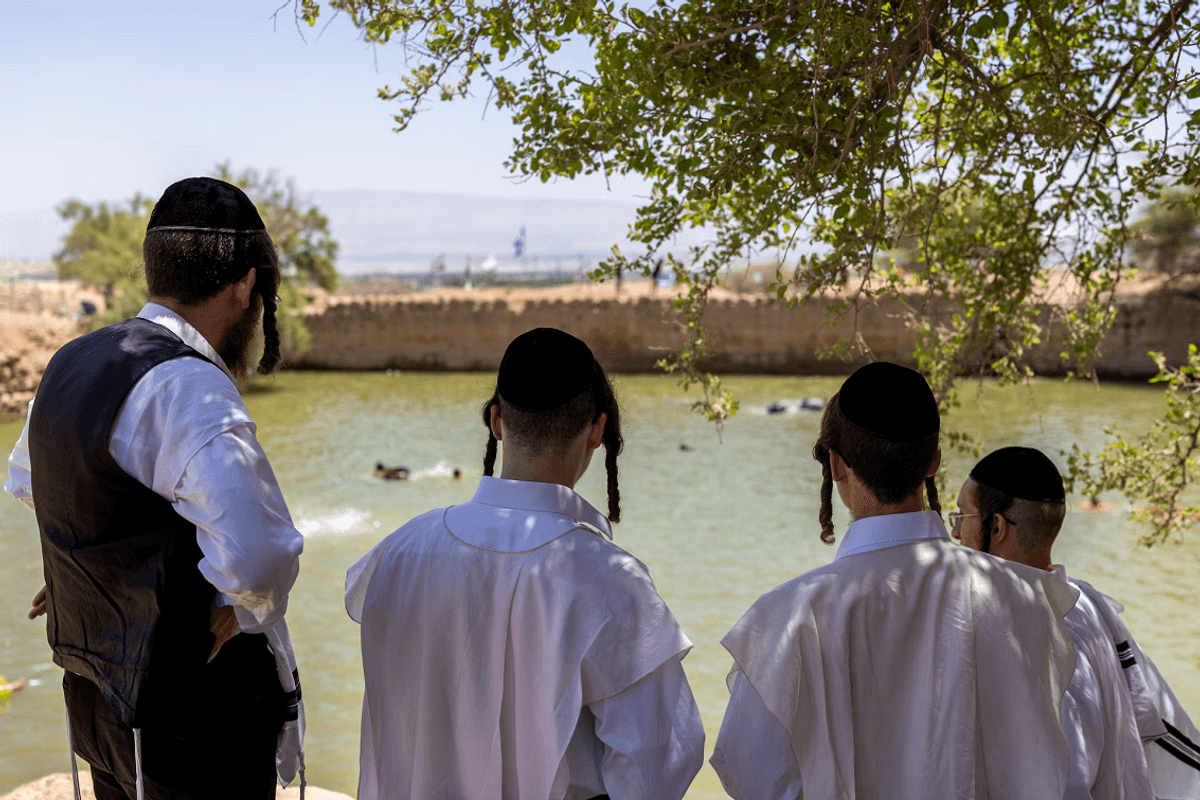
Ultra-Orthodox Jewish people look down at an ancient water reservoir in the Jordan Valley in the Israeli-occupied West Bank, August 5, 2026.
Reuters
Israeli settlers splashed in a West Bank pool created by siphoning off water that had irrigated Palestinian crops in the village of Fasayil, one of many seizures of water resources across the occupied territory.
The spring had served the Jordan Valley village for generations, supplying food, work and drinking water to supplement irregular Israeli supplies.
How did Israeli settlers divert Palestinian water in the West Bank?
Settlers seized farmer Saad Nemer's irrigation pipeline in June and channelled the water into an ancient pool at a nearby archaeological site. They soon advertised the pool as an Israeli tourist attraction, and Israel's far right finance minister pledged financial support for its development. Nemer said settlers are now building a recreational park around the site.
"Our water supply remains cut off to this day, depriving us of the water we depend on for our homes, our livelihoods, and our agricultural land," Nemer said. His greenhouses and fields, normally full of eggplant, zucchini and watermelons, have gone unplanted in the scorched, waterless land. He said the cutoff has cost families their livelihoods and their work.
Are settlers stopping Palestinians from reaching the spring?
Nemer said an employee was beaten by settlers and that he himself faced threats when trying to approach the spring as far back as two years ago. Israeli settler Yishai Shreiber, 21, who was swimming at the pool in August, said Palestinians would not now dare approach because of the crowds of Israeli visitors. Shreiber said the West Bank belonged to the Jewish people and that Palestinians who reject Jewish authority should leave.
Nemer showed Reuters a 2025 land ownership document from COGAT, the Israeli military agency that enforces civilian policy in the occupied territories. He also presented a map from the 1957 pre-occupation registration of his title deeds, showing his land included both the spring and the pool. COGAT and Finance Minister Bezalel Smotrich did not respond to requests for comment.
How widespread are settler water seizures in the West Bank?
The seizure at Fasayil fits a pattern Palestinians say is designed to make life in the West Bank untenable. Israeli settlers have attacked at least 160 water and sanitation sites across the territory this year, according to United Nations data. Field researcher Fares Foqahaa estimated settlers have seized control of 95 percent of springs in the northern Jordan Valley, displacing communities.
Israel's far right coalition government has overseen large scale settlement construction that Smotrich has said is aimed at burying the idea of a Palestinian state, a state recognised by more than 150 of 193 UN member states as encompassing Gaza and the West Bank, including East Jerusalem. The UN and most governments consider the settlements illegal under international law governing military occupation. Israel seized the West Bank in the 1967 war but argues the territory is disputed rather than occupied.
In the West Bank village of Qusra, settlers besieging three homes on Thursday also cut off water and electricity, according to Reuters reporting. Adel Yassin, an official with the Palestinian Authority's water authority, described a systematic campaign. "I see this as a water war. It is the silent bullet that kills Palestinians without a sound," he said.
Is the West Bank pool an archaeological site?
Settler leader Eliav Libi, who has been sanctioned by Canada and other countries, posted a video in early June showing the pool beginning to fill with water. He and other settlers say the pool belonged to the biblical era Jewish king Herod. Alon Arad, an archaeologist with the Israeli rights group Emek Shaveh, said the pool's provenance is unclear and said settlers were damaging the site by filling it with water.
"We see in many cases the use of archaeology ... to create this feeling that the West Bank is exclusively Jewish," Arad said. A billboard outside the pool advertised a 3 million shekel, or $1 million, investment from Smotrich, who said on Telegram the money was for restoring and developing what he called "Herod's Pools." The pool and spring were packed with Israeli families swimming and wading. No Palestinians were present.
Are other Palestinian springs also affected?
One of the few natural springs still accessible to Palestinians sits near Nablus at Wadi al Badhan, where in July families picnicked at plastic tables in shallow streams. The springs, close to Nablus' urban centre, had rarely faced settler incursions before this year. Hundreds of settlers descended on the springs earlier this summer, sitting at the tables and walking through the pools, five Palestinians said.
Nizam Fares, owner of a natural spring park in al Badhan, said people can no longer enjoy visiting the area. "People have become scared and jumpy. They come and ask if the settlers are coming or not?" he said.



Comments
See what people are discussing