

Keisha Lance becomes first black woman to lead a US state
Former Atlanta mayor makes American political history, defeating Republican healthcare billionaire Rick Jackson to become the first Black woman ever elected governor of a U.S. state and the first woman to lead Georgia

News Desk
The News Desk provides timely and factual coverage of national and international events, with an emphasis on accuracy and clarity.
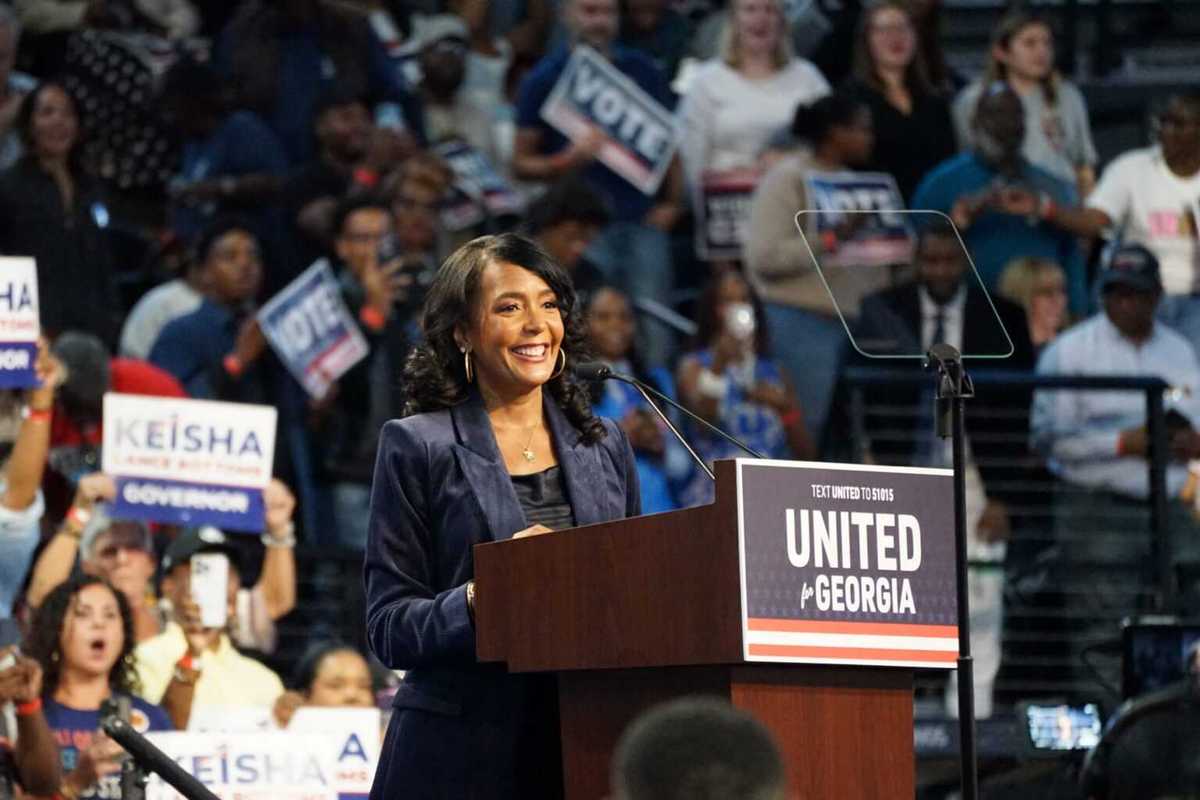
Keisha Lance Bottoms, former mayor of Atlanta, speaks at a rally in South Atlanta with former President Barack Obama and Sen. Jon Ossoff on Oct. 28, 2026. Alander Rocha/
Picture Courtesy: Georgia Recorder
Former Atlanta mayor Keisha Lance Bottoms made American political history on Tuesday, after winning the Georgia gubernatorial race, shattering a centuries-old barrier to become the first Black woman ever elected to lead a U.S. state.
How did Bottoms secure her historic victory over Rick Jackson?
According to The Associated Press (AP), Bottoms defeated Republican healthcare billionaire Rick Jackson in an upset victory, securing approximately 54.2 percent of the vote with more than 86 percent of precincts reporting.
Jackson had initially entered the general election favored to hold the seat for Republicans, but Bottoms shifted momentum down the stretch following high-profile campaign appearances alongside former President Barack Obama and incumbent Democratic Senator Jon Ossoff.
According to The Guardian, Bottoms anchored her gubernatorial bid on kitchen-table economic affordability, pledging to expand Medicaid under the Affordable Care Act and roll back state-level restrictions on reproductive healthcare access.
Her victory also marks the first time in Georgia's 238-year history that a woman has been elected to the governor's mansion.
Why does her election break ultimate executive barrier in American politics?
Bottoms’ triumph marks a long-delayed breakthrough in American executive leadership, piercing a glass ceiling that has stymied women—and women of color in particular—from reaching the pinnacle of state and national executive office.
While women have achieved record representation across legislative chambers and cabinet posts in recent decades, executive leadership has remained notoriously elusive.
In 2016, former Secretary of State Hillary Clinton made history as the first woman nominated for president by a major political party, winning the national popular vote but falling short in the Electoral College.
Four years later, Kamala Harris became the first female, Black, and South Asian Vice President of the United States. Yet despite those milestones, no woman has served as President of the United States, and Black women had never previously led an American state executive.
As noted by The 19th News, while Black women have consistently formed the most loyal voting bloc within the Democratic coalition—delivering critical margins in southern battlegrounds like Georgia—they had never secured a governorship in the nation’s 250-year history.
That barrier had remained intact even after high-profile, trailblazing gubernatorial campaigns by figures like Stacey Abrams in Georgia in 2018 and 2022.
Bottoms’ victory establishes a transformative precedent in American politics, cementing her position as a central national figure in the Democratic Party while reshaping the landscape of executive governance across the American South.





Comments
See what people are discussing