

Khamenei's body arrives in Qom for second day of funeral rites
Millions of Iranians joined officials as Khamenei's body arrived in Qom for funeral rites, part of a six-day mourning period before burial in Mashhad

News Desk
The News Desk provides timely and factual coverage of national and international events, with an emphasis on accuracy and clarity.
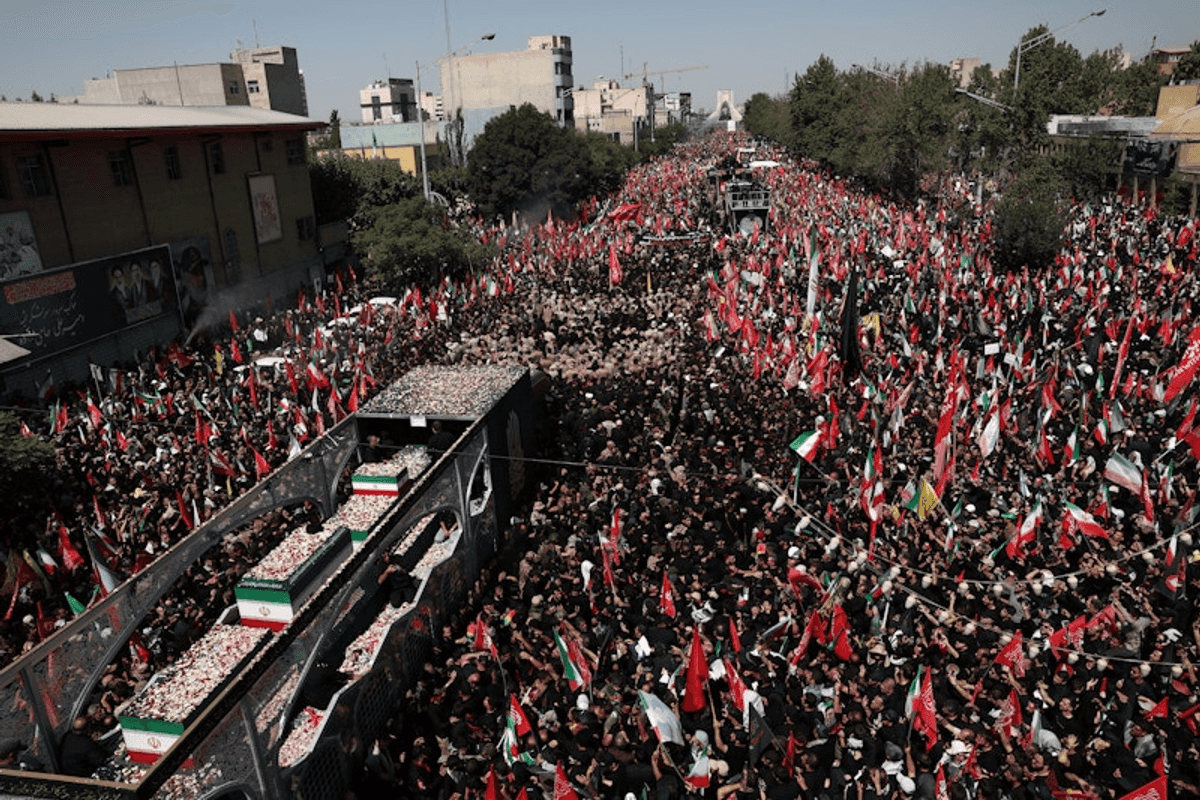
The body of Iran's late supreme leader Ali Khamenei arrived in the holy city of Qom on Monday evening, hours after mass mourning filled Tehran's streets. State television showed a helicopter carrying his remains landing in the city.
Further ceremonies are scheduled in Qom, Najaf and Karbala this week.
Where did Khamenei's body travel after Tehran?
Khamenei's body traveled from Tehran to Qom on Monday evening, alongside the remains of four family members killed in a February 28 US-Israeli strike. A helicopter carried the coffins into the city, where a truck then moved them toward Azadi Square. Officials and residents gathered there for the ceremony.
State television said "the body of the martyred leader has arrived in Qom," south of the capital, sharing footage of the arrival. Millions had turned out earlier in Tehran for an event state media compared to Ayatollah Ruhollah Khomeini's 1989 funeral.
What happened during the funeral procession in Tehran?
Earlier Monday, huge crowds stretched along major boulevards in Tehran, according to AFP images. State television reported millions attended, comparing it to Khomeini's massive 1989 funeral. Mourners dressed in black threw flower petals onto the coffins, including the small casket of Khamenei's 14-month-old granddaughter.
People carried blood-red flags, a symbol of vengeance in Shia Islam, alongside slogans such as "Kill Trump" and images of Mojtaba Khamenei. A 63-year-old mourner who gave his surname as Kazemi vowed to avenge the martyrs' blood. University student Melika Nourian, 22, said she came to show the world Iranians' commitment to the Islamic republic.
Trucks sprayed water on mourners as temperatures neared 40 degrees Celsius along the roughly 20-kilometer route. President Masoud Pezeshkian, who attended the procession, wrote on social media platform X that Khamenei's leadership taught Iranians the value of unity. Another truck displayed images of top Iranian and pro-Tehran officials killed in recent years, including Quds Force commander Qassem Soleimani.
Why is Mojtaba Khamenei's absence raising questions?
Khamenei's son and successor Mojtaba Khamenei has not appeared publicly since his appointment a week after his father's death. Iranian officials say he was wounded in an airstrike, and it remains unclear if he will attend the remaining ceremonies. His continued absence has fueled speculation over his whereabouts and condition.
Mojtaba Khamenei has still taken some official actions, reappointing Gholamhossein Mohseni Ejei as judiciary chief through his social media accounts. Ejei was also seen attending the Tehran procession in person. His public actions offer only limited insight into his physical condition.
What have Iranian officials said about the funeral?
Mohammad Bagher Zolghadr, head of Iran's supreme national security council, made his first public appearance at the procession since replacing Ali Larijani, who was killed in a March airstrike. He said the crowds of millions carrying red flags sent a clear message to Iran's enemies, according to Iranian media.
Foreign Minister Abbas Araghchi and current Quds Force chief Esmail Qaani also attended, according to state media. Former president Mahmoud Ahmadinejad appeared as well, marking his first public appearance since the war began. Ahmadinejad had fallen out with Khamenei during the later years of his presidency.
When and where will Khamenei be buried?
Khamenei will be buried in his hometown of Mashhad in northeastern Iran on Thursday, concluding the six-day funeral sequence. Officials will watch closely for signs that Mojtaba Khamenei attends the burial. The government hopes to showcase mass public support following the recent war and January's protest crackdown.
Authorities are also working to avoid a repeat of the 1989 chaos during Khomeini's funeral, which drew an estimated 10 million mourners. Crowd surges that year killed more than 10 people and injured over 10,000, according to state media. Emergency services chief Jafar Miadfar said no fatalities have been recorded so far this week.


Comments
See what people are discussing