

Millat Tractors begins electric bike production ahead of launch
The XDAO venture plans capacity for 250,000 two-wheelers annually as the tractor maker seeks new growth amid weak agricultural demand and falling exports

Business Desk
The Business Desk tracks economic trends, market movements, and business developments, offering analysis of both local and global financial news.
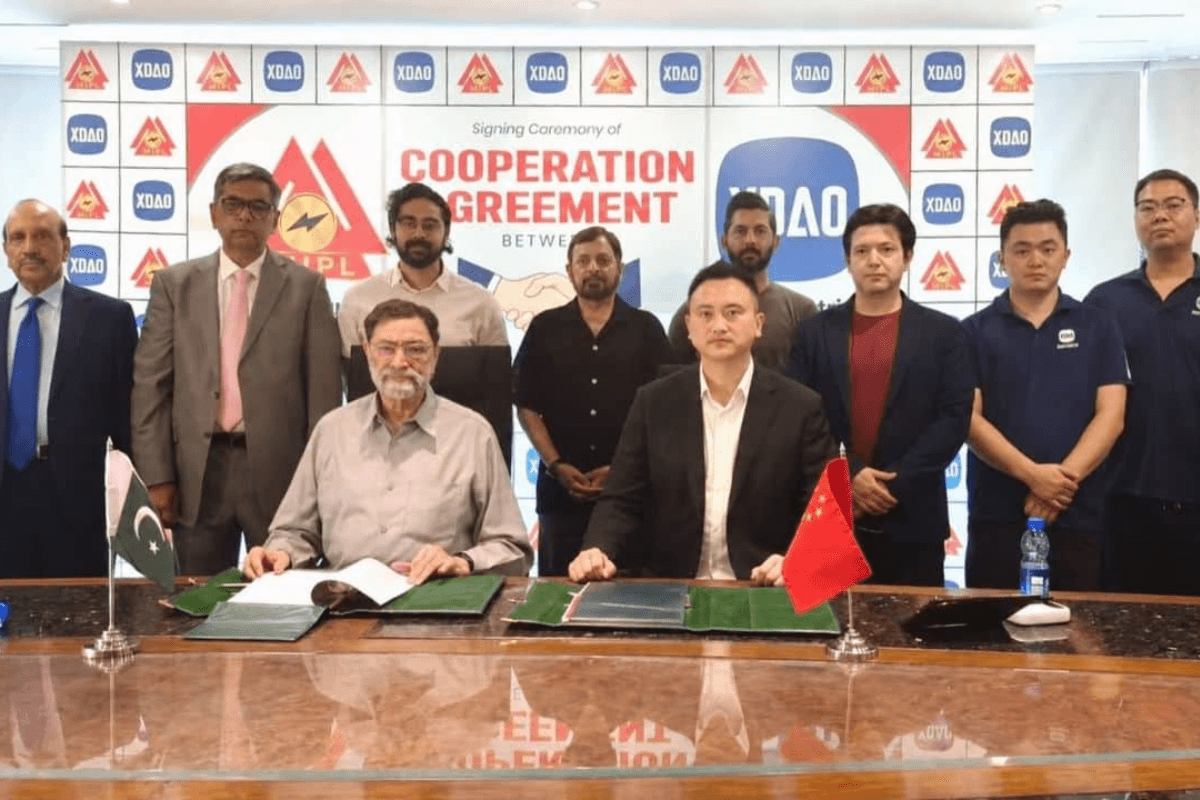
Representatives of Millat Industrial Products and China's XDAO at a cooperation agreement signing ceremony.
XDAO
Millat Tractors is producing electric motorcycles and scooters through its subsidiary Millat Industrial Products ahead of a November 29 launch, according to brokerage reports following its November 24 management briefing. The venture with China's XDAO expands the tractor maker's business as demand for agricultural machinery remains weak.
What are Millat Tractors' plans for electric motorcycles?
Millat Industrial Products, a 64.09%-owned subsidiary of Millat Tractors, is using an existing facility for the electric two-wheeler venture. Management plans annual production capacity of about 250,000 units and an initial range of five to six lithium-ion models. Dealer appointments and initial sales have already begun, according to the brokerage reports.
The project is being developed in collaboration with Chinese electric two-wheeler manufacturer Xiao Dao (XDAO), which signed a cooperation agreement with Millat Industrial Products in October 2026.
The agreement covers technology transfer, localization of components and development of lithium iron phosphate battery technology.
Management sees significant growth potential in Pakistan's electric two-wheeler market, where industry volumes have doubled over the past two years to approximately 100,000 units in FY26, according to reports by Intermarket Securities and JS Global.
The venture uses an existing brownfield manufacturing facility, allowing Millat to expand into electric mobility while retaining its established agricultural machinery operations.
However, the company has ruled out plans to manufacture electric tractors.
How is Millat Tractors performing amid weak agricultural demand?
Pakistan's tractor industry contracted 2% to 28,667 units in FY26, its lowest level in 23 years, according to the brokerage reports.
The decline reflected weaker farm incomes following the abolition of minimum support prices for crops, persistent inflation and delays in government-backed agricultural schemes.
Despite the industry downturn, Millat increased tractor sales by 1.6% to 18,883 units, while production rose 2% to 19,009 units.
Its market share increased to approximately 66%, supported by its position in the high-horsepower tractor segment.
Management expects to maintain a market share of around 65% despite increasing competition, particularly in higher-horsepower tractors.
The company's 90-horsepower model is performing well, while a 100-horsepower tractor is expected to be introduced by the end of FY27.
Millat expects agricultural demand to recover gradually over the next two to three years, with government-backed tractor schemes expected to support near-term sales.
Under the previous Green Tractor Scheme, approximately 15,000 of the 19,500 allocated tractors were delivered. Deliveries reached around 95% of allocations in the high-horsepower category, compared with approximately half in the low-horsepower category.
Under the current scheme covering 10,000 low-horsepower tractors, Millat has delivered more than half of its allocation, with the remainder expected by the end of 2026 or early 2027.
Balloting for the high-horsepower category is still awaited, with most deliveries expected during the second half of FY27.
The company reported no scheme-related sales in the first quarter of FY27, although management said underlying demand remained present even without government support.
How is Millat expanding its agricultural machinery business?
Millat is broadening its agricultural machinery portfolio through partnerships with equipment manufacturers and distributors.
The company signed a distribution agreement with China's Weichai Lovol Intelligent Agricultural Technology in September and has introduced three Lovol combine harvester models priced between PKR 9.5 million and PKR 20 million, depending on capacity.
Management said sales would largely depend on government-backed agricultural mechanization programs, including potential financing through the Bank of Punjab.
The company has also reported a distribution agreement with MS Agile Oil covering balers and combine harvesters, according to the brokerage reports.
What is Millat Tractors' export outlook?
Millat's tractor exports declined to 1,384 units in FY26 from 2,607 a year earlier, primarily because the closure of the Afghan border disrupted shipments to its historically largest export market.
Exports to Afghanistan fell to approximately 350 units, representing about 25% of FY26 export volumes, compared with nearly 80% in the preceding year.
Export revenue declined approximately 11% to PKR 4.8 billion.
The company is seeking to expand shipments to Mexico and African markets, targeting around 2,000 units in FY27, compared with approximately 1,000 units excluding Afghanistan in FY26, according to JS Global.
Management said competition in African markets could slow the company's efforts to establish a presence there.
What is the outlook for Millat's margins and tax refunds?
Millat's gross profit margin improved to approximately 32% in FY26 from 27% in FY25, supported by cost controls and a favorable shift toward higher-horsepower tractors.
Higher-horsepower models account for approximately 45% of the company's product mix, according to the brokerage reports.
However, management said its relatively rigid cost structure could pressure margins if sales volumes weaken.
The company's effective tax rate stood at approximately 46% in FY26 because of super tax, although management expects it to normalize to around 38%–39%.
Regarding the government's proposed new auto policy, management expects limited direct impact because more than 90% of Millat's tractor components are locally sourced.
However, the expiry of the relevant statutory regulatory order (SRO) at the end of FY27 could increase the cost of imported inputs.
Management expects the government to introduce a mechanism addressing the issue and anticipates an increase in the existing 10% completely built-up (CBU) duty on tractors exceeding 85 horsepower.
Separately, Millat's sales-tax refunds and receivables stood at PKR 7.971 billion as of September 30, 2026, compared with PKR 7.411 billion at the end of June, according to its financial statements.
Management told analysts that approximately PKR 3.8 billion in sales-tax claims had received a favorable ruling from the Alternative Dispute Resolution Committee, while another case involving approximately PKR 1.5 billion remained pending before the Supreme Court.
The company expects to recover most of its outstanding claims, while ongoing refunds are being adjusted against sales-tax liabilities, according to the brokerage reports.





Comments
See what people are discussing