

Ministers warn Fazl against criticizing state, accuse him of exploiting religion
Naqvi says he has lost respect for Fazlur Rehman, while Khawaja Asif denies a defense pact was discussed in Tehran and accuses the JUI-F of using religion.

News Desk
The News Desk provides timely and factual coverage of national and international events, with an emphasis on accuracy and clarity.
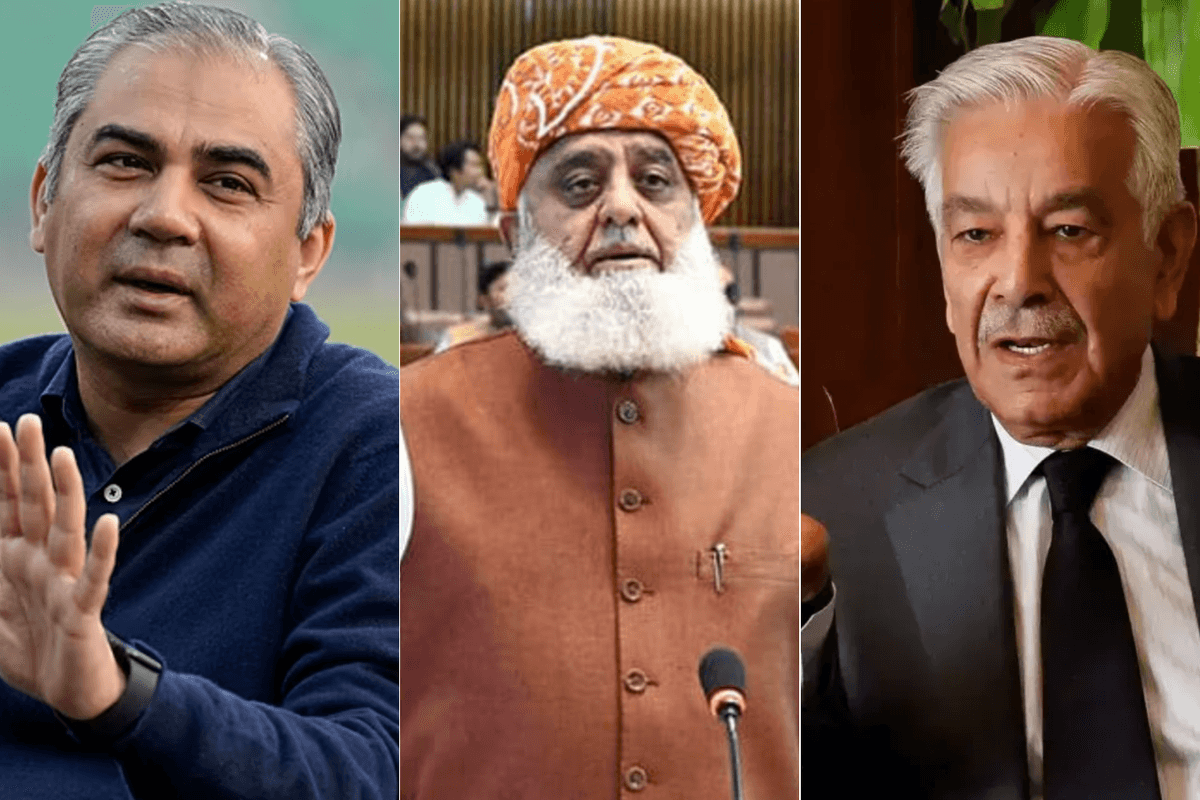
Mohsin Naqvi, Maulana Fazlur Rehman and Khawaja Asif.
File photos
Interior Minister Mohsin Naqvi warned Jamiat Ulema-e-Islam-Fazl (JUI-F) chief Maulana Fazlur Rehman in the Senate on Thursday that he would no longer receive state jobs or money after criticizing the state, while Defense Minister Khawaja Asif accused the party of using religion for political gain.
Why did ministers criticize Fazlur Rehman?
The sharp exchanges followed Fazlur Rehman's remarks a day earlier questioning why Asif was absent from high-level talks in Tehran. Pakistani officials along with Saudi and Turkish leaders had met Iranian leaders there amid a regional crisis. Naqvi responded in the Senate and Asif in the National Assembly, rejecting the criticism and accusing the JUI-F chief of exploiting religion.
"I personally respected and honored Maulana Fazlur Rehman from the bottom of my heart, but yesterday, when he said that I spit on the state, that respect ended," Naqvi told the Senate. He accused the JUI-F chief of turning against the state when he did not receive political positions or other benefits.
"When they receive money from the state, the state is good. When they do not receive money, they turn against it," he said. Naqvi also accused the party of using Islam for business and politics, adding that those who criticized the government should be prepared to hear its response.
The minister rejected claims that his visit to Iran was intended to negotiate a defense agreement. He said Prime Minister Shehbaz Sharif had assigned him a special task related to the regional crisis, that defense matters were not discussed, and that the trip had nothing to do with signing a defense pact.
Opposition lawmakers protested during Naqvi's speech, while Senator Kamran Murtaza objected to the minister's language. Naqvi maintained that the government would respond to criticism and repeated his warning that the party would no longer receive state jobs or money.
What did Khawaja Asif say about the Tehran talks?
In the National Assembly, Asif rejected Fazlur Rehman's criticism, saying no defense agreement was being negotiated in Tehran and his presence at the meetings was unnecessary. Fazlur Rehman had questioned the previous day why the defense minister was sitting in Parliament while a defense agreement was reportedly being discussed in Iran.
Smiling as he addressed Asif, the JUI-F chief had said there should be some shame and concern for one's dignity, drawing laughter in the House. Asif said he appreciated the concern expressed for him but called the criticism misplaced.
He praised Field Marshal Asim Munir for his role in promoting regional peace following Pakistan's conflict with India, describing the military chief's visit to Tehran as a peace mission. Asif said Pakistan had achieved diplomatic successes and gained international recognition, including from Iran, and urged political leaders to put aside their differences and acknowledge the country's efforts to promote peace.
"There are certainly some issues on which we can demonstrate unconditional unity," he said, warning that the conflict in Yemen could have escalated.
What did Asif say about Fazlur Rehman's political record?
Asif then turned his criticism toward Fazlur Rehman's political record, accusing the JUI-F chief of benefiting from successive governments while criticizing political opponents when it suited him. He questioned Fazlur Rehman's performance during his 10 years as chairman of the parliamentary Kashmir Committee, accusing him of enjoying official privileges without delivering meaningful results.
Asif also recalled the cleric's past roles as opposition leader and coalition partner, saying he had participated in previous governing arrangements. "Do not make me open my mouth," Asif said, warning that he could disclose further details about the JUI-F chief's conduct during the Pakistan Democratic Movement coalition government.
He accused the party of making religion and politics a source of income and said Fazlur Rehman should show restraint before taunting others. Asif also suggested that Fazlur Rehman would not have criticized the government the previous day if the JUI-F had been given a share in the Khyber Pakhtunkhwa provincial government.
How did JUI-F lawmakers respond in the National Assembly?
The speech triggered protests from JUI-F lawmakers. Lawmaker Aalia Kamran demanded evidence for Asif's allegations, and the defense minister challenged the party to provide evidence for its own accusations. A quorum was questioned during the uproar, but the assembly was found to have enough members to continue.
Asif, who said he had spent 35 to 36 years in parliamentary politics, acknowledged mistakes in his own political past and said he had publicly apologized for them. He urged lawmakers to focus on national security and development rather than narrow political interests.
"We should find common ground instead of fighting among ourselves," he said.





Comments
See what people are discussing