


News Desk
The News Desk provides timely and factual coverage of national and international events, with an emphasis on accuracy and clarity.
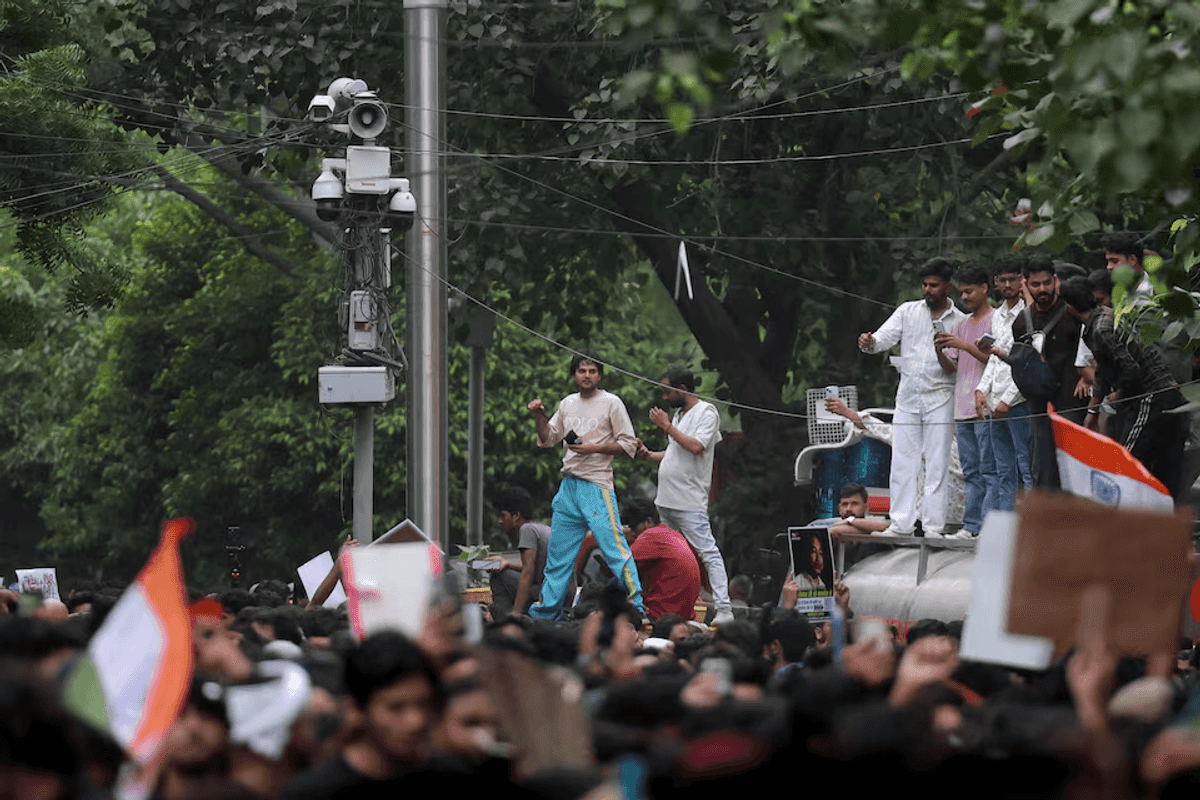
A CCTV camera overlooks the Jantar Mantar protest site in New Delhi, where students demand the education minister's resignation over alleged exam paper leaks, July 19, 2026.
Reuters
Indian activists are challenging Prime Minister Narendra Modi's government over AI-powered surveillance used during the country's largest youth protest in decades, after demonstrators accused police of conducting mass surveillance at a protest over exam paper leaks in New Delhi.
The Delhi High Court is hearing a case that could test the government's surveillance powers.
Why are activists challenging AI-powered surveillance at the India youth protest?
Activists argue police used AI-powered surveillance and facial recognition technology without a legal framework during the student protest. They want the Delhi High Court to declare the surveillance unconstitutional, order the deletion of personal data collected during the demonstration and establish guidelines governing the use of such technology.
The surveillance controversy emerged during last week's student protest over exam paper leaks, when demonstrators shared images on social media showing a mobile police surveillance van equipped with cameras mounted on a telescopic mast, giving officers a 360-degree view of the gathering.
Student activist Aishe Ghosh has asked the Delhi High Court to declare mass surveillance of protesters unconstitutional. She is also seeking an order directing authorities to destroy all personal data collected during the demonstration and frame guidelines governing the use of surveillance technology.
Ghosh is pursuing the case even though the protest ended after Education Minister Dharmendra Pradhan resigned, a rare setback for Modi. The prime minister later announced a panel to overhaul India's exam system following the demonstrations.
India has no law governing the use of facial recognition technology by police, and activists argue surveillance at the main protest site in New Delhi violated existing legal protections.
The government says the security measures were lawful and necessary to maintain public order. Modi's administration has repeatedly rejected accusations from opposition parties and digital rights advocates that it has expanded surveillance powers, saying its actions serve the public interest.
What happened in the Delhi High Court?
During a hearing on Friday, Solicitor General Tushar Mehta defended the police's actions, arguing that privacy claims at a public gathering were "ironical". He said the surveillance measures were "absolutely necessary" and undertaken in the "legitimate state interest."
In a brief hearing on Monday, judges heard arguments from Ghosh that mass surveillance of protesters was disproportionate. She also sought broader disclosures about the state's surveillance policies during public demonstrations. The court is scheduled to hear the matter again on Tuesday.
What concerns have digital rights groups raised?
The Internet Freedom Foundation, a New Delhi-based digital rights organisation, wrote to Delhi's police commissioner on July 24 demanding the deletion of biometric data collected at the protest site.
Delhi Police did not respond to a Reuters request for comment. In a post on X on Sunday, the force said it had not "restricted anyone's freedom through the use of facial recognition technology".
"We need proportionality even if we are to claim national security risks. Accountability must flow both ways," said Akash Karmakar, a technology law partner at Indian law firm Panag & Babu.
He said that if facial recognition technology was used to identify protesters, it should also be used to identify police officers who allegedly operated without visible name badges during the crackdown.
Police officers were also seen recording the Instagram handles of protesters arriving at the demonstration. Inspector Sunil Kumar told Reuters the checks were intended to prevent people with criminal backgrounds from entering the protest.
How was AI-powered surveillance used at the protest?
The surveillance van stationed at the protest site displayed the Delhi Police crest and the branding "Ikshana", the Hindi word for "vision".
Little information about Ikshana is publicly available. A now-removed 2023 post by its development partner, Indian CCTV company CP Plus, described the system as using advanced AI-powered cameras, mobile cameras and varifocal bullet cameras with adjustable lenses.
CP Plus said it supplied the surveillance hardware used by Delhi Police but that operational deployment, databases and surveillance scenarios were controlled by law enforcement authorities.
When a Reuters reporter walked past the van last week, one computer monitor displayed his face inside a green rectangular box alongside a "face accuracy" match score. A police officer closed the van's window shortly afterwards.
"The computers here help us identify those who have a criminal history and it highlights them," police officer Raj Kumar Dahiya told Reuters.
"AI also helps us count the number of protesters."



Comments
See what people are discussing