

Umar Khan left Pakistan with dreams of Europe — his family has been waiting ever since
Families in Khyber Pakhtunkhwa seek answers after 37 Pakistani migrants, including Umar Khan, vanished in Libya following crackdown operations along Mediterranean migration routes

Kamran Ali
Correspondent Nukta
Kamran Ali, a seasoned journalist from Khyber Pakhtunkhwa, Pakistan, has a decade of experience covering terrorism, human rights, politics, economy, climate change, culture, and sports. With an MS in Media Studies, he has worked across print, radio, TV, and digital media, producing investigative reports and co-hosting shows that highlight critical issues.
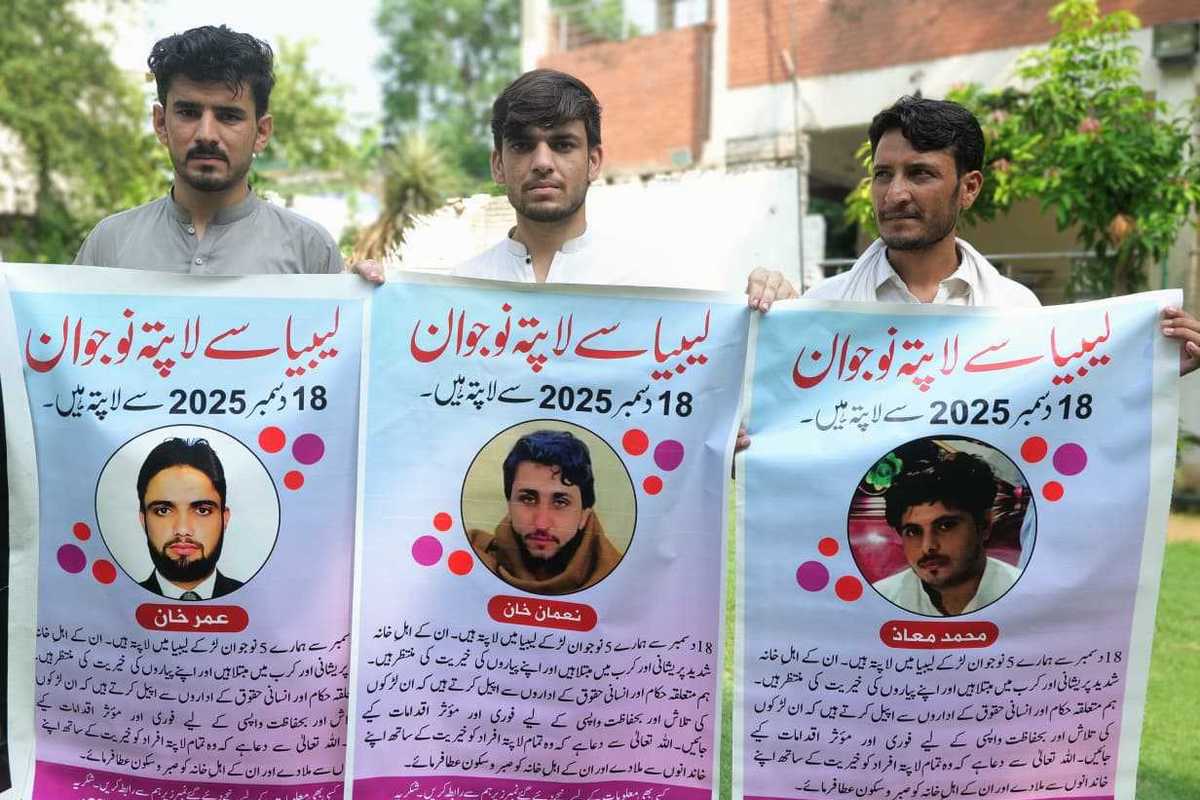
Families in Peshawar, Swabi, Nowshera, Bajaur and Kurram await answers after 37 Pakistani migrants vanish in Libya.
Nukta
For Maulana Salamat Khail, the hardest part of losing a loved one is not knowing whether he has been lost at all.
Almost a year after his nephew Umar Khan left his home in Peshawar, the family remains suspended between hope and mourning. There has been no funeral, no body to bury and no confirmed account of what happened to him. Only a silence that began with a missed call and has stretched for months.
Umar left Pakistan in September 2025 with a destination that existed more vividly in his imagination than on any map: Europe. He was young, unemployed and determined to find a way to earn enough money to change his family's circumstances. The route he chose took him toward Libya, a major departure point for migrants attempting the perilous Mediterranean crossing.
For nearly three months, he remained in contact with his family. Then, on Dec. 18, the calls stopped.
At first, his relatives waited. Then they began searching.
They contacted government offices, approached senior officials and appealed to Pakistan's ministries of foreign affairs and interior. They followed leads from other migrants and spoke with people who might know what had happened along the route.
Nothing produced an answer.
“We are not asking for miracles,” Khail said. “We only want to know where our children are.”
A journey that ended in silence
Umar's disappearance is not an isolated story.
Families interviewed by Nukta say at least 37 young men from Pakistan's Khyber Pakhtunkhwa province have lost contact with relatives after traveling to Libya through irregular migration routes. They come from districts including Peshawar, Swabi, Nowshera, Bajaur and Kurram.
Their circumstances vary, but the pattern is strikingly similar. Economic pressure pushed them to leave. Smugglers arranged parts of their journeys. And then, somewhere along the way, communication stopped.
Some families believe their relatives may have been detained in Libya. But without access to detention records or reliable information from authorities, those suspicions remain unconfirmed.
For Umar's family, fragments of information have offered tantalising glimpses without resolving the central mystery.
Khail said relatives were told by fellow migrants and other informal contacts that Libyan security forces had carried out a crackdown on smuggling operations along the coast around the time Umar disappeared. According to the accounts reaching the family, roughly 100 Pakistani nationals were detained, including at least 36 others from Khyber Pakhtunkhwa.
Whether Umar was among them remains unknown.
“They were taken away, and since then no one has been able to contact them,” Khail said. “We have heard they are somewhere in Libya, but we don't know where, in what condition, or even if they are still there.”
The price of leaving
In Peshawar, another family is living through the same uncertainty.
Noman, 25, left Pakistan after borrowing money to pay for his journey. His brother, Salman Khan, said he had grown frustrated with unemployment and believed Europe offered an opportunity that Pakistan could not.
He left behind a wife, two young children and an elderly mother.
“He wanted to escape unemployment and poverty,” Salman said. “He believed that if he reached Europe, he could support all of us.”
Instead, his family has been left waiting for a call that has not come.
The journeys undertaken by men like Umar and Noman are rarely as simple as a single trip from Pakistan to Europe. They can involve several countries, changing smugglers and increasingly dangerous forms of transport.
Bilal Ahmed, a travel consultant, said smuggling networks have developed routes through countries including Iran, the United Arab Emirates, Egypt, Azerbaijan and Libya. Migrants may initially travel using legitimate visas before being transferred into clandestine networks, he said.
By the time they reach Libya, the journey can become a matter of survival.
Migrants are often placed on overcrowded and poorly equipped boats for the Mediterranean crossing toward Italy or Greece. In the fragmented environment created by years of conflict in Libya, criminal groups have exploited migrants seeking a way into Europe, with profit often taking precedence over safety.
The financial gamble can be enormous. Families may pay between 2 million and 4 million Pakistani rupees — roughly $7,000 to $14,000 — for a journey that may leave them with nothing but debt.
Some sell property. Others borrow from relatives or lenders.
They make the payments believing that the money is an investment in a better future.
For families like Umar's, it can instead become the price of a disappearance.
The Mediterranean's unanswered names
The danger does not end when migrants reach the Libyan coast.
The Mediterranean has for years remained the world's deadliest migration route. The International Organization for Migration says at least 84,834 migrants have gone missing worldwide since 2014, including 13,564 from Asia. Of those, 35,153 are recorded as missing in the Mediterranean.
The reasons are often brutally ordinary: boats that cannot withstand the journey, drowning, exposure, illness and accidents. Violence and exploitation also contribute to deaths and disappearances.
The numbers are large enough to become statistics. For families waiting in Pakistan, they have names.
The continuing demand for the journey is reflected in asylum figures. Data from the European Union Agency for Asylum shows that Pakistani nationals filed about 27,000 asylum applications across the EU+ between November 2024 and March 2026. The number fell to about 19,000 in 2025 and declined further in early 2026, when roughly 4,400 applications were recorded in the first three months.
Even as the numbers fluctuate, the incentive to leave remains powerful for young Pakistanis who see few opportunities at home.
A network difficult to dismantle
Pakistan has tried to make the journey harder to begin.
The Federal Investigation Agency says it stopped 27,432 passengers from leaving the country on suspicion of irregular migration in 2024, 16 percent more than the previous year. Authorities also registered 19,343 inquiries related to human smuggling and arrested 3,345 suspects, according to FIA data.
Muhammad Naeem, an officer with the agency's Anti-Human Smuggling and Trafficking Cell, said airport surveillance and monitoring of known transit routes had been strengthened. Passengers carrying suspicious documents can be subjected to additional scrutiny, while investigators track routes used by smuggling networks.
But the networks are designed to survive arrests.
A migrant may be handed from one facilitator to another as he crosses borders, making it difficult for authorities in any single country to identify the entire chain.
The FIA has established liaison offices in Iran, Turkey and Italy to improve cooperation with authorities in countries along major migration routes, including efforts to identify facilitators and assist with the deportation of irregular migrants.
Still, stopping a smuggler at one border does little to resolve the desperation that brought a migrant there in the first place.
For the families, the journey never really ends
That is what makes Umar's disappearance so difficult for his family to endure.
The journey itself lasted months. The uncertainty has lasted longer.
There is still a possibility, his relatives tell themselves, that he is alive somewhere in Libya. Perhaps he is being held in detention. Perhaps he has lost access to a phone. Perhaps another call will come.
But every possibility creates another question.
For Noman's family, the same questions remain unanswered. His wife and children are left with memories of a man who believed that leaving was the surest way to provide for them.
The warnings against irregular migration are familiar: the risk of detention, trafficking, exploitation, drowning or death is immense. Yet for young men facing unemployment and limited prospects, the danger can seem distant compared with the possibility of earning enough money to transform their families' lives.
That calculation is what brought Umar to Libya.
Now, for the people he left behind, Europe has almost disappeared from the story.
There is only Libya, a vanished phone signal and one question that the family has been asking for months: Where is Umar Khan?





Comments
See what people are discussing