

Pakistan at 80: Can new provinces fix its governance crisis?
Kamran Khan says Pakistan needs to rethink how governance is delivered and power is distributed as debate over new provinces and administrative reforms grows

News Desk
The News Desk provides timely and factual coverage of national and international events, with an emphasis on accuracy and clarity.
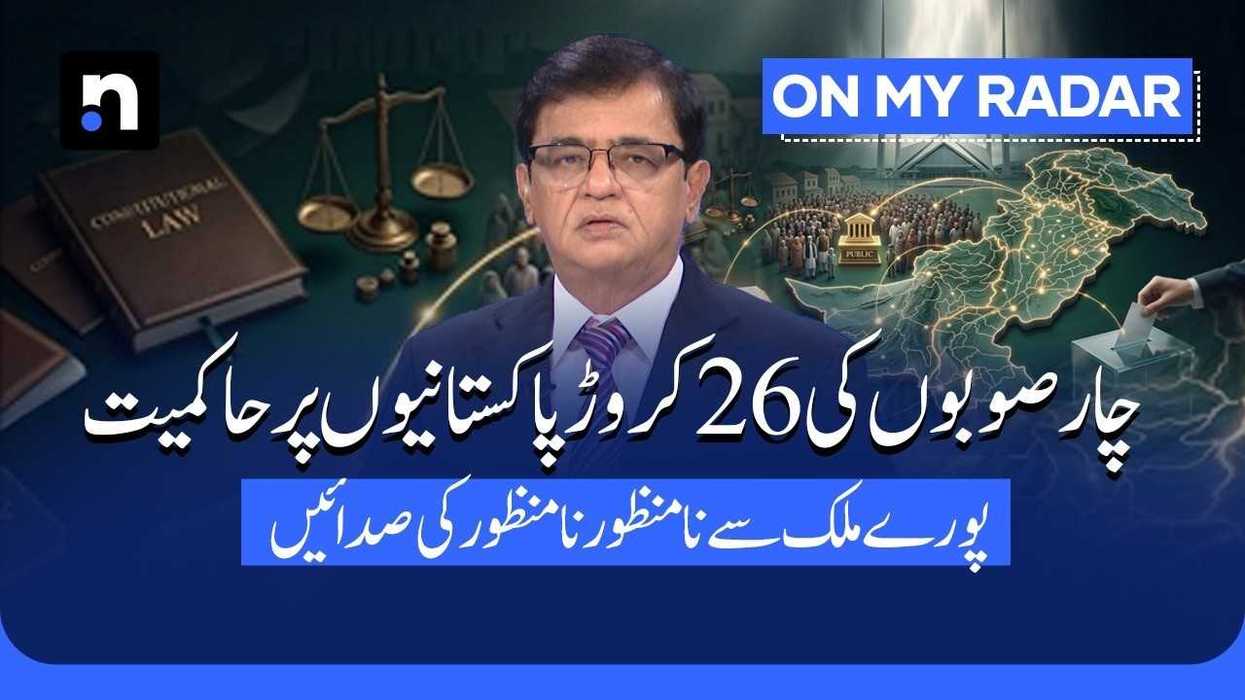
Pakistan is approaching its 80th anniversary with a renewed debate over how the country should be governed and how effectively state institutions can serve ordinary citizens. As political leaders, analysts and experts weigh the creation of new provinces and administrative units, a broader question is emerging: can redrawing administrative boundaries improve governance, or does Pakistan need to take power and resources much closer to the people?
In the latest episode of On My Radar, Kamran Khan said the debate over new provinces and administrative reforms comes at a time when Pakistan needs to seriously rethink how governance is delivered and how authority is distributed across the country.
The debate gained fresh momentum after Federal Interior Minister Mohsin Naqvi and the Director General of Inter-Services Public Relations (ISPR) highlighted the need for new provinces, administrative units or wider reforms to improve governance. Their remarks have prompted discussion among political parties, analysts and constitutional experts over whether Pakistan's existing administrative structure is capable of meeting the needs of a population of more than 250 million.
Quaid-e-Azam Muhammad Ali Jinnah had emphasised the welfare of the people, particularly poorer sections of society, as central to building a prosperous Pakistan. Eight decades later, however, critics argue that decision-making remains heavily concentrated in Islamabad and provincial capitals, making government difficult to access for many ordinary citizens.
Pakistan's four provinces are among the country's largest administrative units in terms of population and territory, and supporters of further division argue that their size makes effective administration and timely delivery of public services more difficult. They believe smaller provinces or administrative units could bring government closer to citizens and improve accountability.
But opponents of the idea say simply creating more provinces will not resolve the country's governance problems. They argue that greater attention should instead be given to institutional reform, constitutional arrangements and, most importantly, transferring meaningful financial and administrative powers to local governments.
The debate broadly revolves around three questions: should Pakistan create new provinces; if not, should it establish additional administrative units; and can governance be improved by giving local governments genuine powers and resources under Article 140-A of the Constitution?
Public opinion also appears to favour further administrative division. According to a survey conducted by ARY News across social media platforms, around 81% of respondents supported the creation of new provinces, while 19% opposed it. The findings, however, represent social media opinion rather than a nationwide scientific survey.
To assess views beyond social media, people in several major Pakistani cities were also asked whether new provinces should be created, whether additional administrative units should be established if provinces were not formed, and whether existing local governments should be given greater powers.
The issue has also exposed differences within the country's political landscape. Some senior Pakistan Muslim League-Nawaz (PML-N) leaders and federal ministers have backed the idea of creating new administrative units, with some proposals even suggesting different administrative arrangements for strategically and economically important areas such as Karachi and Gwadar.
The Pakistan Peoples Party (PPP), a key coalition partner of the federal government, has supported new provinces or administrative units in Punjab and Khyber Pakhtunkhwa but has strongly opposed any division of Sindh.
PPP Chairman Bilawal Bhutto Zardari has said decisions on creating new provinces or administrative units should not be made behind closed doors but with the consent of the people. He has also questioned how the country can seriously discuss autonomy for new provinces or local governments when it has struggled to give full powers to its own prime minister.
That position, however, raises a separate question about the strength of local governments within Sindh and other provinces. Senior PPP leader Qamar Zaman Kaira has acknowledged that provincial governments have retained substantial powers and that resources have not been transferred to local governments at the required level. He has also identified the Provincial Finance Commission and distribution of resources as major issues.
The Muttahida Qaumi Movement-Pakistan (MQM-P) and Jamaat-e-Islami have long advocated the creation of new provinces, arguing that a more decentralised administrative structure is necessary to address people's problems effectively.
The opposition has generally not rejected the idea of new provinces or administrative units but has called for political and national consensus. PTI Chairman Barrister Gohar Khan has described the creation of provinces as a complex and contentious issue, warning that legislation without public demand and broader consensus could deepen divisions within the federation.
Jamiat Ulema-e-Islam-Fazl chief Maulana Fazlur Rehman has called for a comprehensive review of Pakistan's existing administrative structure before creating new provinces or divisions. The issue, he argues, is not simply whether new provinces are desirable, but whether the country is politically and institutionally prepared for such a step.
Constitutionally, the creation of new provinces is also a complex process, particularly because any change to provincial boundaries requires broad political agreement and must meet constitutional requirements.
This has led critics to ask whether creating new provincial boundaries would actually improve the lives of citizens if existing provincial governments are unable or unwilling to devolve their own powers and resources to the local level.
Former State Bank governor Dr Ishrat Hussain, PILDAT President Ahmed Bilal Mehboob and other experts have argued that strengthening local governments under Article 140-A could provide a more practical route to better governance. Their argument is that local governments need clearly defined administrative and financial powers rather than simply being given responsibilities without the resources to perform them.
International experience is often cited in support of this approach. China's economic development, for example, has been accompanied by strong local governments that have played an active role in attracting investment, creating employment and promoting economic activity in their respective areas. Competition among local governments has helped encourage development and investment.
Pakistan's own history also provides an example of an attempt to decentralise power. During General Pervez Musharraf's rule, the 2001 devolution system transferred greater responsibilities to district and local governments in an effort to bring decision-making and service delivery closer to citizens.
Even some critics of Musharraf's rule acknowledge that the system brought certain government functions closer to the people and enabled some local issues to be addressed at the grassroots.
The central question, therefore, may be broader than simply whether Pakistan needs more provinces. The real challenge is determining how to create a system in which decisions, resources and accountability reach citizens more effectively — whether through new provinces, smaller administrative units, stronger local governments or a combination of institutional reforms.
As Pakistan enters its 80th year, the debate is ultimately about how to make governance more accessible, accountable and responsive to the people it is meant to serve.




Comments
See what people are discussing