

Pakistan army chief warns of 'painful consequences' for any future aggression
Field Marshal Asim Munir says Pakistan's defense is fully impregnable as the country marks one year since the Marka-e-Haq conflict with India

News Desk
The News Desk provides timely and factual coverage of national and international events, with an emphasis on accuracy and clarity.
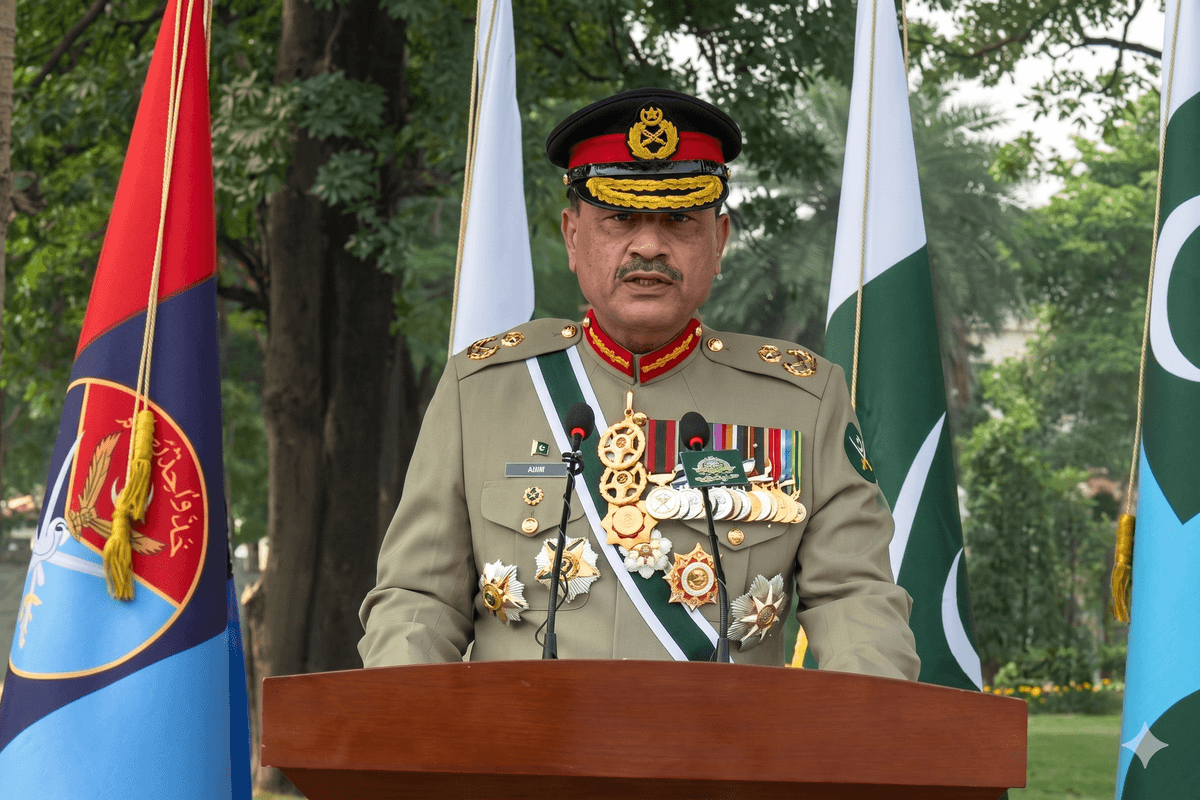
Field Marshal Asim Munir addresses a ceremony at General Headquarters in Rawalpindi on May 10, 2026, marking one year since Marka-e-Haq.
Screenshot
Pakistan's Chief of Defense Forces Field Marshal Syed Asim Munir warned on Sunday that any future aggression against Pakistan would have "far-reaching and painful consequences."
Speaking at a ceremony at General Headquarters in Rawalpindi, he said Pakistan's armed forces achieved "remarkable success" during the conflict, while the "enemy suffered defeat and humiliation."
What did Asim Munir say about future aggression against Pakistan?
Munir said Pakistan would never compromise on its sovereignty, territorial integrity or national dignity.
He warned that any future misadventure would invite a severe and far-reaching response. Pakistan's defense, he added, is "fully impregnable against any external aggression."
What was the Marka-e-Haq anniversary ceremony?
The event commemorated one year since the conflict between Pakistan and India, which began after the April 22, 2025 attack in Pahalgam and ended with a ceasefire on May 10, 2025.
Pakistan refers to the conflict as "Marka-e-Haq," or "Battle of Truth."
- YouTube www.youtube.com
Chief of the Air Staff Air Chief Marshal Zaheer Ahmed Babar Sidhu and Chief of the Naval Staff Admiral Naveed Ashraf also attended.
Before Munir's speech, Sidhu and Ashraf laid floral wreaths at the Yadgar-e-Shuhada, or Martyrs' Monument, and contingents from the three armed forces presented a salute.
How did Munir describe the conflict with India?
Munir said India had tested Pakistan's resolve by violating its sovereignty between the nights of May 6 and May 10 last year, and that Pakistan responded with "full national unity and military force."
He described Marka-e-Haq as more than a conventional war between two militaries. "In reality, it was a decisive battle between two ideologies," he said.
He also said that India had previously attempted to impose "illegitimate war" on Pakistan through "false flag operations" in 2001, 2008, 2016 and 2019.
Munir said the objective of Operation Bunyan-un-Marsoos was to expose what he described as India's efforts to create "war hysteria" to divert attention from internal failures.
He accused India of attempting to alter the regional balance of power and diplomatically isolate Pakistan through military pressure. "Global and defense experts know that India's ambitions proved to be much larger than its stature and capabilities," he said.
Munir said Pakistan's forces shot down enemy warplanes and struck military installations during the fighting. He said Pakistan's strategic missiles and Shaheen systems successfully targeted more than 26 enemy military sites. He paid tribute to those killed in Indian strikes, including women, elderly people and children, calling all those who died "our crown."
What did Munir say about future warfare and regional security?
Munir said future conflicts would involve multi-domain operations using drones, cyber capabilities, long-range weapons and artificial intelligence. He said the Defense Forces Headquarters had been established to align Pakistan's military with modern operational requirements.
Addressing regional security, he accused India of turning to terrorism after ruling out conventional warfare, and urged Afghanistan to eliminate militant camps operating from its territory.
What diplomatic points did Munir highlight?
Munir said Pakistan had gained diplomatic recognition over the past year and strengthened international ties. He highlighted what he called a strategic mutual defense agreement with Saudi Arabia and said Pakistan was hosting talks aimed at facilitating negotiations between the United States and Iran.
He said Pakistan had earned the gratitude of leaders from both countries for its role in those diplomatic efforts.
Reaffirming Pakistan's position on Kashmir, Munir said no story of Pakistan is complete without Kashmir, and pledged continued political, diplomatic and moral support for Kashmiris.
He thanked Pakistan's president, prime minister, federal cabinet and political parties for their unity during the conflict, and praised Pakistani media and youth for countering what he called enemy propaganda, cyberwarfare and psychological tactics.




Comments
See what people are discussing