

Pakistan brickmakers scorched by sun above and fire below
Brick kiln workers in Pakistan face 1,000C furnaces below and record summer heat above, as climate change deepens risks in a poorly regulated industry

News Desk
The News Desk provides timely and factual coverage of national and international events, with an emphasis on accuracy and clarity.
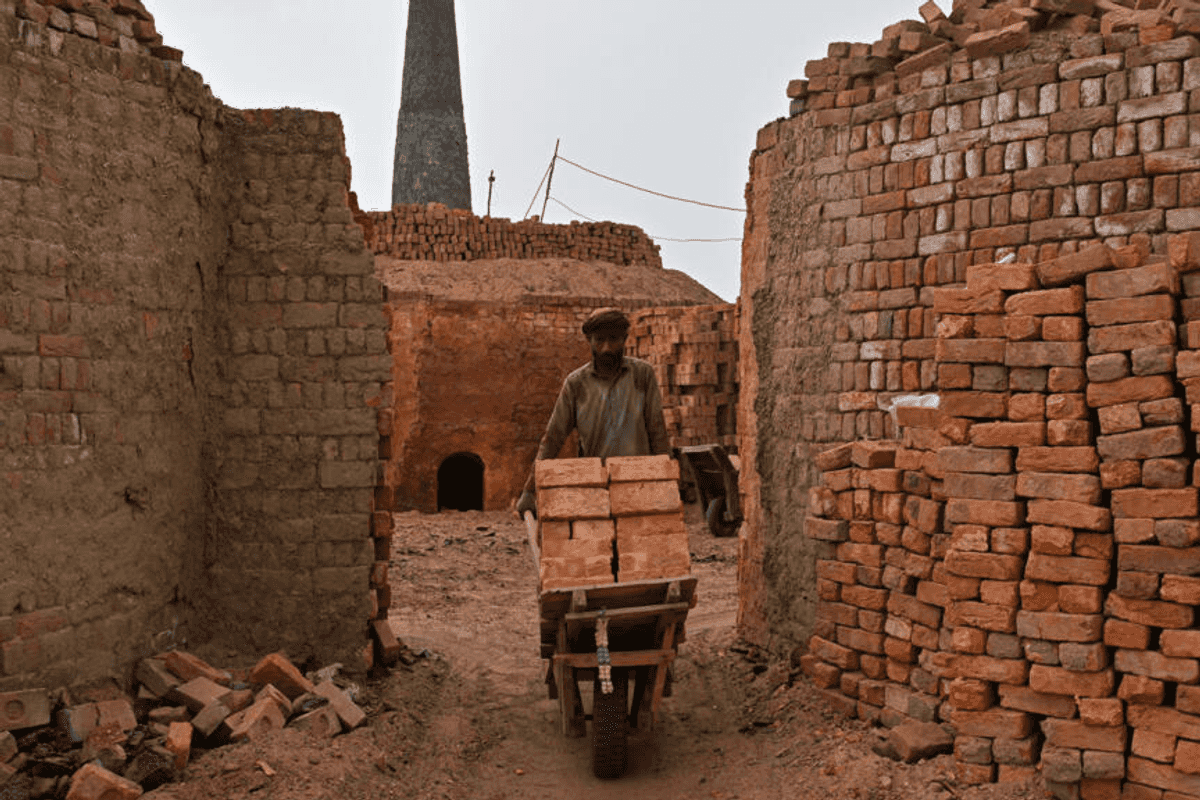
A worker pushes a wheelbarrow at a brick kiln in Sheikhupura, in Pakistan's Punjab province, on July 20, 2026.
AFP
In Sheikhupura, Pakistan, brickmakers labor between kiln fires that burn past 1,000C and summer heat regularly above 40C, as climate change pushes conditions in the country's brick kiln industry toward unbearable. Hundreds of thousands work in a sector labor advocates call poorly regulated and badly paid, even as rising temperatures make the job increasingly dangerous.
How many brick kiln workers are there in Pakistan?
Pakistan has more than 18,000 brick kilns nationwide, employing over a million workers, according to 2018 data cited in a Climate and Clean Air Coalition report. Sheikhupura, in Punjab province, sits at the heart of this industry. Pakistan's fast-growing construction sector continues to drive demand for kiln labor, even as wages remain around $3 a day.
As dark plumes billow from overhead smokestacks, brickmakers crush coal through small holes beneath their feet into the fiery chambers below. Abid Hussain, a 35-year-old laborer whose clothes were covered in dark soot, told AFP the work felt like being trapped between fire below and, increasingly, fire above. "The heat is undoubtedly extreme but when you think about the financial pressures at home, you have no option but to keep working," he said.
Why is heat exposure so dangerous for brick kiln workers?
Pakistan ranks among the countries most vulnerable to climate change globally, and its brick kiln workers face compounding risks from extreme heat. Health experts warn that prolonged exposure, especially at traditional kilns, raises the risk of skin disorders, respiratory problems and kidney disease. Syeda Ghulam Fatima, general secretary of the Bonded Labor Liberation Front Pakistan, described the kilns as "places of confinement," where workers endure blazing sun overhead and rising heat from the kiln beneath them.
Fatima said workers remain trapped in a cycle of debt, extreme heat and deteriorating health, with rising global temperatures amplifying the danger. Despite the scorching sun and dust filling the air, laborers stay on the heated kiln surface for hours at a stretch.
How much do Pakistan's brick kiln workers earn?
Hussain earns roughly 25,000 Pakistani rupees, about $90, a month, which he says barely covers rent and his children's basic needs. Fatima said many workers receive advance payments that leave them unable to refuse dangerous work without falling into further debt. "No matter the situation, whether we are ill or there are family matters, we still have to work," Hussain said. "If I take time off, we'll be in trouble."
Why can't brick kiln workers take breaks from the heat?
Mujeeb Ullah, 45, a supervisor at the kiln, said extended rest breaks are not feasible because kiln temperatures must stay stable regardless of weather. "Whether it is extreme heat, cold, or rain, the work must continue uninterrupted," he said. Workers are given drinking water and occasional short breaks, but little more.
On the other side of the compound, a worker squatted beside rows of unbaked bricks, mixing wet mud and packing it by hand into a wooden mould. Muhammad Azeem, 28, said there was no alternative regardless of conditions. "As for the weather, whether it's good or bad, work is work, it has to be done," he said.
Is Pakistan improving conditions at its brick kilns?
The Punjab provincial government is pushing to convert kilns to zigzag technology, which reduces air pollution and respiratory hazards compared with traditional kilns. This shift offers some hope for improved conditions, though it does not directly address the extreme heat workers face on the kiln surface itself. For now, the industry's structure, built on debt and daily wages, keeps most workers locked into the job through the hottest months of the year.


Comments
See what people are discussing