

Pakistanis deeply dissatisfied with govt’s anti-corruption efforts, TI survey shows
Even with a 6-point improvement, the police ranked as most corrupt, with Punjab showing the highest perception at 34%

News Desk
The News Desk provides timely and factual coverage of national and international events, with an emphasis on accuracy and clarity.
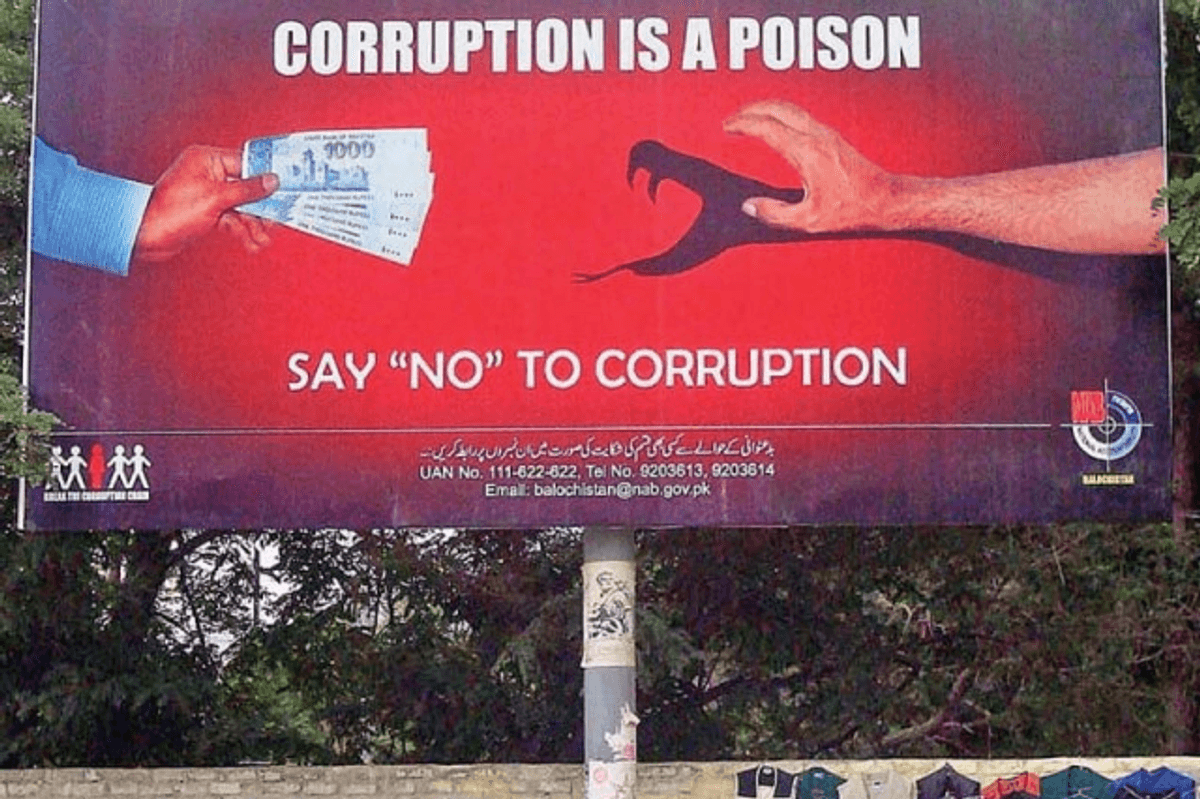
A billboard carrying an anti-corruption message in Quetta.
Photo via X
A large majority of Pakistanis surveyed - 77% - are dissatisfied with the government’s efforts to curb corruption, according to a countrywide study by Transparency International Pakistan released on Tuesday.
The National Corruption Perception Survey 2025, conducted from Sept. 22 to Sept. 29, gathered responses from 4,000 people across all four provinces.
The report captures public perceptions of corruption levels, economic pressures and institutional performance.
Most corrupt institutions, police perception shifts
Although the survey showed a 6-percentage-point improvement in public perception of the police compared with 2023, the force remained the most corrupt institution nationally (24%).
The perception was highest in Punjab (34%), followed by Balochistan (22%), Sindh (21%) and Khyber Pakhtunkhwa (20%).
Tendering and procurement ranked second (16%), while the judiciary stood third (14%).
Bribery experiences varied across regions. Nationally, 66% of respondents said they did not pay any bribe in the past year. Sindh recorded the highest reported bribe payments (46%), followed by Punjab (39%), Balochistan (31%) and KP (20%).
Economic strain, governance concerns dominate
More than half of those surveyed (57%) reported a decline in their purchasing power over the past 12 months, while 43% said it had improved.
Views on economic management were mixed: 40% partially agreed and 18% fully agreed that IMF-backed reforms and Pakistan’s exit from the FATF grey list had helped stabilize the economy.
Respondents identified lack of accountability (15%), lack of transparency and limited access to information (15%), and delays in corruption case disposal (14%) as the top causes of corruption.
A majority (59%) believed provincial governments were more corrupt than local ones.
Strong demand for oversight of anti-graft bodies
Oversight of anti-corruption agencies emerged as a major public concern, with 78% favoring accountability of bodies such as the National Accountability Bureau (NAB) and the Federal Investigation Agency (FIA).
Respondents cited lack of transparency in investigations, absence of independent oversight and political victimization as key problems.
Survey participants recommended enhancing accountability (26%), limiting discretionary powers (23%), and strengthening right-to-information laws (20%) as the most effective measures to curb graft.
Healthcare, political financing also under scrutiny
Corruption in the health sector weighed heavily on public opinion. 67% said unethical practices had a major impact on people’s lives. Hospitals (38%), doctors (23%) and pharmaceuticals (21%) were identified as the most corruption-prone areas.
Participants supported stricter rules on pharmaceutical commissions to doctors (23%) and a ban on private practice by public-sector doctors (20%).
Political financing reforms also drew broad backing. A combined 83% favored either banning or regulating business funding to political parties. Additionally, 55% supported a complete ban on using political party names and leaders’ images in publicly funded advertisements.
The survey highlighted limited awareness of corruption-reporting mechanisms: 70% said they did not know of any official channels, and only 43% of those aware had ever reported wrongdoing.
Stronger whistleblower protections would make 42% feel safe reporting corruption.
On charitable institutions, 51% of those surveyed said tax-exempt organizations should not charge fees, while 53% believed they should publicly disclose their donors and contribution amounts.
Motivations for reporting corruption included anonymity (38%) and financial rewards (37%), the survey found.





Comments
See what people are discussing