

Pakistan debates sweeping shift of power to local governments
Kamran Khan says debate over Islamabad administrative unit highlights push to devolve power across Pakistan

News Desk
The News Desk provides timely and factual coverage of national and international events, with an emphasis on accuracy and clarity.
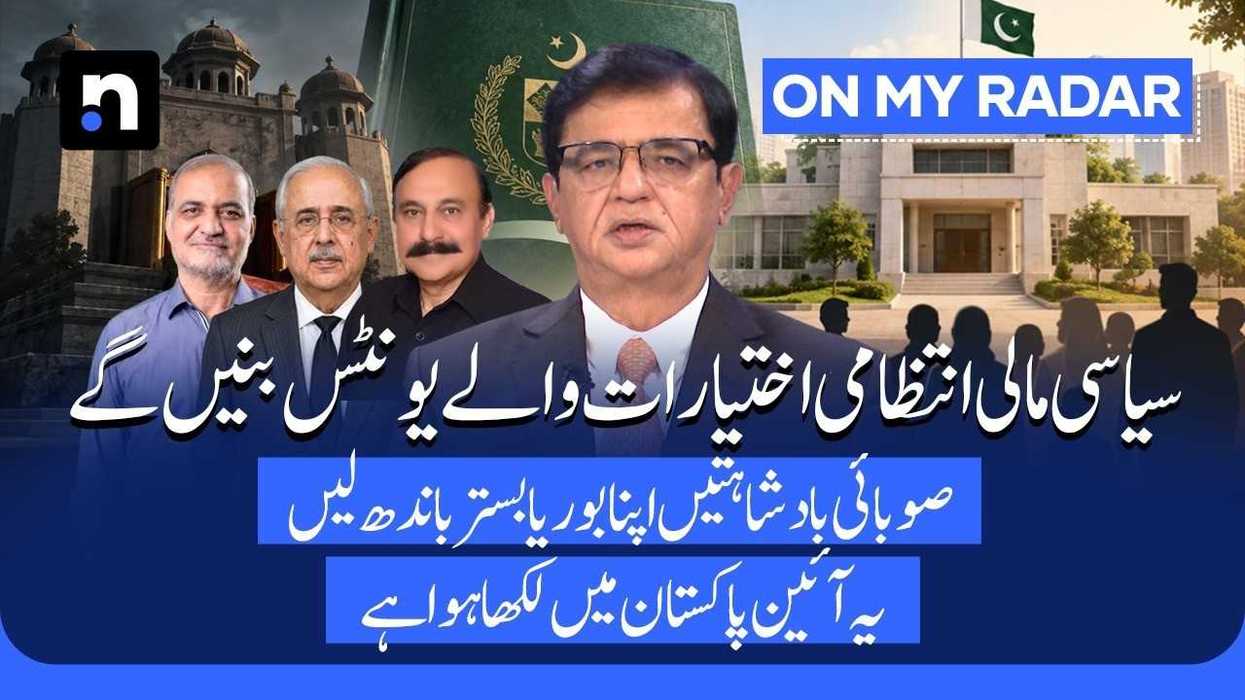
Pakistan has begun a debate over a major overhaul of its system of government, with growing calls for political, administrative and financial powers to be transferred from the federal and provincial capitals to local governments, Kamran Khan said in the latest episode of his “On My Radar” program.
The debate has focused in recent days on creating new provinces and administrative units, giving Islamabad a separate administrative status and strengthening local governments. But a new development has brought the issue into sharper focus: Federal Interior Minister Mohsin Naqvi has called for a national dialogue on giving Islamabad provincial status.
Naqvi questioned why Islamabad does not receive a share of the National Finance Commission (NFC) despite its residents contributing major tax revenues. He said that if Pakistan is debating new provinces and administrative units, the federal capital should also be considered for provincial status.
The proposal received support from the Pakistan Muslim League-Nawaz leadership in Islamabad. Raja Khurram Shehzad Nawaz, a member of the National Assembly from Islamabad and chairman of the National Assembly Standing Committee on Interior, said provincial status for Islamabad has long been a demand of its residents.
Islamabad currently lacks the full financial powers of a province, does not have a share in the NFC and does not have an elected local government structure with comprehensive authority over key civic matters.
That makes the capital a test case for a broader question: whether residents of major cities should have greater control over their own resources, elected governments and local decisions.
If the debate over giving Islamabad a separate administrative or provincial status advances, it could become a template for other parts of Pakistan, raising questions about whether major cities should control their resources, have stronger elected governments and make decisions about their own development.
But the debate goes beyond creating new provinces or administrative units. At its core is Article 140A of Pakistan's Constitution, which requires every province to establish a local government system and devolve political, administrative and financial responsibility and authority to elected local representatives.
“This is not something I am saying; it is written in the Constitution,” Kamran Khan said while explaining the provision.
The constitutional requirement means that holding local elections, forming councils and electing mayors is not enough if the substantive powers remain with chief ministers, chief secretaries and provincial departments. Article 140A calls for political, administrative and financial authority to be transferred to the local level.
This raises questions about Pakistan's existing system of governance. If a city cannot determine its own development projects, manage its finances or exercise full authority over civic institutions, and must depend on the provincial government for major decisions, it is unclear whether it can be considered a genuinely empowered local government.
Likewise, if a mayor has an electoral mandate but decisions involving money, land, police, water, transportation, building controls and major civic institutions are made elsewhere, accountability becomes blurred.
The push for administrative reform is therefore gaining momentum, but creating new administrative units and implementing Article 140A are separate issues. The article does not require the creation of new provinces. It does, however, establish a principle that political authority should not remain concentrated at a single level of government.
Rana Sanaullah has also said that devolution of power under Article 140A is inevitable.
If Pakistan creates new administrative units, their purpose should not be to establish smaller provincial secretariats or new centers of political power, Kamran Khan argued. The goal should instead be genuine devolution, with elected local leaders given the authority, resources and accountability needed to address problems in their communities.
Pakistan's four provincial governments currently wield substantial financial and administrative powers. The 18th Amendment transferred significant authority from the federal government to the provinces, but much of that authority has not moved further down to districts, cities, tehsils and local governments.
“If the transfer of powers from the federal government to the provinces is democracy, then the transfer of powers from the provinces to cities is also democracy,” Kamran Khan said.
Whether the change comes through new administrative units, stronger municipal governments or a district government system, Pakistan needs a model in which decision-making moves closer to the people, he said.
The central question, Kamran Khan said, is what Article 140A actually requires: How far must provincial governments devolve political, administrative and financial powers to elected local governments, and does Pakistan's existing local government system meet that constitutional requirement?





Comments
See what people are discussing