

Pakistan government defends FY27 budget, touts relief for salaried class and growth push
Finance minister says tax cuts, export incentives and structural reforms aim to shift economy from stabilization to sustained growth
Haris Zamir
Business Editor
Experience of almost 33 years where started the journey of financial journalism from Business Recorder in 1992. From 2006 onwards attached with Television Media worked at Sun Tv, Dawn Tv, Geo Tv and Dunya Tv. During the period also worked as a stringer for Bloomberg for seven years and Dow Jones for five years. Also wrote articles for several highly acclaimed periodicals like the Newsline, Pakistan Gulf Economist and Money Matters (The News publications)
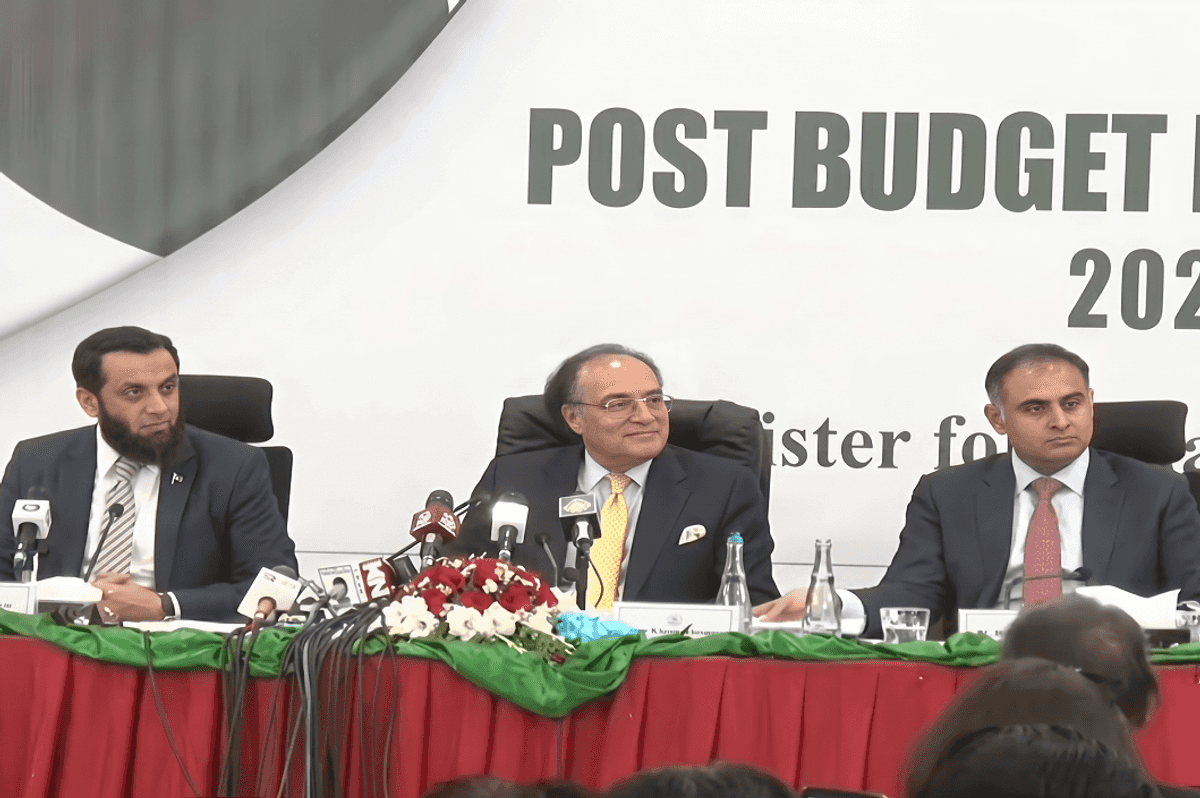
Pakistan defends FY2026-27 budget, highlighting relief for salaried class and growth-focused reforms
Screengrab
Pakistan’s finance team on Friday defended the federal budget for fiscal year 2026-27, describing it as a people-friendly package that provides relief to salaried taxpayers, supports exporters and businesses, and lays the foundation for sustained economic growth after achieving macroeconomic stability.
Addressing a post-budget news conference, Finance Minister Muhammad Aurangzeb said the government had reduced income tax rates for salaried individuals and remained committed to shifting the economy from stabilization toward growth.
“The salaried class has been provided relief in this budget,” Aurangzeb said, adding that the tax rate for the lowest income slab had been cut from 5% to 1%, while another slab previously taxed at 15% would now be taxed at 13%.
He said positive feedback was being received from chambers of commerce across the country and that the government had sought to present a business-friendly budget after extensive consultations with the private sector.
“We have tried to create an enabling environment for export-led growth,” he said, adding that the government had reduced the Super Tax rate and decided to abolish it for exporters to encourage investment and competitiveness.
Aurangzeb said economic progress during the outgoing fiscal year had positioned Pakistan on a path toward growth, citing improvements in key macroeconomic indicators.
“We have moved from economic stability toward growth,” he said. “The current budget is the best example of that journey.”
The finance minister also announced that customs duties on the import of agricultural machinery had been reduced to zero to support farm productivity. He said PKR 262 billion had been allocated under the prime minister’s loan programme, including PKR 125 billion earmarked for agricultural financing.
Aurangzeb acknowledged that Pakistan’s energy infrastructure had suffered in recent years and stressed the need for greater private-sector participation in the economy.
“We have to move toward public-private partnerships and encourage the private sector,” he said.
He added that the government had undertaken a right-sizing exercise that resulted in the merger of several ministries and departments. He noted that overlap existed between the Board of Investment and the Special Investment Facilitation Council (SIFC), and said Prime Minister Shehbaz Sharif had already decided to merge the institutions.
Minister of State for Finance Bilal Azhar Kayani said the budget had been designed to benefit all major sectors of the economy, including salaried workers, exporters, industrialists, farmers and the real estate sector.
“This is a public budget,” Kayani said. “It is a budget for salaried people, industry and exporters.”
He said the government had eliminated income tax for individuals earning up to PKR 600,000 annually and increased allocations for the Benazir Income Support Programme (BISP) by 17%.
Kayani said the budget had been prepared after consultations with business chambers and other stakeholders across the country.
“We are standing with the salaried class,” he said, adding that the fiscal space created for tax relief had not emerged overnight but was the result of sustained economic reforms.
Information Minister Attaullah Tarar said the government had fulfilled its commitment to provide relief to the public despite fiscal constraints and had succeeded in turning economic stabilization into a platform for growth.
“The prime minister is always ready to provide relief to the people,” Tarar said.
He said the Federal Board of Revenue’s ongoing digitalization drive, carried out under the prime minister’s direct supervision, would enhance transparency and reduce leakages in the tax system.
“The political culture of the FBR has changed, and leakages worth billions of rupees have been plugged,” Tarar said.
The information minister said the budget included measures to facilitate property transactions for the middle class and introduced the “Apna Ghar” housing scheme for low-income families.
Calling the budget inclusive, Tarar said it catered to farmers, workers, salaried employees and businesses alike.
“This is a budget for every segment of society,” he said.
Tarar also credited the government’s economic team for achieving macroeconomic stability, saying international institutions, including the International Monetary Fund (IMF), had acknowledged Pakistan’s economic management.
He said efforts to promote a cashless economy had helped bring large segments of economic activity into the documented sector and improve transparency.
The government’s economic team maintained that the FY2026-27 budget balances fiscal discipline with growth-oriented measures and provides targeted relief to households and businesses while supporting investment, exports and job creation.





Comments
See what people are discussing