

Four years after floods, Sindh's education crisis shows little sign of recovery
Kamran Khan says Sindh's education crisis deserves far greater national attention than it currently receives

News Desk
The News Desk provides timely and factual coverage of national and international events, with an emphasis on accuracy and clarity.
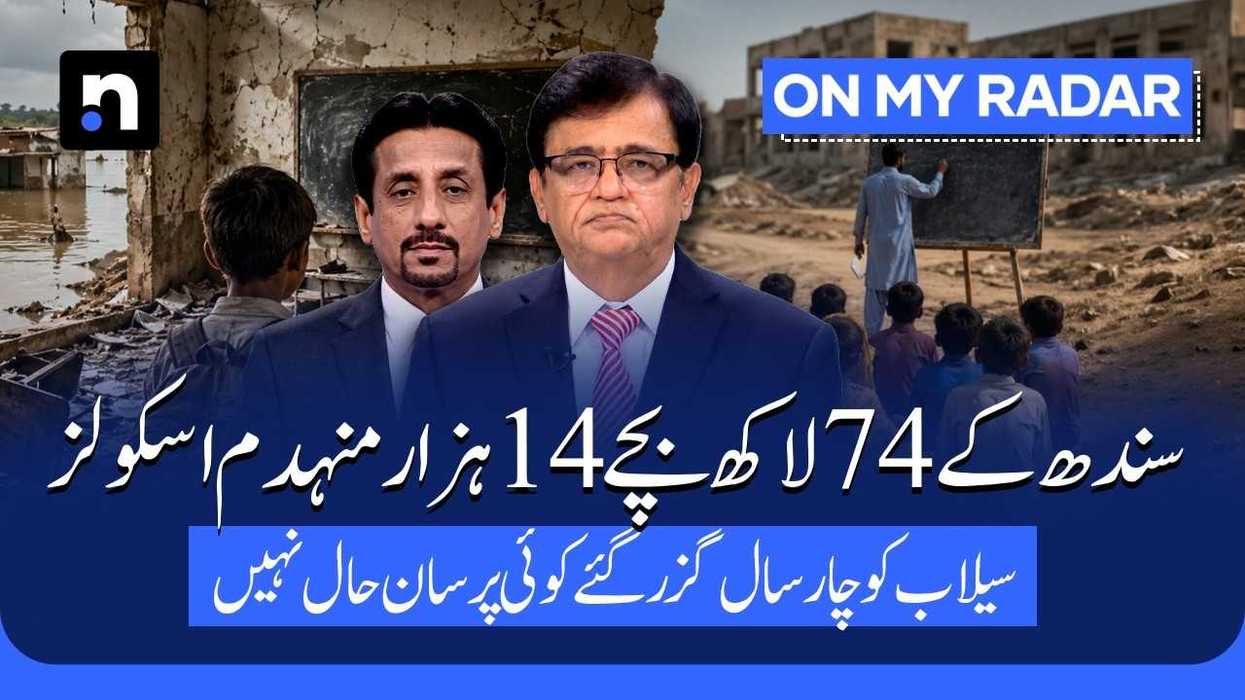
For decades, Sindh's education system has been presented as a success story by the provincial government. Yet official data and conditions on the ground paint a starkly different picture.
Four years after Pakistan's catastrophic 2022 floods, thousands of schools remain in ruins, millions of children are still out of the classroom, and serious questions persist over whether the province's education system is preparing children for the future—or failing them.
The 2022 floods devastated large parts of Sindh, destroying schools across the province. But years later, the pace of reconstruction remains painfully slow. While government claims have highlighted progress, official figures reveal that much of the damage has yet to be repaired, leaving thousands of children without access to proper learning facilities.
In the latest episode of On My Radar, Kamran Khan said the condition of Sindh's education system raises fundamental questions about the province's priorities, arguing that the issue deserves far greater national attention than it currently receives.
At a meeting chaired by Sindh Chief Minister Syed Murad Ali Shah in March, the provincial government acknowledged that 14,343 of the more than 19,500 schools damaged by the 2022 floods are still awaiting reconstruction.
Despite that admission, the Sindh government allocated just 234 million rupees ($0.8 million) in its latest budget for the rehabilitation of flood-damaged schools. That amount is unlikely to fully restore even a few dozen schools, although it may be enough to produce optimistic official announcements.
The damage extends well beyond flood-hit buildings. Across rural Sindh, many schools continue to exist only on official records. On the ground, classrooms have collapsed walls, missing roofs, no toilets or, in many cases, no teachers. On paper, the schools remain functional; in reality, education is steadily deteriorating.
According to the federal government's Girls' Education: Statistics & Trends Report 2023–24, Pakistan has 26.2 million out-of-school children, including 7.4 million in Sindh. Put differently, nearly one in every three out-of-school children in Pakistan comes from Sindh.
These figures are more than just statistics—they reflect decades of governance. Many of these children were once enrolled in school. Some returned after the floods but quietly dropped out again. Their absence often went unnoticed, while enrolment and attendance registers continued to be maintained. Even today, many schools across Sindh have attendance books filled with names but classrooms with few, if any, students.
If, after decades of uninterrupted rule, schools continue to exist largely on paper, millions of children remain out of education and the system has become little more than a numbers exercise, then the problem can no longer be blamed solely on natural disasters. It is a systemic failure and when systems fail, it is future generations that bear the cost.



Comments
See what people are discussing