

Pakistan’s irrigation system losing efficiency as water scarcity deepens: SBP
State Bank report warns deteriorating Indus Basin infrastructure, poor water management, and climate change threaten long-term food security

Haris Zamir
Business Editor
Experience of almost 33 years where started the journey of financial journalism from Business Recorder in 1992. From 2006 onwards attached with Television Media worked at Sun Tv, Dawn Tv, Geo Tv and Dunya Tv. During the period also worked as a stringer for Bloomberg for seven years and Dow Jones for five years. Also wrote articles for several highly acclaimed periodicals like the Newsline, Pakistan Gulf Economist and Money Matters (The News publications)
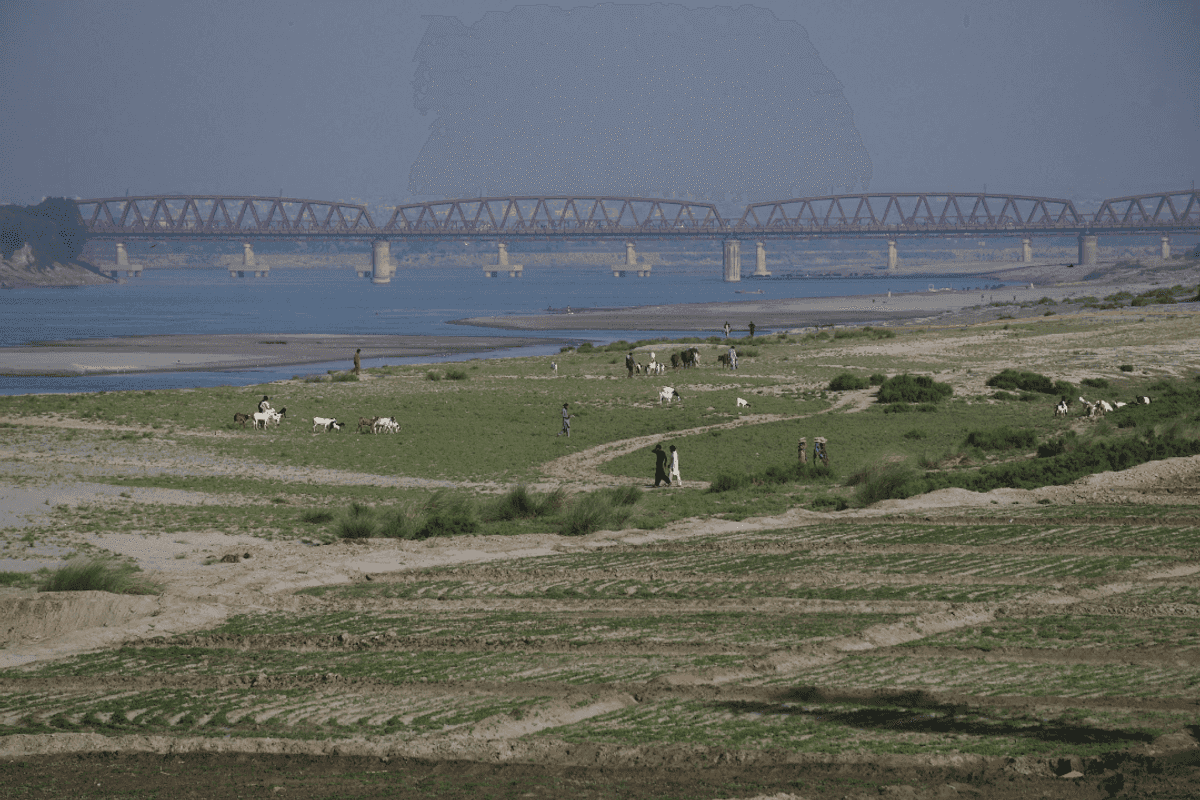
People walk next to a cultivated land on the dry riverbed of the Indus River in Hyderabad, Pakistan April 25, 2025
Reuters
Pakistan’s aging irrigation network is operating at barely one-third efficiency, with deteriorating canals, outdated infrastructure, and worsening water shortages posing serious threats to the country’s agricultural sustainability, according to a new report by the State Bank of Pakistan (SBP).
The report said the Indus Basin Irrigation System (IBIS)—one of the world’s largest canal networks and the backbone of Pakistan’s food production—now operates with a delivery efficiency of only 36%, meaning that much of the water released from canals never reaches crops.
Built during the colonial era, much of the Indus system is “old and in dire need of modernization”, the SBP noted. Silted channels, eroded canal walls, and inadequate maintenance have led to significant seepage losses, worsening waterlogging and salinity in farmland.
The country’s traditional water distribution method, known as warabandi, further limits efficiency. The system delivers water at fixed intervals and at full capacity whenever available, often mismatching the timing and volume of water needed for different crops, the report said.
Water availability and usage
Around 90% of Pakistan’s food production depends on water withdrawn from the Indus River and its tributaries, making the system both a lifeline and a vulnerability. But mounting pressures from water scarcity, inefficient canal operations, and climate change are straining the network.
The SBP warned that underpricing of canal water has encouraged cultivation of water-intensive crops such as sugarcane and rice, offering little incentive for conservation or efficiency.
Pakistan’s renewable water resources per capita have declined sharply—from 4,470 cubic meters in 1967 to just 1,013 cubic meters in 2022, well below the global water stress threshold of 1,700 cubic meters. The country’s water stress level stood at 110% in 2022, signaling unsustainable use, with agriculture as the largest consumer followed by municipal and industrial sectors.
This combination of shrinking per capita water availability and excessive withdrawals has led to groundwater depletion and placed immense pressure on IBIS to meet agricultural needs.
Climate change intensifies risks
The report said Pakistan’s irrigation system is heavily dependent on glacial meltwater, making it highly vulnerable to the effects of climate change and glacial retreat. Rising temperatures have increased evapotranspiration rates, reducing soil moisture, while erratic rainfall patterns are disrupting traditional sowing and harvesting cycles.
“These effects are most pronounced in arid and semi-arid regions, where canal water is often the only viable irrigation source,” the SBP said.
The country also lacks adequate infrastructure to store excess water. Pakistan’s water storage capacity is limited to only 30 days, compared to 1,000 days in Egypt, 900 days in the United States, and 220 days in India. As a result, more than two-thirds of annual river flow from the western rivers flows into the sea between June and August, even as water demand remains high throughout the year.
The central bank urged investment in irrigation rehabilitation, efficient water pricing, and enhanced storage capacity to address the crisis. Without reform, it warned, Pakistan’s declining irrigation efficiency could deepen food insecurity and undermine future agricultural growth.




Comments
See what people are discussing