

Pakistan’s two senior judges question legality of revised judicial code of conduct
Justices Mansoor Ali Shah and Munib Akhtar accused SJC of rubber-stamping revisions 'unconstitutionally' approved by National Judicial Policy Making Committee

Ali Hamza
Correspondent
Ali; a journalist with 3 years of experience, working in Newspaper. Worked in Field, covered Big Legal Constitutional and Political Events in Pakistan since 2022. Graduate of DePaul University, Chicago.
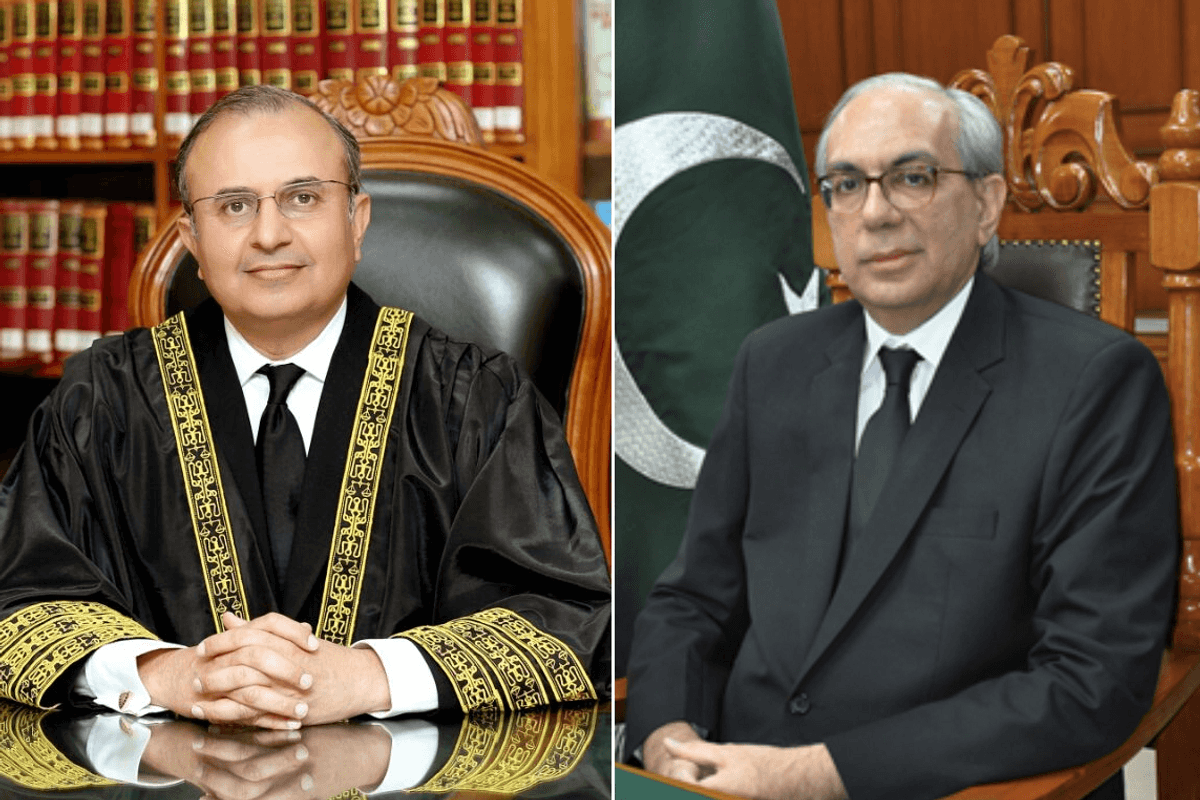
Justice Mansoor Ali Shah (left) and Justice Munib Akhtar of the Supreme Court of Pakistan are seen in these combined images.
Photos via X
A letter written by two of Pakistan’s senior Supreme Court judges, Mansoor Ali Shah and Munib Akhtar, has raised serious objections to the recently amended code of conduct for judges and to the process through which it was approved.
The letter, addressed to the Supreme Judicial Council (SJC) and dated October 17, followed by a signed copy on October 20, accuses the country’s top judicial oversight body of rubber-stamping revisions that were first discussed and endorsed by what the judges termed an “unconstitutional forum.”
The controversy follows last week’s SJC meeting, where the council approved major revisions to the judicial code of conduct. Chief Justice Yahya Afridi had presented the updated code, which had been under review since a decision by the SJC on July 12, 2025.
After extensive deliberations, the amendments were approved by majority vote, paving the way for their publication in the official gazette, circulation among superior court judges and posting on the Supreme Court’s official website.
What the new code says
The revised code emphasizes that judges must uphold the dignity, independence, and impartiality of the judiciary by avoiding not only impropriety but also its appearance in all professional and personal conduct.
It bars judges from presiding over or attending social, cultural, political, or diplomatic events and prohibits them from directly soliciting or accepting invitations from foreign or international agencies, unless routed through the relevant chief justice.
The updated rules also ban the acceptance of hospitality that could create a perception of bias or impropriety. Above all, the code reminds judges to remain entirely independent and free from external influence in performing their duties.
The judges’ objections
In their letter, Justices Shah and Akhtar argue that the amendments were first introduced and approved by the National Judicial Policy Making Committee (NJPMC) even though Article 209 of Pakistan’s Constitution grants exclusive authority for drafting and amending the judicial code of conduct to the SJC.
The judges described the move as a violation of constitutional procedure that “undermined the separation of powers within the judiciary.”
They noted that Chief Justice Yahya Afridi, Justice Aalia Neelum and Islamabad High Court Chief Justice Sarfraz Dogar were members of both the NJPMC and the SJC.
According to the letter, these same judges later sat on the SJC and, by majority vote, rejected objections to amendments they had already endorsed earlier through the NJPMC.
The two judges said Chief Justice Afridi, who chairs both bodies, acknowledged during the SJC meeting that only the council could amend the code and had even directed the secretary to ensure that the rules reflected this principle.
They also revealed that the Chief Justice informed the council that one clause - which would have classified a high court judge issuing a ruling contrary to the Supreme Court’s as misconduct - was rejected by the NJPMC after opposition from a high court chief justice.
“Such a council cannot amend a code of conduct on which it has already expressed an opinion,” the judges warned, saying the process “compromised institutional integrity.”
Concerns over judicial independence
The letter further criticizes the discussion of the code in the NJPMC meeting held just a day before the SJC session, calling it an “unconstitutional development.”
Both judges said they participated in the SJC meeting via video link despite poor connectivity and submitted their written comments at the outset.
They reiterated that the amendments, if implemented, would “limit judicial independence,” weaken transparency, and centralize power "in one individual”. The judges described the changes as inconsistent with international judicial norms and containing “dangerous ambiguity” that could be used to silence dissenting judges.
The letter also raises objections to new restrictions on judges’ interactions with the media, calling them “unwarranted.” The judges noted that, in many democracies, judges publicly discuss judicial reform and institutional issues - engagement that, they argued, helps foster public understanding of the judiciary.
Finally, Justices Shah and Akhtar pointed out that a pending challenge to the 26th Constitutional Amendment before the Supreme Court could directly affect the status of two current SJC members - including Chief Justice Yahya Afridi and Justice Sarfraz Dogar - suggesting that the council’s composition itself may be subject to judicial scrutiny.




Comments
See what people are discussing