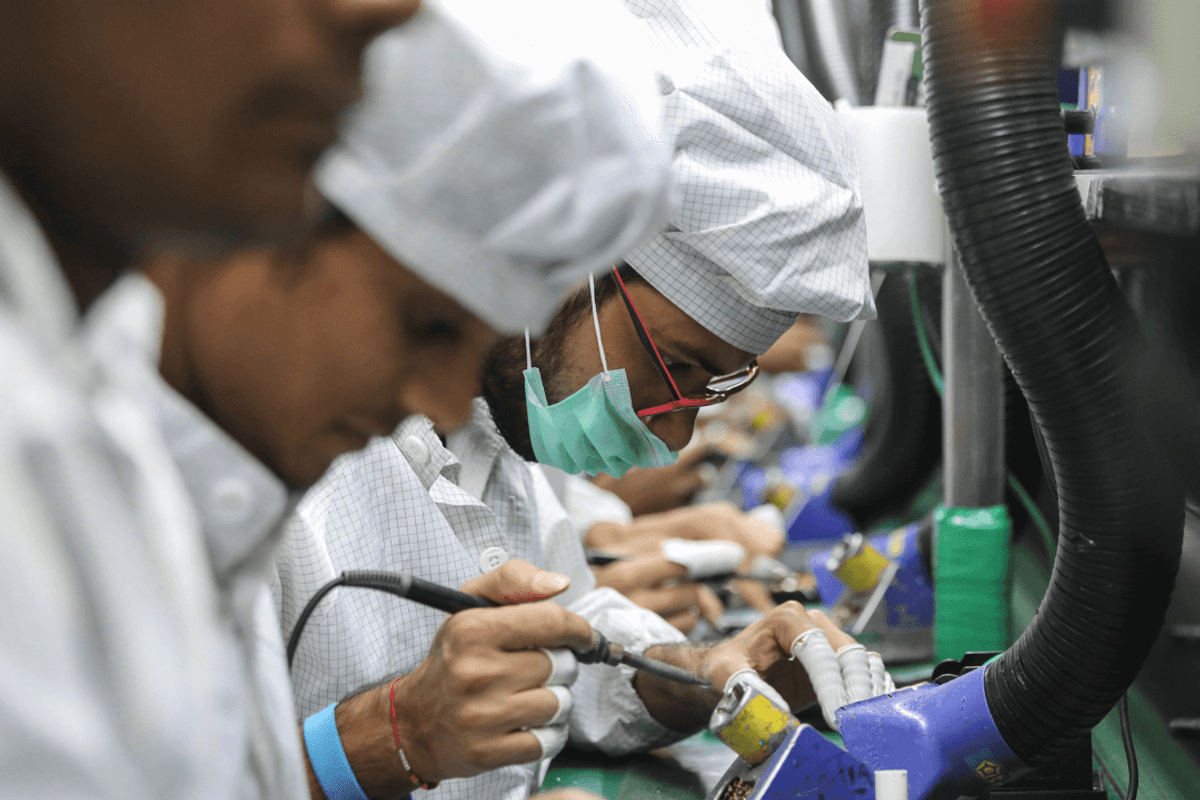
Pakistan has unveiled a new seven-year industrial policy aimed at transforming its mobile phone and electronics sector from a basic assembly base into a manufacturing and export-driven industry, after officials acknowledged deep structural failures under the previous framework.
The Ministry of Industries & Production introduced the Mobile and Electronic Devices Manufacturing Policy 2026-33, replacing the 2020-23 regime that officials say expanded assembly capacity but failed to deliver value addition or exports.
Under the earlier policy, 37 licensed original equipment manufacturers (OEMs) established production capacity exceeding 30 million units annually.
However, domestic value addition stalled at roughly 10% — far below the 50% target — while exports remained virtually nonexistent.
Critical components such as batteries, displays, cameras and printed circuit board assemblies (PCBAs) continued to be imported, leaving Pakistan largely dependent on Completely Knocked Down (CKD) kits rather than domestic manufacturing.
The ministry said Pakistan spent PKR 577 billion in customs and tax concessions during the previous policy period without achieving meaningful localization or export growth.
The cost disadvantage for Pakistan
The policy document also highlights a structural cost disadvantage of 8.36% against China, Pakistan’s primary CKD supplier. Electricity prices are roughly double China’s, financing costs are more than triple, while freight charges and provincial cesses further inflate input costs.
Tariff distortions and constraints under the China-Pakistan Free Trade Agreement (CPFTA) have compounded the problem, allowing some finished Chinese goods to enter at low tariffs that undercut locally assembled alternatives.
The new framework introduces digitally enforceable localization schedules, over 70 new import tracking codes, and a mandatory Bill of Materials integration with Pakistan Single Window to prevent manufacturers from claiming duty concessions without increasing local sourcing.
Officials say enforcement credibility will determine whether the new policy avoids repeating the failures of its predecessor.







Comments
See what people are discussing