

Pakistan mulls new policy to boost local mobile phone manufacturing
Sources say the government could impose a 5% levy on imported mobile phones to support local manufacturing

Business Desk
The Business Desk tracks economic trends, market movements, and business developments, offering analysis of both local and global financial news.
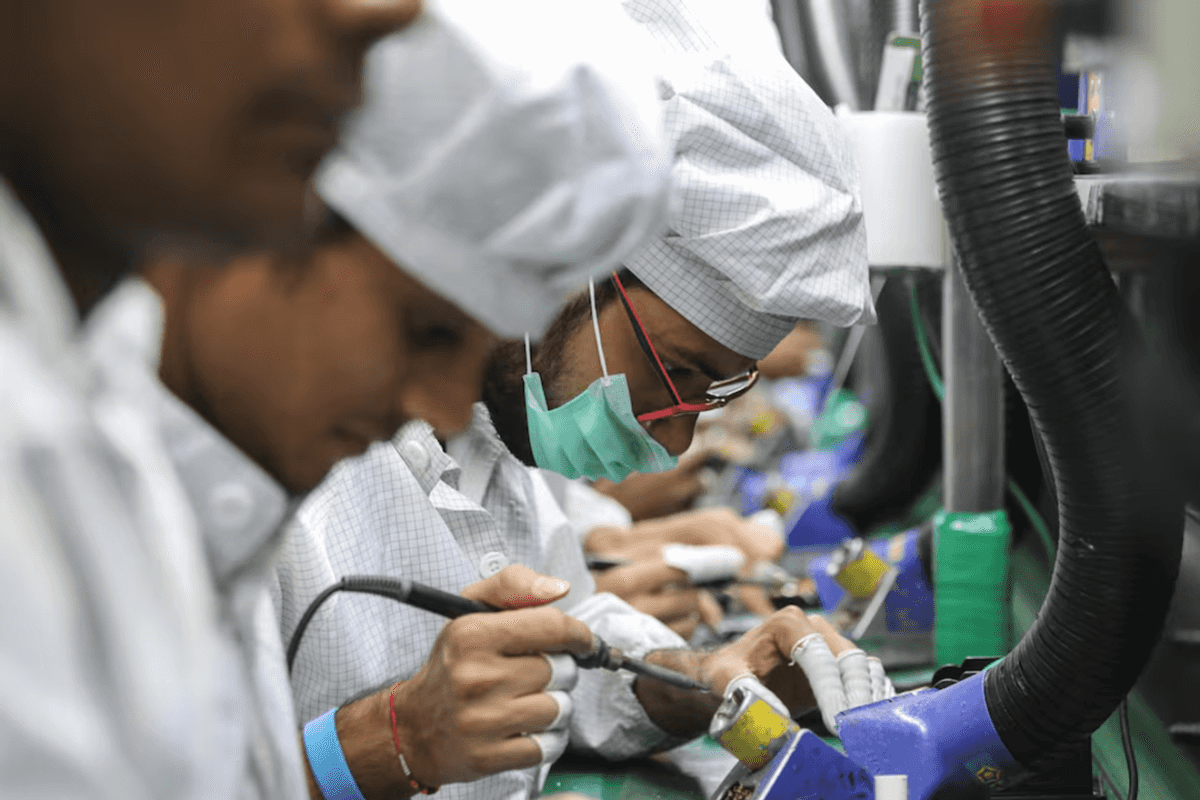
Workers solder wires on printed circuit boards of a mobile handset at a manufacturing plant in India.
Reuters
Pakistan will launch a new electronics manufacturing policy to move from basic assembling to full-scale manufacturing, according to Ministry of Industry sources.
The draft Mobile and Electronic Device Manufacturing Policy is expected to be presented to the prime minister for approval.
The policy, covering the period from 2026 to 2033, proposes a 5% levy on imported mobile phones, a move officials say is intended to support localization of manufacturing.
Ministry sources said the government expects the levy to generate about $368 million over seven years, with revenues earmarked for developing domestic manufacturing capabilities.
The policy sets a target of achieving 50% localization in mobile phone manufacturing by 2033, mirroring ambitions under the previous Mobile Device Manufacturing Policy of 2020. That policy aimed for 49% localization by 2023 but fell short, with local activity largely limited to assembly rather than production of key components.
Industry assessments of the 2020 policy show that while nearly 95% of domestic demand is now met through what is termed “local production,” most of this consists of assembling imported completely knocked down or CKD kits.
Apart from a limited number of casings, few major components are manufactured locally.
Over the past few years, imports of fully built phones declined due to heavy taxation, but dependence shifted toward imported kits, replacing one form of import reliance with another.
Ministry sources acknowledged that the new draft policy introduces revised targets without a detailed public review of why earlier localization goals were not met.
Structural issues such as limited technology transfer, skills shortages and weaknesses in the broader industrial ecosystem were not fully addressed under the previous framework, they said.
Pakistan already imposes a high tax burden on mobile phones, with cumulative duties and taxes in some cases reaching about 55% of the handset price.
Critics within the industry argue that adding another levy risks pushing prices higher without materially improving domestic capability, noting that duties, regulatory charges and sales tax have so far failed to spur local production of critical components.
Officials say the policy is designed to support a broader manufacturing ecosystem, including the development of skilled labor and integration into global value chains.
The draft also sets targets for training 50,000 skilled workers, including 15,000 specialized professionals, and for recovering 70% of electronic waste through organized systems.
The policy was reviewed this week during a meeting chaired by Special Assistant to the Prime Minister Haroon Akhtar Khan. It was also attended by senior officials from the Ministry of Industries and Production, the Engineering Development Board, and representatives of mobile phone manufacturers.
Khan said the policy was formulated after extensive consultations with stakeholders and covers mobile phones, laptops, and other electronic devices.
He described it as a major shift from assembly to manufacturing and said it was essential for boosting manufacturing and exports.





Comments
See what people are discussing