

Pakistan may move to ban jailed ex-PM Imran Khan's party
PTI’s popularity, parliamentary strength and provincial influence make a ban hard to enforce

Umer Zaib
Senior Producer
Umer Zaib is a Karachi-based journalist and good Samaritan with five years of experience at Pakistan's leading news publications.
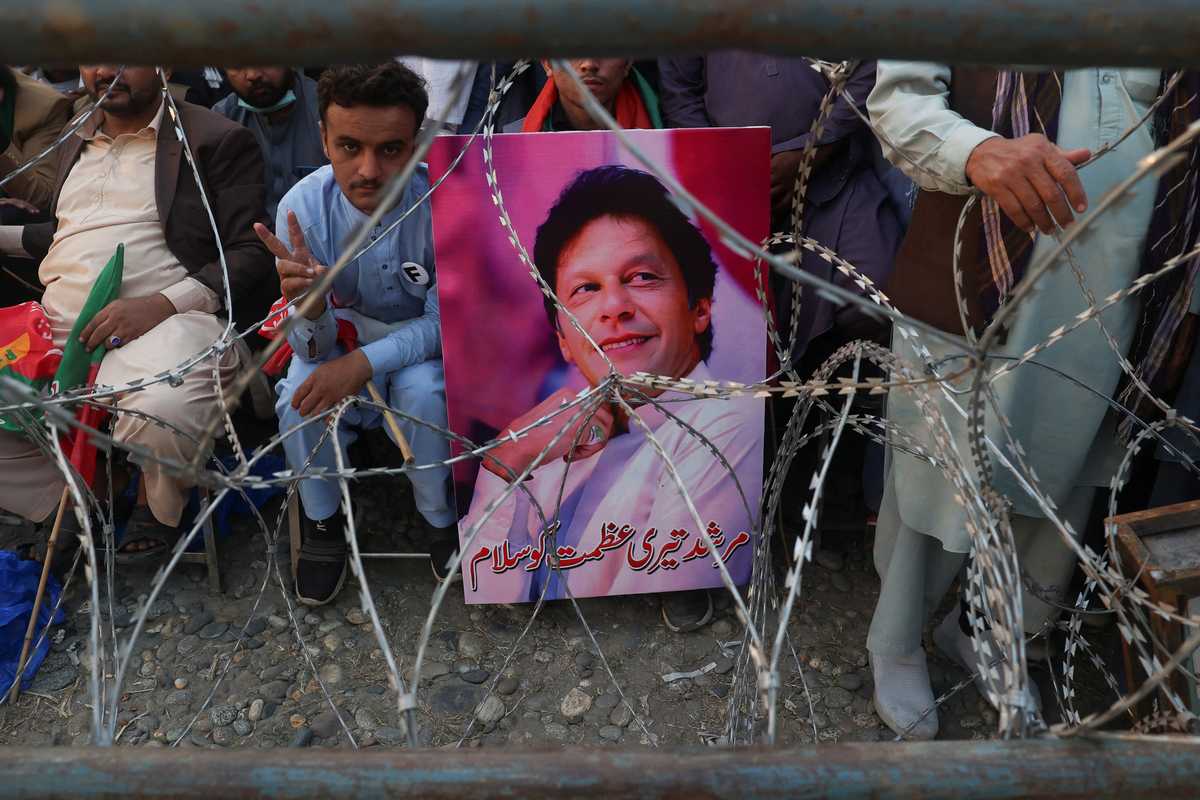
A PTI supporter reacts during a rally demanding jailed former PM Imran Khan’s release in Swabi, Pakistan, November 9, 2024.
Military spokesperson called Khan 'mentally ill' and a national security threat amid escalating rhetoric
Government banned all jail meetings, claiming Khan uses family visits to direct anti-state campaigns
Pakistan’s ruling coalition appears to be moving toward banning the country’s main and popular opposition party, escalating a political standoff as the military’s chief spokesperson publicly labeled jailed former prime minister Imran Khan a national security threat, even as his party continues to govern one of the country’s four provinces.
The crisis reached a new intensity Friday when Lt. Gen. Ahmed Sharif Chaudhry, Director General of Inter-Services Public Relations, called Khan "mentally ill" and a "narcissist" whose anti-army rhetoric has crossed from politics into security concerns.
Hours later, Information Minister Attaullah Tarar announced a complete ban on all jail meetings with Khan, calling him an "extremist consumed by war hysteria."
By Sunday, Senator Faisal Vawda - known for defending the military and ruling coalition - delivered the starkest ultimatum yet in a television interview to a private TV channel: Khan's Pakistan Tehreek-e-Insaf party must accept a "minus-one formula" essentially abandoning its founder, or face "complete political elimination."
The escalating rhetoric suggests that Khan, imprisoned since August 2023, remains influential enough through family visits and released statements to require the most severe restrictions available, including a formal party ban.
Yet analysts say sidelining him remains practically difficult as PTI maintains public support, parliamentary seats and provincial governance.
Government's case
The government argues Khan has turned his prison cell into a command center for anti-state activities. Tarar has claimed jail authorities reported Khan conducting political discussions during visits meant for family and legal consultation, using these meetings to promote what the government characterizes as an "anti-state narrative."
Defense Minister Khawaja Asif defended the military spokesperson’s remarks, arguing that Khan has “targeted military leadership,” including during recent border conflicts. Planning Minister Ahsan Iqbal said Khan’s statements have undermined state institutions and eroded public confidence in the armed forces.
However, the current coalition has offered little to no public evidence to support claims of foreign coordination or economic sabotage. PTI’s rhetoric has primarily targeted military and government leadership rather than Pakistan’s sovereignty, a distinction acknowledged by many Pakistanis despite disapproval of Khan’s confrontational approach.
The ruling coalition’s concern appears to be driven as much by political considerations as security. Khan was known for taking a hard line against opponents during his 2018-2022 tenure, and the current government has responded in a similarly harsh manner. A PTI return to power with its leader embittered by imprisonment could lead to more intense political confrontation than previously seen.
Practical obstacles
But the government's strategy faces significant obstacles. PTI currently governs Khyber Pakhtunkhwa province, and the party also emerged as the single largest bloc in parliament after the 2024 elections.
On the other hand, historical precedent suggests bans rarely succeed. The far-right Tehreek-e-Labbaik Pakistan was proscribed in 2021 only to have restrictions lifted less than a year later.
Lastly, calls for accountability have been notably one-sided in a country where multiple power centers have historically bent democratic processes to their advantage.
The standoff leaves Pakistan's institutions speaking with one voice against an opposition that, despite imprisonment of its leaders and systematic legal pressure, retains both electoral legitimacy and provincial governance responsibilities, making any ban practically difficult to implement and potentially destabilizing if attempted.
The government has not yet filed formal measures to initiate the ban process.





Comments
See what people are discussing