

New provinces could cost Pakistan PKR 730Bn a year: study
A six-province plan would have a lower fiscal burden, while 14 of 30 proposed units exceed the study's 10% administrative-cost screening threshold

Business Desk
The Business Desk tracks economic trends, market movements, and business developments, offering analysis of both local and global financial news.
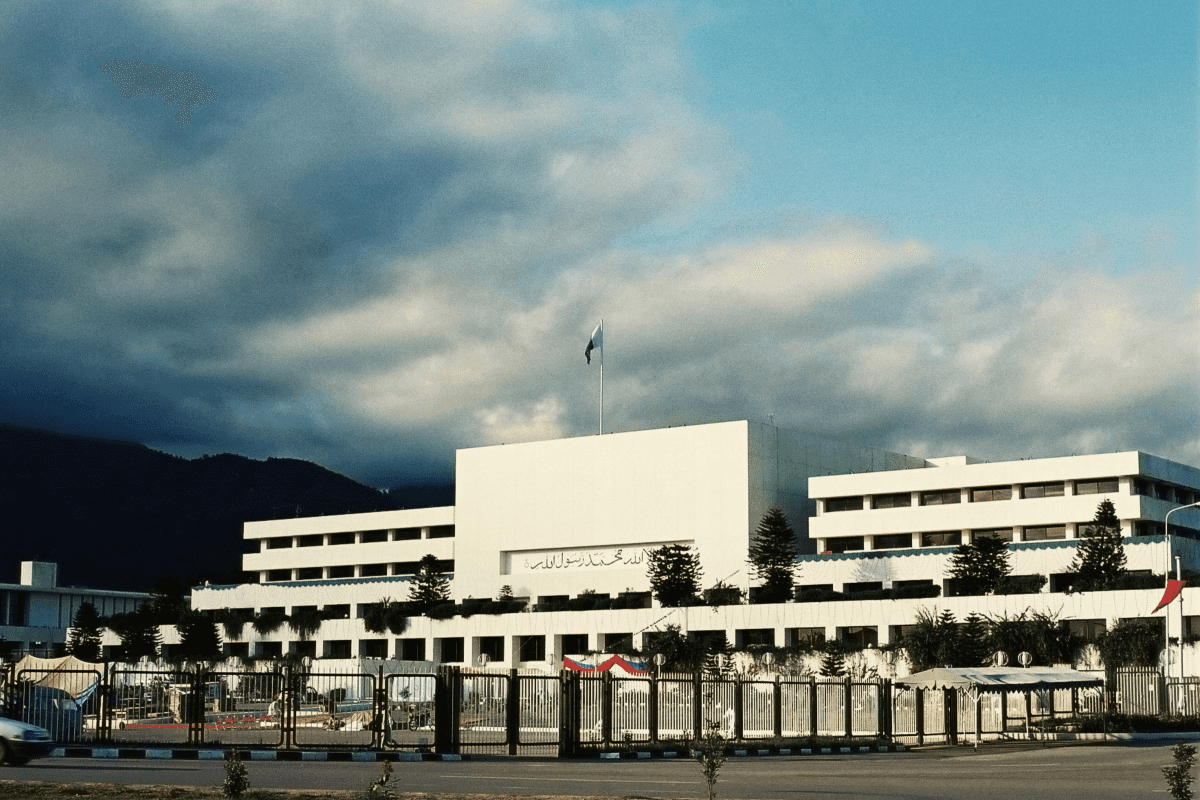
Parliament House in Islamabad. A PRIME Institute study estimates that creating new provinces could add up to PKR 730.3 billion annually to government expenditure.
Usman Ghani / Wikimedia Commons
Creating new provinces in Pakistan could add between PKR 46.9 billion and PKR 730.3 billion to annual recurring public spending, depending on the scale of restructuring, according to an October study by the Policy Research Institute of Market Economy (PRIME). The estimates highlight the fiscal trade-offs in proposals to divide the country's four provinces.
How much would new provinces cost Pakistan?
PRIME's six-province scenario, which splits Punjab into Bahawalpur, South Punjab and the remaining Punjab, would add PKR 46.9 billion to PKR 56.2 billion annually. A separate scenario turning all 30 existing administrative divisions into provinces would raise recurring costs by PKR 609.2 billion to PKR 730.3 billion.
The analysis, prepared by PRIME research economist Maryam Ayub, examines how administrative restructuring could affect government expenditure and the distribution of resources under the 7th National Finance Commission (NFC) Award.
The study estimates that establishing the core institutions of a new provincial government would cost between PKR 22.4 billion and PKR 25.9 billion annually, before adjustments for Senate representation and savings from existing administrative offices.
These institutions include the governor's office, chief minister's secretariat, provincial assembly, central secretariat, finance and planning departments, judicial bodies and other essential administrative functions.
Under the six-province model, two additional provincial governments would increase recurring provincial expenditure by PKR 44.8 billion to PKR 51.8 billion.
After accounting for additional Senate costs and savings from abolishing commissioners' offices, the net annual burden would reach PKR 46.9 billion to PKR 56.2 billion, equivalent to 0.55% to 0.66% of the formula-based provincial resource pool.
The 30-province scenario would require 26 additional provincial governments, raising their combined institutional expenditure by PKR 582.4 billion to PKR 673.4 billion.
Including Senate-related costs and administrative savings, the net annual expenditure would increase to PKR 609.2 billion to PKR 730.3 billion, representing 7.18% to 8.61% of the formula-based provincial pool.
Both scenarios are hypothetical fiscal models rather than finalized government restructuring plans.
How would NFC resources be divided among new provinces?
The study uses a nested allocation model under which each existing province retains its share of the 7th NFC Award, with that share subsequently divided among its proposed successor provinces.
Under the six-province scenario, South Punjab would receive an illustrative allocation of PKR 1,001.06 billion, while Bahawalpur would receive PKR 537.01 billion.
The remaining Punjab would receive approximately PKR 2,852.59 billion, while Sindh, Khyber Pakhtunkhwa and Balochistan would retain their existing boundaries.
The distribution would become considerably more fragmented under the 30-province model.
Lahore would receive the largest illustrative NFC allocation at approximately PKR 721 billion, followed by Karachi at PKR 690.84 billion.
At the other end of the distribution, Loralai would receive just PKR 45.62 billion and Zhob PKR 49.83 billion.
According to the study, 11 of the 30 proposed provinces would receive less than PKR 150 billion each.
The allocations are based on the existing NFC criteria of population, poverty and backwardness, revenue collection or generation, and inverse population density.
Population carries an 82% weight under the existing formula, followed by poverty and backwardness at 10.3%, revenue generation at 5% and inverse population density at 2.7%.
However, the researchers used population shares as a proxy for the revenue criterion because reliable divisional revenue-generation data were unavailable. The resulting allocations are therefore illustrative rather than definitive assessments of each proposed province's entitlement.
The study redistributes the existing formula-based resource pool rather than assuming that creating additional provinces would generate more federal transfers.
Why would smaller provinces face higher administrative costs?
The study finds that smaller provinces would face a disproportionately heavy administrative burden because the cost of maintaining essential provincial institutions does not decline in proportion to population or available resources.
Under the 30-province model, Lahore and Karachi would spend approximately 3% to 4% of their illustrative NFC allocations on their core provincial government structures.
However, the same institutions would absorb around 49% of Loralai's allocation, 45% of Zhob's and 37% of Rakhshan's under the low-cost estimate.
Every proposed province with a population below 1.2 million would need to devote more than one-third of its illustrative NFC allocation to maintaining its core provincial administration.
Using a 10% fiscal sustainability benchmark, the study finds that only 16 of the proposed 30 provinces would remain at or below the threshold under the low-cost scenario.
The remaining 14 would exceed it, suggesting that administrative expenses could absorb a substantial share of their available formula-based transfers.
This could leave smaller provinces with less fiscal space for education, healthcare, infrastructure and development expenditure after meeting the recurring costs of their government institutions.
The study cautions that the percentages represent the share of illustrative NFC allocations absorbed by core administrative costs, rather than the proportion of a province's entire budget spent on administration.
Provincial own-source revenues, grants and other transfers are not included in that comparison.
How would creating new provinces affect Senate expenditure?
Provincial restructuring would also have financial implications for the Senate because Article 59 of the Constitution provides for equal representation of the provinces in the upper house.
Under the study's assumption that the existing allocation of Senate seats per province is retained, expanding the country to 30 provinces would increase the number of senators from 96 to 694.
The model estimates additional annual Senate expenditure of PKR 30.11 billion to PKR 60.2 billion under that scenario.
For the six-province model, the Senate would expand to 142 members, with additional expenditure ranging from PKR 2.31 billion to PKR 4.6 billion annually.
These costs are included in the study's net recurring expenditure estimates, alongside projected savings from eliminating commissioners' offices.
However, the researchers caution that their calculations represent a lower-bound assessment of the recurring fiscal burden.
The estimates exclude the full cost of establishing separate provincial police headquarters and duplicating all departmental secretariats.
They also exclude one-time expenditure on provincial assembly buildings, government offices, secretariats and official residences.
Actual restructuring costs could therefore exceed the amounts estimated in the study.
Could stronger local governments offer a cheaper alternative?
PRIME recommends strengthening local governments where the main objective of creating smaller administrative units is to improve public representation, access to services and decision-making.
The study argues that empowered district and municipal governments could bring administrative authority closer to citizens without requiring the duplication of provincial institutions.
It also recommends that every proposal for a new province undergo a formal fiscal costing exercise examining its expected NFC allocation, revenue-generation capacity and recurring expenditure.
Under the proposed 10% fiscal screening benchmark, the cost of maintaining core provincial institutions should not exceed 10% of a proposed province's illustrative NFC allocation using the low-cost estimate.
Proposed units exceeding that threshold should undergo further examination of their boundaries, resource base and administrative structure before being considered fiscally suitable for provincial status.
The study also calls for reconsidering the NFC framework if Pakistan substantially increases the number of provinces.
It suggests that any future resource-sharing formula should balance population, poverty, geographical constraints and incentives for greater provincial revenue generation.
The researchers' assessment focuses on fiscal costs rather than determining whether creating additional provinces would improve governance or public services.
The analysis concludes that the fiscal consequences of creating new provinces would depend not only on their number and size, but also on how resources, responsibilities and revenue-raising powers are divided among federal, provincial and local governments.





Comments
See what people are discussing