

Pakistan's listed banks post PKR 505 billion profit, down 1% in nine months
Higher non-interest income and lower taxes help cushion earnings as operating costs rise and banks adjust their balance sheets

Business Desk
The Business Desk tracks economic trends, market movements, and business developments, offering analysis of both local and global financial news.
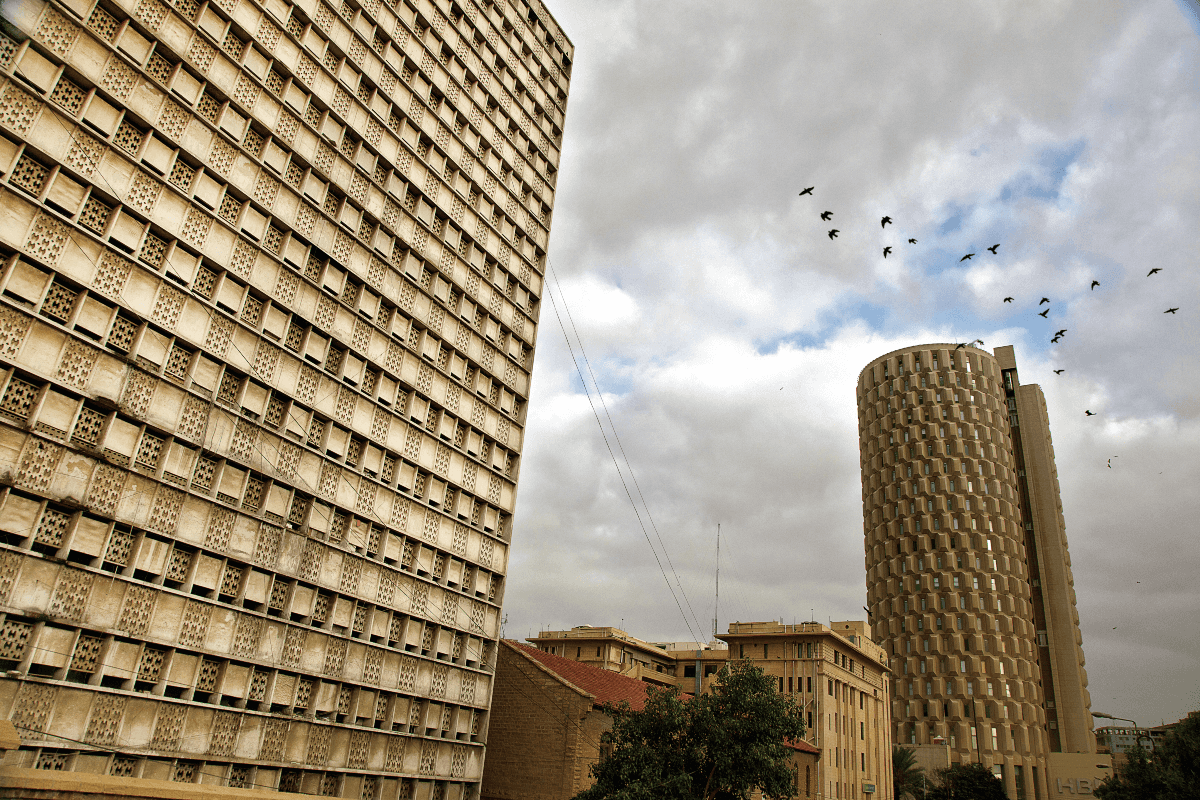
Habib Bank Plaza in Karachi. Pakistan's listed banks reported combined profits of PKR 505 billion in the first nine months of 2026.
Furqanlw/Wikimedia Commons
Pakistan’s listed banking sector recorded a combined profit after tax of PKR 505 billion in the first nine months of 2026, down 1% from a year earlier, as higher non-interest income and lower taxation largely offset rising operating expenses and pressure on interest margins, Arif Habib Limited said in a research report.
The sector’s net interest income remained almost unchanged at PKR 1.646 trillion during January–September, despite a 6% year-on-year increase in interest earned and a 9% rise in interest expenses, the brokerage said.
Non-interest income provided support to earnings, increasing 18% to PKR 504 billion, driven by an 11% growth in fee income, a 36% increase in foreign exchange income and a 30% rise in capital gains.
Banks’ average interest yield declined to about 11% during the nine-month period from 13% a year earlier, reflecting lower interest rates, while the average cost of funds fell to around 6% from 8%. This resulted in a sector-wide net interest margin of about 4%, the report said.
The average policy rate stood at approximately 11.1% during the period, compared with 11.4% in the corresponding period last year.
However, the banking sector’s earnings dynamics have shifted amid significant balance-sheet adjustments by banks preparing for potential interest-rate volatility stemming from the US-Iran conflict, Arif Habib said.
The sector recorded a net provisioning reversal of about PKR 21 billion in the nine months, indicating improved recoveries from specific lending portfolios.
National Bank of Pakistan recorded the largest provisioning reversal at PKR 6 billion, followed by United Bank Limited at PKR 4.4 billion and Bank Alfalah at PKR 3.2 billion.
Operating expenses increased 15% to PKR 1.1 trillion, while profit before tax declined 5% to PKR 1.071 trillion. However, an 8% reduction in taxation to PKR 563 billion, bringing the effective tax rate down to 53%, helped limit the decline in after-tax earnings.
How did banks perform in the third quarter?
On a quarterly basis, listed banks posted a combined profit of PKR 164 billion in July–September, down 3% year-on-year and 2% from the preceding quarter.
Net interest income increased 3% year-on-year to PKR 566 billion during the third quarter, while non-interest income rose 5% to PKR 154 billion. However, operating expenses increased 14% to PKR 384 billion.
The sector’s quarterly net interest income benefited from higher yields following the 100-basis-point policy rate increase in the second quarter. Average asset yields increased to about 11% in the third quarter from 10.7% in the previous quarter, while the cost of funds rose to 6.4% from 6.1%.
The sector recorded a quarterly provisioning reversal of PKR 12.2 billion, compared with PKR 4.9 billion in the same period last year. Bank Alfalah, Bank AL Habib and Meezan Bank recorded the largest reversals at PKR 2.6 billion, PKR 2.5 billion and PKR 2.5 billion, respectively.
Which banks led profitability?
United Bank led the sector in nine-month profitability, posting earnings of approximately PKR 117 billion, followed by Meezan Bank at PKR 74 billion and Habib Bank Limited at PKR 54 billion.
In the third quarter, Bank Alfalah recorded the highest year-on-year profit growth among banks covered by the brokerage at 46%, followed by Habib Bank at 16% and Meezan Bank at 14%.
United Bank’s earnings were supported by a 71% increase in non-interest income during the third quarter to PKR 24 billion, including a 75% rise in foreign exchange income to PKR 8.8 billion and a 15% increase in fee income.
Meezan Bank’s performance benefited from 10% growth in core income, while stronger fee and foreign exchange income supported Habib Bank’s profitability, the report said.
How are banks adjusting their balance sheets?
The brokerage noted that deposit growth across the sector slowed to just 0.02% quarter-on-quarter in the third quarter. United Bank recorded a 6% increase in deposits to PKR 6.5 trillion, followed by Meezan Bank with 5% growth and MCB Bank with 4%.
Banks also reduced their investment portfolios by about 6% during the quarter, apparently allowing investments to mature and using the proceeds to reduce exposure to borrowing through open market operations.
United Bank’s investments declined 20% quarter-on-quarter, while its borrowings fell 32%. Bank Alfalah reduced its investments by 27% and retired about PKR 600 billion in borrowings.
Arif Habib said banks appeared to be deleveraging their balance sheets in anticipation of interest-rate volatility to limit future earnings fluctuations.
What is the outlook for banking sector earnings?
Looking ahead, the brokerage expects banking sector earnings to face some pressure in the fourth quarter following the State Bank of Pakistan’s 50-basis-point policy rate increase to 12% in October.
However, banks with strong current and savings account (CASA) deposit profiles, lower leverage and shorter investment portfolio durations are better positioned to absorb the impact, it said.
In terms of dividend payments, MCB Bank remained the highest-paying bank, with cumulative dividends of PKR 27 per share during the nine months, followed by United Bank at PKR 24 and Meezan Bank at PKR 23.50.
Meezan Bank recorded the highest return on equity at about 32%, followed by United Bank at 30% and Standard Chartered Bank Pakistan at 23%.
Standard Chartered posted the highest net interest margin in the listed banking sector at about 7%, followed by Meezan Bank at 6.3%.
The report also identified several banks trading below the sector’s market-capitalization-weighted average price-to-book multiple of 1.1 times, including Askari Bank, Bank Alfalah, Bank of Punjab, Habib Bank and National Bank.
Among these, Askari Bank, Bank Alfalah and Bank of Punjab reported returns on equity of 17%, 19% and 17%, respectively, above the sector average of about 16%, suggesting potential valuation opportunities, Arif Habib said.




Comments
See what people are discussing