

Pakistan's top 20 listed textile firms post 11% profit growth in FY26
Combined profit reached PKR 51.9 billion as financing costs fell 19.2% and the effective tax rate declined to 33.2%, Topline Securities says

Business Desk
The Business Desk tracks economic trends, market movements, and business developments, offering analysis of both local and global financial news.
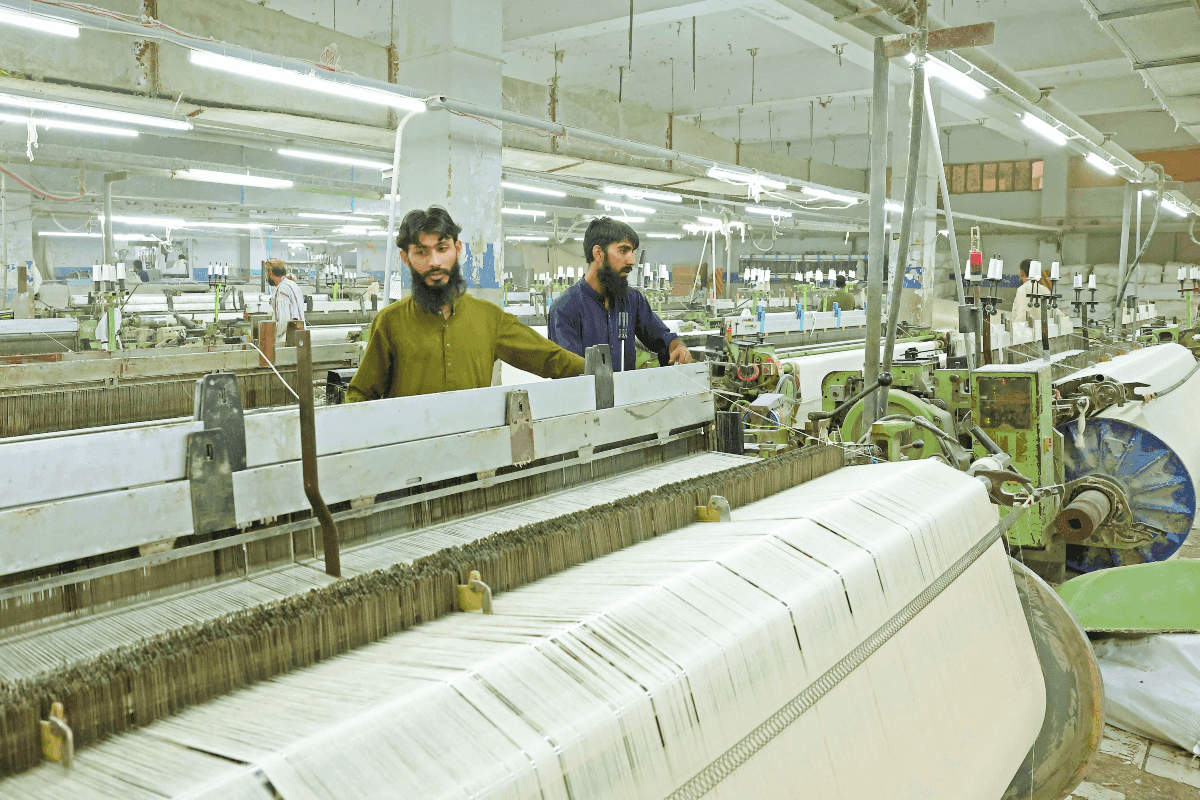
Workers inspect loom machines, weaving fabric at a textiles manufacturer in Karachi.
Reuters
Pakistan’s top 20 listed textile companies increased their combined profit by 11.4% from a year earlier to PKR 51.96 billion in fiscal 2025-26, supported by lower financing costs and a reduced effective tax rate, according to Topline Securities.
The companies generated sales of PKR 1.404 trillion, equivalent to about USD 5 billion, during the year ended June 30, down 0.3% from a year earlier despite geopolitical headwinds and domestic freight challenges.
The sample spans composite, spinning, weaving, woolen and apparel businesses and accounts for 83% of the selected textile sector’s total market capitalization, Topline said in its October 13 report.
What drove textile companies' profit growth in FY26?
Lower borrowing costs and reduced taxation were the main drivers of earnings growth. Finance costs fell 19.2% to PKR 54.5 billion as financing rates declined and companies reduced Export Finance Scheme borrowings, while the sample's effective tax rate dropped to 33.2% from 37.1% a year earlier.
Topline attributed the lower tax rate mainly to reversals of deferred tax liabilities following changes in the future super tax treatment of exporters, including the exemption of export-oriented companies from the levy.
Underlying operating performance was largely stable. Gross margins remained unchanged at 13.1%, while aggregate gross profit declined 0.2%.
Pakistan’s textile exports reached a record USD 17.6 billion in FY26, up 2% from a year earlier and accounting for 57% of the country’s total goods exports, Topline said. The report’s export chart cites the State Bank of Pakistan as its source.
Value-added textile exports increased 3% to USD 13 billion.
Cotton prices were also broadly stable. The Cotlook A Index averaged around USD 0.79 per pound, while local cotton prices averaged PKR 18,353 per maund compared with PKR 18,268 in FY25.
Interloop leads textile earnings
Interloop Ltd. was the largest contributor to the sample’s profitability, followed by Sapphire Textile Mills and Nishat Mills Ltd. Together, the three companies accounted for 48% of the sample’s total profit.
Interloop’s consolidated profit rose 129% from a year earlier to PKR 12.7 billion, with earnings per share increasing to PKR 9.06 from PKR 3.96.
Its gross margin improved by 230 basis points to 22.8%, while finance costs fell 35%. Other income increased 6.3 times, primarily because of SIDC discounting income, according to Topline.
Interloop’s sales increased 5% to PKR 187.7 billion, and the company contributed 24% of the sample’s total profit.
Sapphire Textile Mills’ unconsolidated profit increased 73% to PKR 6.8 billion from PKR 3.9 billion a year earlier.
Its earnings per share rose to PKR 314.46 from PKR 182.16, supported by a 2.2-fold increase in other income to PKR 7.5 billion, lower financing costs and a reduced effective tax rate.
Sapphire’s sales, however, fell 13% to PKR 81.2 billion. The company accounted for 13% of the sample’s total profit.
Nishat Mills’ unconsolidated profit declined 9% to PKR 5.5 billion from PKR 6 billion in FY25 as lower dividend income and weaker gross margins weighed on earnings.
Its gross margin narrowed to 9.8% from 11.2%, while a reduction in its effective tax rate to 20% from 44% partly offset the pressure.
Nishat Mills’ sales increased 2% to PKR 181.6 billion, with the company contributing 11% of total sample profitability.
What is the outlook for Pakistan's textile sector?
Topline expects measures announced in the FY27 budget and lower financing costs to support textile-sector profitability. However, elevated energy costs, uncertainty over Pakistan's GSP+ status and the risk of weaker demand in developed markets remain key challenges.
Textile companies are increasingly turning to renewable energy and other lower-cost power sources to reduce energy expenses and protect their competitiveness in international markets, the brokerage said.
A slowdown in developed economies, including the United States and European markets amid tighter monetary conditions, could also weigh on demand.
Topline maintained a Market Weight stance on the textile sector and identified Interloop as its top pick.





Comments
See what people are discussing